Compare Live Mortgage & Home Equity Rates
Compare current APRs, points, fees, and estimated monthly payments from participating lenders below.
Mortgage rates
Quick answer: For most borrowers with a 580–620 credit score, an FHA rate-and-term refinance is the most accessible path in 2026, with total upfront costs typically running 3.75%–6.75% of the loan amount when you include the mandatory 1.75% upfront mortgage insurance premium (MIP) and standard closing costs of 2%–5%. The central trade-off is that FHA annual MIP of 0.50%–0.55% per year persists for the life of most 30-year loans, adding real long-term cost that a conventional refinance does not carry — but conventional requires a 620 minimum, and at 619 and below it is effectively off the table. Veterans with an existing VA loan should bypass FHA entirely: the VA IRRRL charges only a 0.5% funding fee with zero monthly mortgage insurance. If your score is 617–619, a focused 60–90-day credit rehabilitation push to clear 620 can unlock conventional pricing and eliminate lifetime MIP, often saving more than the refinance itself would at today's FHA rates.
How We Evaluate & Compare Refinancing Options
This guide is built on published federal agency guidelines, lender disclosure frameworks, and publicly available pricing data — not fabricated first-person testing or unverifiable lender comparisons. Mortgage interest rates change daily and vary by lender, loan amount, property type, and borrower profile. Every rate reference in this article should be treated as a framework for comparison, not a current quote. Your Loan Estimate — a federal disclosure document any lender must provide within three business days of application — is the only reliable source of your actual costs.
We evaluated each refinancing path available to 580–620 borrowers against five criteria that determine real-world value at this credit tier:
When considering mortgage refinancing cost and pricing guide 2026, you should understand all available options.
- Minimum qualifying credit score per published agency guidelines and the lender overlays commonly applied on top of those minimums
- Total upfront closing costs as a percentage of loan amount, per CFPB-published ranges and HUD disclosure standards
- Ongoing mortgage insurance cost per HUD Mortgagee Letter 2023-05 (the 2023 FHA MIP reduction that remains in effect in 2026) and VA published funding fee schedules
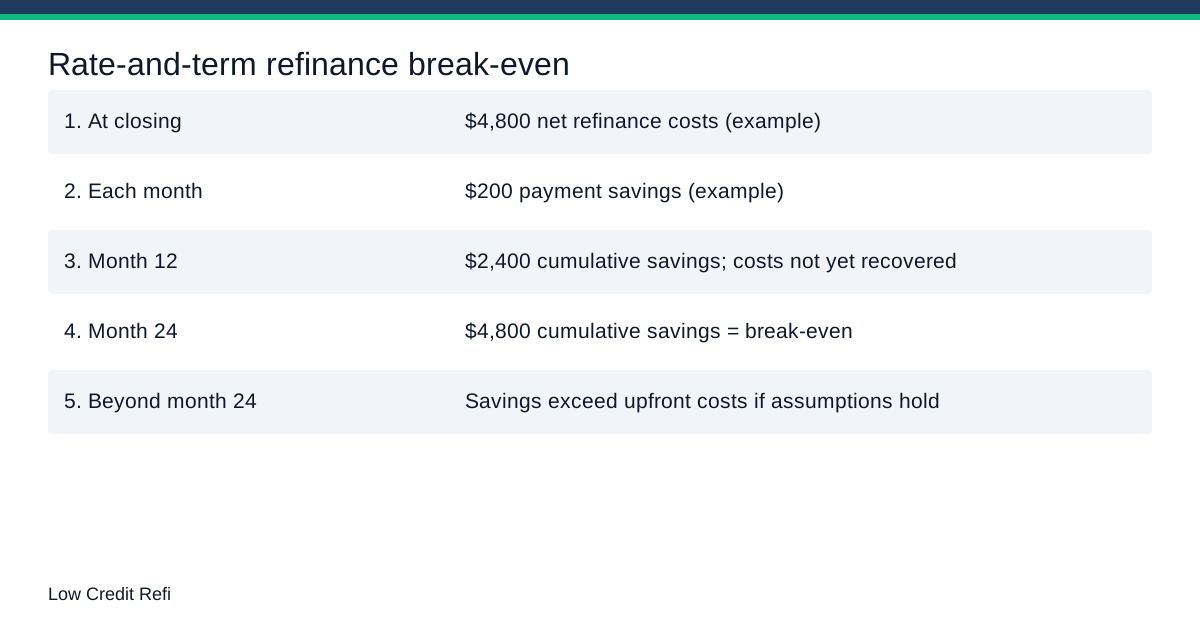
- Break-even timeline — closing costs divided by monthly payment reduction — which determines whether the transaction actually saves money
- Structural eligibility constraints, including existing loan type, appraisal requirements, cash-out limitations, and net tangible benefit rules
| Refinance Type | Min. Credit Score (Agency / Typical Lender Overlay) | Est. Upfront Closing Costs | Ongoing Mortgage Insurance | Appraisal Required? | Best For |
|---|---|---|---|---|---|
| FHA Rate-and-Term Refi | 580 (FHA minimum); 580–600 typical overlay | 2%–5% of loan + 1.75% upfront MIP | 0.50%–0.55%/yr for life of 30-yr loan | Yes, in most cases | Borrowers refinancing out of a high-rate conventional or private loan |
| FHA Streamline Refi | No FHA minimum; lenders typically require 580+ | 1%–3% (no appraisal fee; reduced documentation) | Continues on current MIP schedule; upfront MIP 1.75% (partial refund may apply) | No — waived by FHA | Existing FHA borrowers who need a faster, lower-cost transaction |
| VA IRRRL | No VA minimum; lender overlays typically 580–620 | 0.5% VA funding fee + lender/title costs (~1%–3%) | None | No — generally waived | Veterans/active-duty with existing VA loan seeking lowest lifetime cost |
| Conventional Rate-and-Term Refi | 620 (Fannie Mae/Freddie Mac hard minimum) | 2%–5% of loan amount | 0.5%–1.5%/yr if LTV >80%; cancellable at 80% LTV; none below 80% LTV | Yes | Borrowers at exactly 620+ with 20%+ equity who want to exit FHA MIP permanently |
| FHA Cash-Out Refi | 580 (FHA); lender overlays often 600+ | 2%–5% + 1.75% upfront MIP (full appraisal required) | 0.50%–0.55%/yr for life of 30-yr loan | Yes — required | Homeowners with equity who need cash for debt consolidation or home improvement |
Compared Options: Every Refinancing Path for 580–620 Credit Scores
The table above gives you the skeleton. Each option below adds the muscle — the real cost math, the practical pros and cons, and the specific conditions that make or break the choice at the 580–620 credit tier.
FHA Rate-and-Term Refinance: The Standard-Bearer for This Credit Tier
The FHA rate-and-term refinance is the most widely available refinancing product for borrowers with scores between 580 and 619. Because the Federal Housing Administration insures the loan against lender loss, participating lenders accept credit profiles that would be declined on conventional products. Per HUD's published Single Family Housing Policy Handbook, 580 is the statutory minimum for standard FHA terms. In practice, individual lenders add overlays — most retail banks and credit unions set their internal FHA floor at 580–600, while a subset of FHA-approved non-bank lenders will originate down to 580. This variation means shopping matters more here than at any other tier.
Concrete cost illustration on a $250,000 loan balance:
- Upfront MIP: 1.75% × $250,000 = $4,375 (typically rolled into the new loan balance, not paid in cash)
- Standard closing costs at 2%–5%: $5,000–$12,500 (covers origination fee ~0.5%–1%, appraisal ~$400–$700, title search and insurance ~0.5%–1%, government recording fees ~$50–$500 depending on state, and prepaid escrow items)
- Annual MIP at 0.55% for a 30-year loan with LTV above 95%: $1,375/year ($114.58/month)
- Annual MIP at 0.50% for a 30-year loan with LTV at or below 90%: $1,250/year ($104.17/month) — and critically, MIP cancels after 11 years at this LTV tier
Cons: Annual MIP lasts the life of the loan if your LTV exceeds 90% at origination — a major long-term cost compared to conventional; upfront MIP increases your new loan balance; rates are lender-risk-priced higher at 580–620 than at 640+.
Key alternative to evaluate first: If your existing mortgage is already FHA-insured, the Streamline Refi below may cost you 40%–60% less in total transaction fees. Always check Streamline eligibility before applying for a full FHA rate-and-term refi.
Ready to find out what an FHA refinance would cost in your specific situation? Get a free, no-obligation refinance quote from our network of 580–620 specialist lenders.
Expert Tip
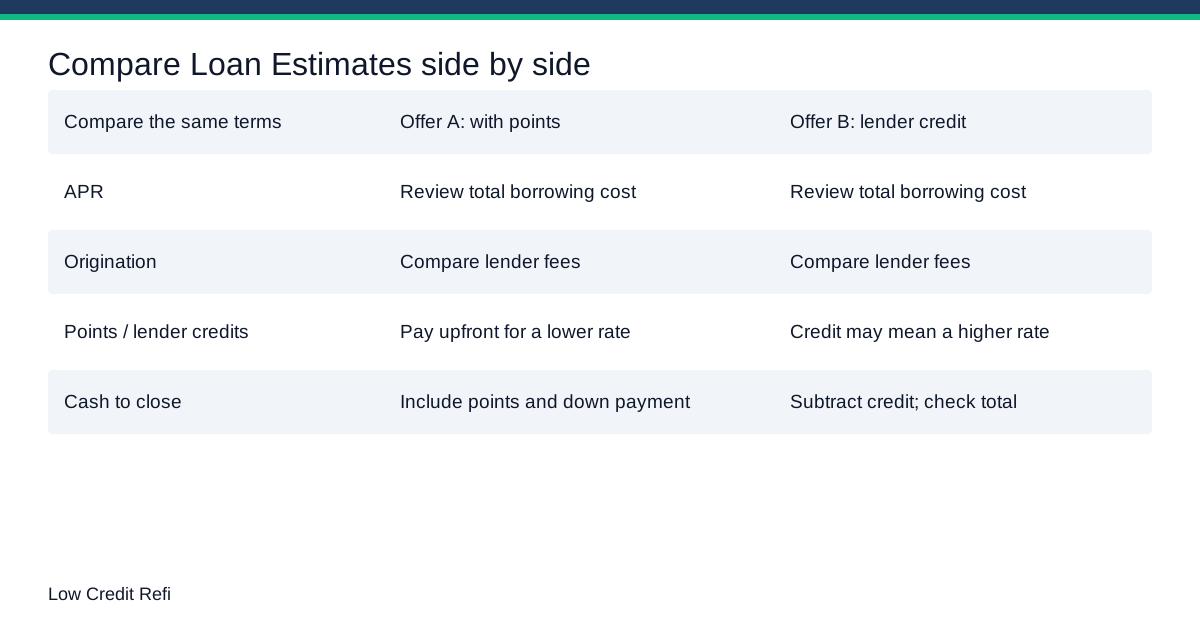
Compare Loan Estimates for the same loan type and term. Include closing costs when calculating whether refinancing saves money.
FHA Streamline Refinance: Lowest Transaction Cost for Existing FHA Borrowers
The FHA Streamline is only available if you currently have an FHA-insured mortgage — but if you do, it is almost always the lower-cost path compared to a full rate-and-term refi. HUD waives the appraisal requirement (saving $400–$700), reduces documentation requirements, and expedites processing. The FHA sets no formal credit score floor for the Streamline, but most lenders apply a 580+ overlay.
What "reduced documentation" actually means: FHA does not require a full income re-verification or a new appraisal for a Streamline. You still need to demonstrate a payment history on the existing FHA loan (typically no 30-day lates in the previous 12 months and no more than one 30-day late in the 12 months prior to that), and the loan must be current at application. Employment documentation requirements are lender-discretionary for a non-credit-qualifying Streamline.
Upfront MIP on a Streamline: Still 1.75%, but HUD's refund schedule applies. If your original FHA loan closed less than 36 months ago, you receive a pro-rated refund credit applied toward the new upfront MIP. For example, a loan closed 12 months ago receives a refund credit equal to approximately 58% of the original upfront MIP — materially reducing your effective upfront cost.
Net Tangible Benefit rule: HUD requires the Streamline to deliver a documented benefit, typically a combined rate-and-MIP reduction of at least 0.5 percentage points, or a conversion from an adjustable-rate mortgage to a fixed rate. Lenders must document this before closing. If the rate reduction does not meet the threshold, the Streamline is not permitted — a built-in consumer protection against fee-harvesting refis.
Pros: Lowest total transaction cost of any FHA refinance; appraisal waiver removes the risk of a low appraisal blocking the deal; negative equity is not a disqualifier; fastest timeline to closing.
Cons: Cannot extract any cash; loan balance cannot increase beyond allowable financed closing costs; exclusively for current FHA borrowers; lender participation varies.
VA IRRRL: Unmatched Lifetime Value for Eligible Veterans
For veterans, active-duty service members, and qualifying surviving spouses who already have a VA-guaranteed mortgage, the VA Interest Rate Reduction Refinance Loan (IRRRL) is the most cost-efficient refinancing product available anywhere in the mortgage market at the 580–620 credit tier. The VA charges a single flat funding fee of 0.5% of the new loan amount — the only government-backed insurance equivalent — and there is no monthly mortgage insurance of any kind.
Cost comparison on a $250,000 loan versus FHA:
- VA IRRRL funding fee: 0.5% × $250,000 = $1,250
- FHA upfront MIP (same loan): $4,375 — a $3,125 difference at closing alone
- FHA annual MIP at 0.55%: $1,375/year ongoing vs. $0/year for VA
- Over 10 years, FHA MIP adds $13,750 in insurance premiums; VA adds $0 after the one-time funding fee
Pros: Dramatically lower lifetime insurance cost versus FHA; no monthly MIP; appraisal generally not required; reduced lender documentation; funding fee waived for disabled veterans.
Cons: Eligibility strictly limited to veterans/active-duty with an existing VA mortgage; lenders impose overlays (580–620 typical); net tangible benefit must be documented.
Conventional Rate-and-Term Refinance: Available at 620, With Caveats
Fannie Mae and Freddie Mac publish a hard minimum credit score of 620 for all conventional conforming mortgages. This is not a lender overlay — it is the agency floor. Borrowers at 580–619 are categorically ineligible for conventional refinancing through any Fannie/Freddie-backed lender, period.
For borrowers at exactly 620, conventional access opens, but it opens expensively. Fannie Mae's publicly available Loan-Level Price Adjustment (LLPA) matrix imposes credit score surcharges that increase as scores decline. At the 620–639 score band, the LLPA on a standard rate-and-term refinance with 75%–80% LTV can add 2.75–3.25 percentage points in loan-level fees. Lenders typically convert these LLPAs into a higher interest rate rather than a cash fee at closing, but the economic effect is identical: borrowers at 620 pay significantly more for conventional money than borrowers at 660 or 700.
The MIP-elimination calculus: The reason to pursue conventional at 620 is the potential to eliminate mortgage insurance entirely if your LTV is 80% or below. An FHA loan at 0.55% annual MIP on a $250,000 balance costs $1,375/year — money that a conventional loan at 80% LTV does not spend. Over 5–7 years, this difference can dwarf the rate premium of an FHA loan, making conventional the mathematically superior choice for borrowers with sufficient equity and a score at or above 620.
Pros: No MIP if LTV ≤80%; PMI is cancellable at 80% LTV (unlike most FHA annual MIP); no FHA-specific program restrictions.
Cons: 619 and below is ineligible without exception; 620 borrowers face steep LLPA surcharges; PMI at 620 with LTV above 80% can run 0.8%–1.5% annually — comparable to FHA MIP, without FHA's easier credit access.
FHA Cash-Out Refinance: Highest Cost, Specific Use Cases
The FHA cash-out refinance allows borrowers to refinance up to 80% of their home's appraised value and receive the equity difference in cash. It is available from 580 (with most lenders requiring 600+ in practice). This is the highest-cost FHA product in the stack, combining the full 1.75% upfront MIP, 0.55% annual MIP, 2%–5% closing costs, and a mandatory full appraisal — while simultaneously increasing the loan balance.
Where the math can still work: If the cash proceeds eliminate high-interest revolving debt — credit cards typically running 20%–29% APR in 2026 — trading that rate for a mortgage rate of even 7%–8% produces a net interest savings that justifies the transaction cost, often within 12–24 months. Home improvement use may carry a tax benefit (consult a tax professional for your situation). The key discipline is using the cash for wealth-building purposes, not recurring consumption expenses, because a cash-out refi resets your equity clock.
Pros: Access to equity without selling; single consolidated payment; mortgage interest rates lower than most consumer debt alternatives.
Cons: Highest total cost of all options in this comparison; full appraisal required and a low value can kill the deal; increases your loan balance and resets amortization; LTV capped at 80% limits accessible equity.
Thinking about accessing your home equity? Get a free consultation to calculate how much equity you could access and what it would cost.
What Matters Beyond the Headline Numbers
The Break-Even Calculation: The Number That Actually Decides
The interest rate on your refinance makes headlines. The break-even period makes or breaks the transaction. The formula is simple: divide your total closing costs (including any rolled-in upfront MIP) by your monthly payment reduction. The result is the number of months until you have recovered every dollar spent on the refinance.
Example on a $250,000 FHA rate-and-term refi: total upfront costs of $10,875 (1.75% upfront MIP rolled in, plus $6,500 in closing costs) divided by a $220/month payment reduction equals a 49-month break-even. If you sell, move, or refinance again before month 49, the transaction cost you money on net. If you hold for 7 years, you save $5,505 beyond the closing costs.
For 580–620 borrowers, break-even periods tend to be longer than for prime borrowers for two structural reasons: (1) the rate reduction may be modest if the borrower is already in an FHA loan at a competitive rate; and (2) the 1.75% upfront MIP adds a significant base cost that must be recouped before any net savings begin. A useful decision rule: if the break-even exceeds 36 months and you do not have a compelling reason to expect holding the property that long, the refinance may not be the right move yet.
Lender Overlays: Why Agency Minimums Are Only Half the Picture
FHA publishes a 580 minimum credit score, but FHA does not originate loans — lenders do. Individual lenders can and do impose "overlays," which are internal credit standards stricter than agency minimums. In 2026, a meaningful portion of retail lenders set their practical FHA floor at 600+, which means a borrower at 583 may be declined by one lender and approved by another, on the exact same FHA product. This is not inconsistency — it is a legal, common practice that reflects each lender's own portfolio risk tolerance.
The practical implication: at 580–620, applying to multiple lenders is not just smart rate shopping — it is essential to finding an originator willing to do the transaction at all. Applying within a concentrated 45-day window protects your credit score, because FICO scoring models count all mortgage inquiries within a 45-day period as a single inquiry.
LTV Ratio: The Lever That Controls Your MIP Tier and Long-Term Cost
Your loan-to-value ratio (current balance divided by appraised value) directly determines which FHA MIP tier applies and whether that MIP ever cancels. The critical boundary is 90% LTV:
- LTV above 90% at origination: Annual MIP of 0.55% lasts the full loan term — 360 months for a 30-year mortgage. There is no automatic cancellation, regardless of how much equity you build.
- LTV at or below 90% at origination: Annual MIP of 0.50% and — significantly — MIP cancels after 11 years of payments. This is a material long-term savings that many borrowers overlook.
The Credit Score Pricing Cliff: Why 619 to 620 Is Worth Fighting For
Mortgage pricing does not move in a straight line with credit scores. Risk-based pricing operates in bands, and there are meaningful pricing cliffs at specific score thresholds. The 619-to-620 boundary is one of the most consequential in all of consumer mortgage lending: it is the difference between FHA-only access (with lifetime MIP) and Fannie Mae conventional access (with cancellable or eliminable MIP). For a borrower with 20% equity, crossing 620 can eliminate 0.50%–0.55% in annual mortgage insurance cost permanently. On a $250,000 loan, that is $1,250–$1,375 per year — $12,500–$13,750 over ten years — that does not exist on a conventional loan without MIP.
A borrower at 617 who spends 60–90 days reducing credit utilization, disputing reporting errors, and avoiding new inquiries before applying can often cross 620 and access an entirely different — and permanently cheaper — product tier. The short-term delay is almost always worth it unless the existing loan rate is genuinely unaffordable and immediate relief is required.
Authoritative Guidance & Official Standards
The following official sources govern the costs, eligibility rules, and consumer protections applicable to mortgage refinancing in 2026. These links point to real, published government and agency resources. Their guidance informs the loan programs discussed in this article but does not constitute an endorsement of any specific lender.
- CFPB — Owning a Home: The Consumer Financial Protection Bureau's mortgage borrower hub explains the Loan Estimate and Closing Disclosure — the two federally required documents that itemize all lender and third-party costs. Every borrower should use these documents, not verbal quotes, to compare lenders. CFPB also publishes a rate explorer tool for tracking market rate trends by credit tier.
- HUD — FHA Single Family Housing Policy Handbook: HUD's official Handbook (HUD 4000.1) and associated Mortgagee Letters define every aspect of FHA underwriting, including credit score floors, MIP schedules, Streamline Refi eligibility, and the Net Tangible Benefit requirement. Mortgagee Letter 2023-05 — the MIP reduction that lowered annual MIP from 0.85% to 0.55% for most 30-year loans — is published here and remains in effect in 2026.
- VA — Interest Rate Reduction Refinance Loan: The VA's official IRRRL page documents the 0.5% funding fee, the complete eligibility framework for veterans and surviving spouses, the funding fee waiver for service-connected disabled veterans, and the net tangible benefit rules that protect veterans from predatory refinancing offers.
- FTC — Mortgage Refinancing: The Federal Trade Commission's refinancing consumer guide covers warning signs of predatory refinancing (excessive points, hidden prepayment penalties, unnecessary products), explains how to evaluate competing offers, and provides recourse information. Borrowers in the 580–620 range are disproportionately targeted by bad-faith refinancing offers, making this resource particularly relevant.
- Fannie Mae — LLPA Matrix: The publicly available Loan-Level Price Adjustment matrix is the definitive tool for quantifying how credit score and LTV together affect the cost of conventional conforming mortgages. Borrowers approaching 620 should download this document and use it to calculate the exact financial benefit of raising their score before applying for a conventional refi.
Questions to Answer Before Deciding (FAQ)
How much does it cost to refinance a mortgage with a 580–620 credit score?
Total upfront refinancing costs for FHA products — the dominant option at this credit tier — typically fall between 3.75% and 6.75% of the loan amount, when you combine the mandatory 1.75% upfront MIP with standard closing costs of 2%–5%. On a $250,000 loan, that is roughly $9,375–$16,875 in total upfront costs, the majority of which is usually rolled into the new loan balance rather than paid in cash at closing. The specific line items to expect on your Loan Estimate include: loan origination fee (typically 0.5%–1% of loan amount), appraisal fee ($400–$700 depending on property and market), title search and lender's title insurance (~0.5%–1%), owner's title insurance (varies by state; often optional but recommended), government recording fees ($50–$500 depending on jurisdiction), and prepaid escrow items for property taxes and homeowners insurance. Compare the Loan Estimate — not verbal quotes, not websites — across a minimum of three lenders before committing.
What is the break-even period and why does it determine whether I should refinance now?
The break-even period is the number of months until cumulative monthly savings equal your total closing costs. The calculation: Total Closing Costs ÷ Monthly Payment Reduction = Months to Break Even. This single number often determines whether a refinance makes financial sense. If your break-even is 30 months and you are confident you will hold the property for at least 4–5 years, the math strongly favors refinancing. If the break-even is 60 months and your life circumstances are uncertain, the risk-adjusted case weakens significantly. For 580–620 borrowers, break-even periods tend to be longer than for prime borrowers because (a) rate reductions over an existing reasonably-priced loan may be modest, and (b) the 1.75% upfront MIP must be fully recouped before real savings begin. Always calculate this number before signing a loan application.
Can I actually refinance with a 580 credit score in 2026?
Yes — FHA guidelines establish 580 as the statutory minimum for standard FHA loans, and this applies to refinancing as well as purchases. However, FHA does not originate loans; participating lenders do, and they routinely impose credit overlays requiring 580–600 as their internal floor. This means a 580-score borrower may be approved by one FHA lender and declined by another on the exact same program. The FHA Streamline (for existing FHA borrowers) technically has no FHA-mandated minimum score, giving the most flexibility at very low scores, but most lenders still set informal floors. The strategic action at 580: apply with multiple FHA-approved lenders simultaneously, specifically seek non-bank lenders who specialize in the 580–620 tier, and gather all Loan Estimates within a 45-day window so multiple inquiries count as one for FICO purposes. Note that a score of 500–579 requires 10% equity for FHA; 580+ requires only 3.5% equity, making the 580 threshold a meaningful milestone.
What are the steps to qualify for a 600 credit score home loan refinance?
Qualifying for a refinance at 600 follows a clear, executable sequence. Step 1: Pull your tri-merge credit report from all three bureaus (Equifax, Experian, TransUnion) through AnnualCreditReport.com and audit every tradeline for errors. Disputing inaccuracies through the formal bureau dispute process can resolve errors within 30–45 days, and even one removed negative item can shift a score meaningfully. Step 2: Reduce revolving credit utilization below 30% — ideally below 10% — because utilization is the fastest-moving FICO variable. Paying down a credit card from 80% utilization to 20% can add 20–40 points within one billing cycle. Step 3: Avoid opening new credit accounts or making large purchases on existing cards in the 90 days before applying. Step 4: Verify 24 months of stable employment documentation (W-2s, pay stubs, tax returns if self-employed) — FHA requires documented employment history and gaps require a letter of explanation. Step 5: Calculate your debt-to-income ratio (DTI). FHA allows up to 43%–50% DTI with compensating factors, but lower DTI strengthens your file. Step 6: Apply with at least three lenders within a 45-day window, compare Loan Estimates, and select the lowest total cost — not just the lowest rate.
Should I pay discount points to lower my rate on a refinance at this credit score?
Discount points — each equal to 1% of the loan amount and typically buying 0.125%–0.25% off the interest rate — can be a sound investment if the break-even on the points themselves is within your holding period. Concrete example: 1 point on a $250,000 loan costs $2,500 and saves approximately $35–$50/month depending on rate environment, producing a point-specific break-even of 50–71 months. For most 580–620 borrowers who are already carrying a higher rate and paying MIP, deploying $2,500 in cash at closing to buy a quarter-point off the rate is often a weaker use of capital than reducing the loan balance directly (which lowers both your payment and your MIP basis) or building cash reserves for the post-closing period. The exception: if you have confirmed you will hold the property for 7–10 years and interest rates are elevated, points can produce meaningful lifetime savings. Ask your lender for a rate sheet with a no-points scenario, a 0.5-point scenario, and a 1-point scenario, then run the break-even for each.
Will shopping multiple lenders damage my credit score?
No — provided you concentrate your rate-shopping within a 45-day window. FICO scoring models (Version 8 and newer, which the majority of mortgage lenders use) treat all mortgage-related hard inquiries within a 45-day period as a single inquiry. The credit score impact of a single mortgage inquiry is typically 2–5 points, temporary, and recovered within 3–6 months. The far greater credit risk is applying sporadically over several months — each new inquiry outside the window counts separately. The strategic protocol: decide you are ready to refinance, then apply with all target lenders within the same 4–6 week period, compare every Loan Estimate systematically, and choose. Borrowers who avoid rate-shopping out of credit score concern typically leave hundreds to thousands of dollars per year on the table in excess interest and fees.
Related Guides
- 590 Credit Score Mortgage: Your Complete 2026 Guide to Loan Options — If your score sits at 590, this guide maps out exactly which loan programs are accessible, what rate premium to expect at this specific score band, and which lender types are most likely to approve your application.
- Streamline Refinance No Credit Check: The Complete 2026 Guide — The FHA Streamline's expedited process may remain available even if your credit has declined since your original FHA loan closed. Read the full eligibility rules and documentation requirements before assuming you are disqualified.
- 590 Credit Score Home Loan: Your Complete 2026 Buyer's Guide — For borrowers considering a purchase alongside or instead of a refinance, this guide covers the full 580–620 purchase loan landscape: down payment requirements, program eligibility, and realistic rate expectations.
The Bottom Line
Mortgage refinancing with a 580–620 credit score in 2026 is genuinely achievable — but the total cost picture is more complex than the rate advertised in any lender's marketing. The FHA rate-and-term refinance is the most widely accessible path, with clearly published costs anchored by the 1.75% upfront MIP and 0.50%–0.55% annual MIP. The FHA Streamline offers the lowest transaction cost for existing FHA borrowers, often cutting closing costs by 40%–60% versus a full refi. The VA IRRRL is the objectively superior lifetime-cost product for eligible veterans — lower upfront cost, zero ongoing MIP, and an effective interest savings advantage that compounds over the full loan term. Conventional refinancing opens meaningfully at exactly 620, and the elimination of permanent MIP for borrowers with 20%+ equity makes it worth fighting for a score crossing that threshold before applying.
The most important numbers are not your rate and your new payment — they are your total closing costs and your break-even period. If the break-even exceeds your realistic holding horizon, the refinance costs you money. If your score is 617–619, a 60–90 day credit rehabilitation effort may unlock conventional access and eliminate lifetime MIP, saving far more over the loan term than any rate reduction available today on an FHA product at 619.
Your next step is to get a real Loan Estimate, not a marketing quote. Request a free, no-obligation refinance quote from lenders who specialize in the 580–620 credit tier — compare at least three before deciding.
Key Takeaways
- Understanding your options for mortgage refinancing cost and pricing guide 2026 is the first step
- Getting pre-qualified helps you understand your real options