Compare Live Mortgage & Home Equity Rates
Compare current APRs, points, fees, and estimated monthly payments from participating lenders below.
Mortgage rates
Quick answer: Three federal programs — the FHA Streamline (non-credit-qualifying track), the VA Interest Rate Reduction Refinance Loan (IRRRL), and the USDA Streamlined Assist Refinance — let eligible homeowners reduce their mortgage rate or monthly payment without a traditional credit pull per agency guidelines. The main trade-off: you must already hold the matching government-backed loan, satisfy seasoning requirements, and demonstrate a measurable net tangible benefit. If you carry a conventional mortgage, have a recent delinquency, or want to cash out equity, a full credit-qualifying refinance is the better fit.
How We Evaluate & Compare Options
This guide compares the four primary refinance paths available to government-backed loan holders in 2026 against a conventional rate-and-term refi baseline. Our analysis is grounded in published agency guidelines from HUD's Single Family Housing Policy Handbook 4000.1, VA Lenders Handbook Chapter 6, and the USDA Rural Development Guaranteed Loan Program handbook — not first-person loan originations. Where lender practices diverge from agency minimums (a common and consequential gap explained below), we note that clearly.
Evaluation criteria include: credit review requirement per agency vs. lender overlay reality, appraisal requirement, seasoning rule, net tangible benefit (NTB) threshold, income documentation burden, upfront cost structure, and which borrower profile benefits most. No interest rate figures are quoted as current benchmarks because mortgage rates change daily; the structural savings mechanics, however, are fixed in program rules and reliably comparable.
When considering streamline refinance no credit check, you should understand all available options.
| Program | Existing Loan Required | Credit Check (Agency Guideline) | Appraisal Required | Seasoning Requirement | Net Tangible Benefit Threshold | Income Verification |
|---|---|---|---|---|---|---|
| FHA Streamline — Non-Credit-Qualifying | Existing FHA loan | No (lender overlays may still apply) | No | 6 payments made; 210 days from first payment due date | Combined rate + MIP must drop ≥0.5% (fixed-to-fixed) | Not required by FHA |
| VA IRRRL | Existing VA loan | No VA minimum; lender overlays typically 580–620 | No (exceptions for certain ARM-to-fixed) | 6 payments made; 210 days from first payment due date | New rate must be lower than current rate (ARM-to-fixed exception) | Not required by VA guidelines |
| USDA Streamlined Assist Refinance | Existing USDA Guaranteed or Direct loan | No credit review required | No | 12 consecutive on-time monthly payments | P&I payment must decrease by at least $50/month | Income eligibility check (≤115% area median income) |
| FHA Streamline — Credit-Qualifying | Existing FHA loan | Yes — typically 580+ score required | No | 6 payments made; 210 days from first payment due date | Same NTB as non-credit-qualifying track | Yes — full income documentation |
| Conventional Rate-and-Term Refinance | Any conventional mortgage | Yes — typically 620–700+ depending on LTV | Usually required | Varies by lender; often 6–12 months | No set minimum — lender discretion | Yes — full documentation required |
Compared Options
Each refinance path below targets a specific borrower profile. They appear in the same order as the table above. If you are unsure which loan type you currently hold, check your original closing disclosure or call your servicer — the loan type is stated on page 1.
Ready to find out if you qualify? A licensed mortgage specialist can check your current loan type, seasoning status, and potential monthly savings in minutes — at no cost to you.
Get Your Free Streamline Refinance Quote
FHA Streamline Refinance — Non-Credit-Qualifying Track
The non-credit-qualifying FHA Streamline is the most widely discussed "no credit check" refinance product. Under HUD Handbook 4000.1, this track allows an existing FHA borrower to refinance into a new FHA loan with a lower interest rate without FHA requiring a new credit report, new appraisal, or income documentation. The agency-level requirement is straightforward: the borrower must have made at least six monthly payments on the current FHA mortgage, at least 210 calendar days must have elapsed since the first payment due date, and the transaction must produce a net tangible benefit.
Net tangible benefit for a fixed-rate-to-fixed-rate transaction means the new combined rate — interest rate plus annual MIP expressed as a percentage — must be at least 0.5 percentage points lower than the existing combined rate. For an ARM-to-fixed transaction, HUD considers the stability itself a net tangible benefit even if the new fixed rate is higher than the current ARM rate. For a fixed-to-ARM, the combined rate must drop by at least 2 percentage points.
Critical nuance — lender overlays: HUD does not require a credit check, but individual lenders frequently impose their own minimum credit score requirements (commonly 580–620) to satisfy Ginnie Mae investor guidelines or their own risk policies. This means the same loan that HUD classifies as "non-credit-qualifying" may require a credit pull at your chosen lender. Shopping at least two to three lenders is essential to find one that honors the agency's no-check standard.
Expert Tip
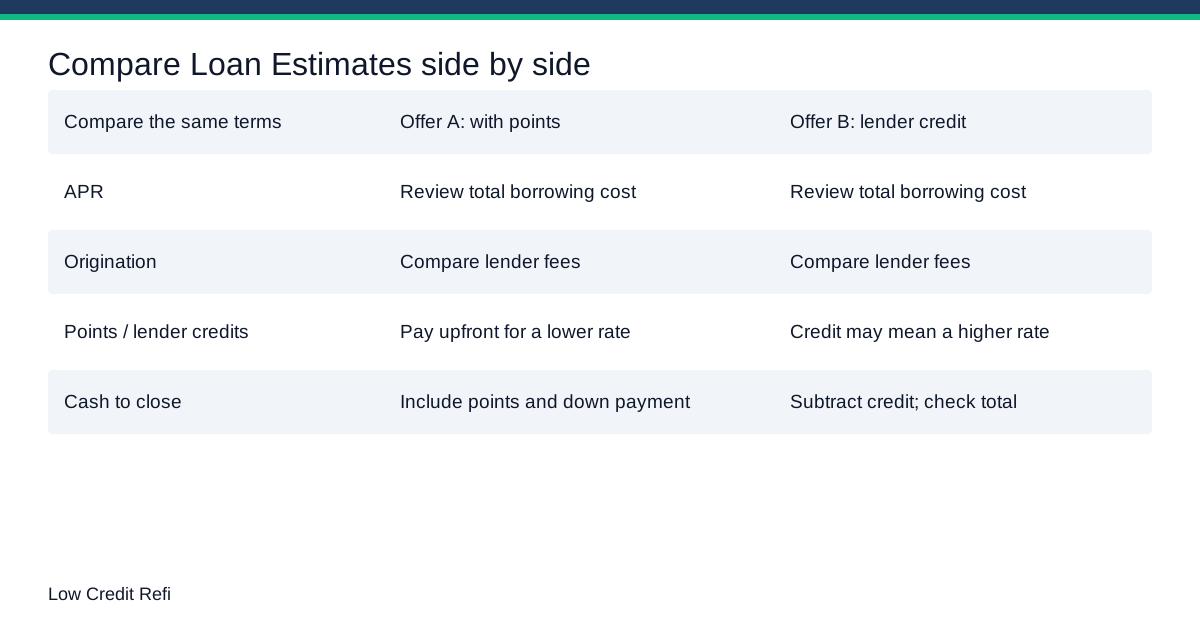
Compare Loan Estimates for the same loan type and term. Include closing costs when calculating whether refinancing saves money.
MIP consideration: If your original FHA loan was endorsed before June 1, 2009, you qualify for a significantly reduced UFMIP rate of 0.01% and an annual MIP of 0.55% — a strong financial incentive that makes the streamline especially attractive for older FHA borrowers.
Pros: No appraisal protects borrowers with flat or declining home values; reduced paperwork burden; no income documentation requirement; relatively low closing costs (often 2–3% of loan amount, which can frequently be rolled into the new loan).
Cons: Must already have an FHA loan; cannot take cash out; cannot remove MIP via this track alone (must refinance to conventional to eliminate MIP entirely); delinquent borrowers are excluded — no 30-day lates in the prior 3 months, and no more than one 30-day late in the prior 12 months.
VA Interest Rate Reduction Refinance Loan (IRRRL)
The VA IRRRL — widely known as the VA Streamline — is arguably the most borrower-friendly streamline product available. Per Chapter 6 of the VA Lenders Handbook, the VA sets no minimum credit score and does not require a new appraisal in most cases. The program is reserved for veterans, active-duty service members, and surviving spouses who currently hold a VA-backed mortgage.
Seasoning rules mirror the FHA Streamline: the borrower must have made at least six monthly payments and 210 days must have passed since the loan's first payment due date. The new interest rate must be lower than the existing rate, with one exception: refinancing from an adjustable-rate VA loan to a fixed rate is permitted even if the fixed rate is higher, because the VA treats rate predictability as a benefit in itself.
The VA funding fee for an IRRRL is 0.5% of the loan amount — substantially lower than the 2.15%–3.3% funding fee on a VA purchase loan for a subsequent user. This fee can be rolled into the loan balance, though doing so increases the principal and therefore the long-run interest cost.
Lender overlays: Just as with the FHA Streamline, most lenders impose credit score floors of 580–620 on VA IRRRLs despite the VA's own silence on the subject, driven by Ginnie Mae eligibility and secondary market requirements. The VA does not explicitly prohibit lenders from pulling credit; it simply does not require it.
Pros: No mortgage insurance of any kind; lowest funding fee of any VA loan; typically the fastest closing timeline of any refinance product (often 20–30 days); no income verification per VA guidelines.
Cons: Only available to VA loan holders; rate must decrease (for fixed-to-fixed); cannot pull cash out via IRRRL; lender overlays may negate the no-credit-check benefit at some institutions.
Are you a veteran with an existing VA loan? You may be leaving money on the table. See how much an IRRRL could cut your monthly payment — consultation is free and takes under 10 minutes.
See If You Qualify for a VA IRRRL
USDA Streamlined Assist Refinance
The USDA Streamlined Assist is the least-known of the three no-credit-check paths, but it offers genuinely strong protections for rural homeowners. Governed by USDA Rural Development guidelines, this program waives both the credit review and the property appraisal entirely. The eligibility bar is a full 12 consecutive on-time monthly payments on the existing USDA Guaranteed or Direct loan — a tighter seasoning window than the FHA/VA programs.
The NTB requirement is a fixed-dollar threshold: the new principal-and-interest payment must be at least $50 per month lower than the existing P&I payment. Escrow changes (taxes and insurance) are excluded from the calculation, which can sometimes create confusion — the total monthly payment may change by less than $50 if insurance or property tax has risen, but as long as the P&I component drops by the threshold, the transaction qualifies.
Income is not re-underwritten for creditworthiness purposes, but borrowers must still certify that household income does not exceed 115% of the area median income, consistent with USDA program eligibility. Property must remain in an eligible rural or suburban area.
Pros: Strictest "no credit check" standard of the three programs — no exceptions or investor overlays commonly observed; no appraisal; low guarantee fee structure (1% upfront, 0.35% annual); strong option for rural borrowers with impaired credit history.
Cons: Requires 12 months of on-time payments (longest seasoning period); geographic eligibility limits apply; $50/month savings threshold can be difficult to hit if rates have moved unfavorably; cannot extend the loan term beyond the original 30-year maximum.
FHA Streamline — Credit-Qualifying Track (Reference Comparison)
The credit-qualifying FHA Streamline is worth understanding as a contrast point. This track uses the same no-appraisal benefit as the non-credit-qualifying version but adds a full credit review and income verification. It is typically chosen when a borrower needs to remove a co-borrower who is no longer on title, add a new co-borrower, or when a lender cannot approve the non-credit-qualifying path due to payment history concerns. The net tangible benefit thresholds are identical; what changes is the underwriting burden and the ability to address derogatory credit under standard FHA guidelines.
What Matters Beyond the Headline Numbers
The Lender Overlay Problem — and How to Navigate It
The single most misunderstood aspect of streamline refinances is the gap between agency guidelines and lender practice. HUD, the VA, and USDA can each structure a program without a mandatory credit review — but they cannot force every approved lender to offer the product without credit overlays. Lenders sell the majority of government-backed loans into Ginnie Mae mortgage-backed securities, and Ginnie Mae has historically restricted the pooling of loans below certain credit score thresholds. This means a borrower who qualifies under HUD's published handbook may still be declined by three lenders before finding one willing to close a true non-credit-qualifying transaction.
The practical solution: explicitly ask each lender at the outset whether they require a credit score for non-credit-qualifying FHA Streamlines or VA IRRRLs. Credit unions and smaller community lenders frequently retain loans in portfolio rather than selling to Ginnie Mae, making them more likely to honor agency-level standards. Mortgage brokers with access to multiple wholesale investors can also identify which investors have no overlay on a particular program.
Closing Costs and the Break-Even Calculation
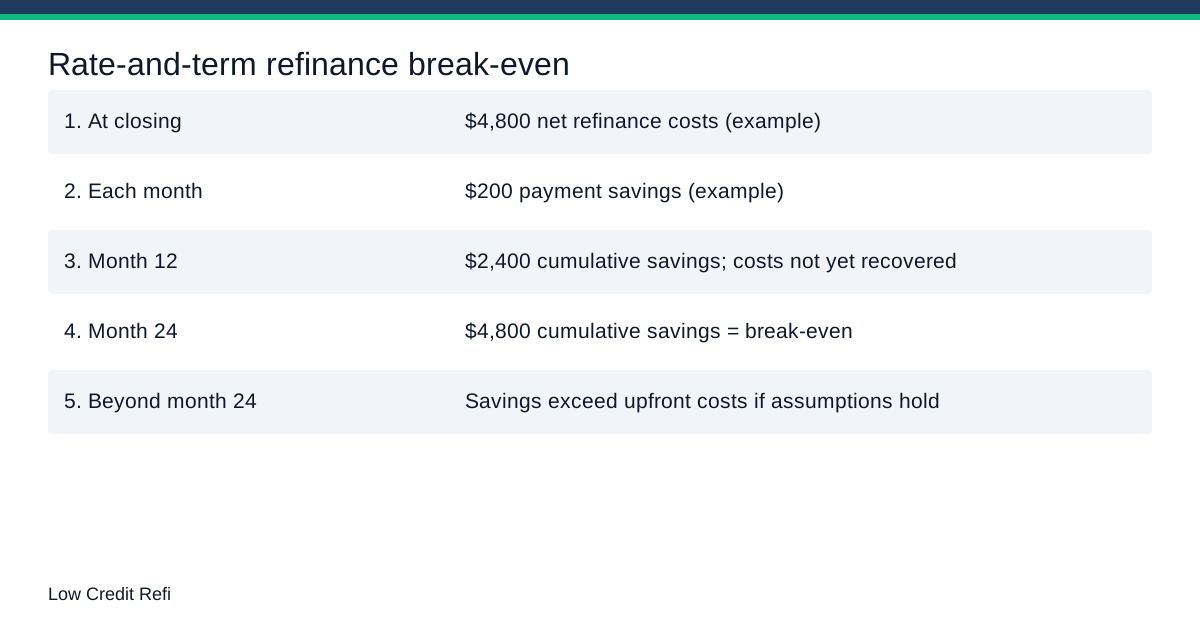
Even without an appraisal or credit report fee, streamline refinances carry real closing costs: origination fees, title search, government recording fees, and prepaid items like initial escrow deposits. A no-cost streamline (where closing costs are rolled into the rate via lender credits) avoids out-of-pocket expense but results in a higher interest rate than a cost-bearing transaction. For borrowers with high remaining loan balances and long remaining terms, accepting a modest upfront cost in exchange for a lower rate typically produces a better lifetime outcome. The break-even calculation is: total closing costs ÷ monthly payment reduction = months to break even. If you plan to stay in the home beyond that point, the upfront cost version wins.
Payment History Is the Real Gatekeeper
All three no-credit-check programs share a hard stop that borrowers frequently underestimate: recent delinquency disqualifies the transaction regardless of credit score. The FHA Streamline requires no 30-day late payment in the prior 3 months and no more than one in the prior 12. The VA IRRRL and USDA Streamlined Assist carry similar recent-history requirements. A single missed payment in the last quarter may bar you from the streamline path and redirect you toward a full credit-qualifying refinance — which will be harder to secure if your score was already low.
MIP Trap: FHA Borrowers and Long-Term Cost
FHA Streamlining into another FHA loan preserves the mortgage insurance premium. For most borrowers with loans originated after June 3, 2013, FHA MIP is permanent for the life of a 30-year loan — it does not cancel when equity reaches 20%, unlike private mortgage insurance on conventional loans. Borrowers who have built substantial equity (typically ≥20%) may find that a full conventional refinance — despite requiring a credit check — eliminates MIP entirely and produces lower total monthly costs even at a modestly higher rate. Running both scenarios with a licensed mortgage professional before committing to the streamline is worthwhile.
Authoritative Guidance & Official Standards
The following official sources govern these programs and inform the guidance above. Links point to agency-published materials; inclusion here is informational and does not imply endorsement of any lender or guarantee of individual eligibility.
- HUD Single Family Housing Policy Handbook 4000.1 (HUD.gov) — the authoritative FHA underwriting reference covering both credit-qualifying and non-credit-qualifying FHA Streamline Refinance rules, net tangible benefit definitions, and MIP rate schedules.
- VA IRRRL Program Overview (VA.gov) — VA's official explanation of the Interest Rate Reduction Refinance Loan, including eligible borrowers, funding fee schedules, and occupancy requirements.
- USDA Single-Family Housing Guaranteed Loan Program (USDA Rural Development) — program rules and income eligibility for the Streamlined Assist Refinance; area eligibility maps are accessible from this page.
- CFPB: What Is a Streamline Refinance? (ConsumerFinance.gov) — the Consumer Financial Protection Bureau's plain-language explanation of streamline programs, closing cost considerations, and borrower protections under RESPA and TILA.
- FTC: Mortgage Refinancing (FTC.gov) — Federal Trade Commission guidance on understanding refinance cost disclosures, identifying predatory terms, and comparing Loan Estimates under the TRID framework.
Questions to Answer Before Deciding (FAQ)
Does "no credit check" mean my credit score is completely ignored?
Per agency guidelines, yes — for the FHA non-credit-qualifying track, VA IRRRL, and USDA Streamlined Assist, the agency itself does not require a minimum credit score and, in many cases, does not require a credit report at all. However, the lender executing your loan may pull your credit for their own risk assessment or to satisfy Ginnie Mae investor eligibility requirements. This is called a "lender overlay" and it is legal and common. To maximize your chances of a true no-pull transaction, ask lenders explicitly whether they impose a credit overlay before authorizing them to run your report. A hard inquiry is generally minor (typically a 5-point drop) and usually irrelevant to the streamline decision itself, but it is a fair question to ask upfront.
What is the "net tangible benefit" rule and how do I know if I clear it?
Net tangible benefit (NTB) is a federal requirement designed to prevent lenders from churning borrowers into new loans without a meaningful financial improvement. For fixed-to-fixed FHA Streamlines, your new combined rate — interest rate plus annual MIP — must be at least 0.5 percentage points lower than the old combined rate. For VA IRRRLs on fixed-rate loans, the new interest rate must simply be lower than the existing rate. For USDA Streamlined Assist, the principal-and-interest payment must drop by at least $50/month. Your lender is required to calculate and document NTB in your loan file; you can request this calculation before committing to the transaction. If rates have not moved meaningfully since you closed, you may not clear the NTB threshold — and the refinance would not proceed.
Can I roll my closing costs into the new loan?
Yes, in most cases. All three programs allow closing costs to be financed into the new loan balance, subject to a cap. For FHA Streamlines, the new loan amount cannot exceed the original principal balance plus allowable costs (including financed UFMIP). For VA IRRRLs, allowable fees and the 0.5% funding fee can be rolled in as long as the resulting loan balance does not exceed the appraised value — but since no appraisal is required, most VA IRRRL loans are capped at the outstanding balance plus costs. The trade-off: rolling in costs increases your principal, which means you pay interest on those costs for the life of the loan. For a $5,000 closing cost at 6.5% over 30 years, you pay roughly $6,370 in total — the effective cost of the "no out-of-pocket" option.
What if I've missed a payment in the last year — am I automatically disqualified?
Not automatically, but your window narrows. The FHA Streamline non-credit-qualifying track requires no 30-day lates in the past three months and allows a maximum of one 30-day late in the prior 12 months. Two or more lates in the past year disqualify the non-credit-qualifying path. The USDA Streamlined Assist requires 12 consecutive on-time payments — any lapse resets the clock. VA IRRRL guidelines require the most recent 12-month payment history to show no more than one 30-day late. Borrowers who fall outside these windows typically need a credit-qualifying FHA refi or a conventional rate-and-term refi, both of which evaluate full credit history and may require a minimum score of 580–620+.
How long does a streamline refinance take to close?
Streamline refinances close faster than full refinances because the underwriting scope is narrowed. VA IRRRLs frequently close in 20–30 days. FHA Streamlines typically close in 25–35 days. USDA Streamlined Assist tends to run 30–45 days because USDA itself must issue a conditional commitment before closing, adding a processing step. By comparison, a full conventional refinance with appraisal and full underwriting commonly takes 45–60 days in a normal rate environment. Timelines can lengthen during high-volume refinancing waves when lenders and appraisers are backlogged — though the streamline programs are somewhat insulated from appraisal delays since no appraisal is required.
Should I use my current servicer or shop other lenders for a streamline refinance?
Shopping is strongly advisable even though streamline refinances are available through your current servicer. Your existing servicer may offer the convenience of a smooth payoff process and an existing relationship, but they have no obligation to give you their best rate. Third-party lenders — including mortgage brokers who access multiple wholesale lenders — often offer lower rates or reduced overlay requirements, particularly for the no-credit-check variants. Under TRID (TILA-RESPA Integrated Disclosure) rules, any lender must provide you a Loan Estimate within three business days of receiving your application; comparing at least two Loan Estimates side by side on the same transaction type is the most reliable way to ensure competitive pricing.
Related Guides
- FHA Loan Requirements in 2026: Credit Score, Down Payment & Eligibility Explained — everything you need to know about FHA qualification, MIP costs, and how FHA loans compare to conventional financing.
- VA Home Loan Guide 2026: IRRRL, Funding Fees & Eligibility for Veterans — a deep dive into VA loan benefits, funding fee tables, occupancy rules, and how to maximize the IRRRL streamline option.
- USDA Loan Requirements 2026: Rural Eligibility, Income Limits & Streamlined Assist — area eligibility maps, income limit thresholds, and a comparison of USDA Guaranteed vs. Direct loan programs.
- When Does Refinancing Make Sense? The Complete 2026 Break-Even & Savings Guide — how to calculate your break-even point, compare no-cost vs. cost-bearing refinances, and decide between streamline and conventional paths.
The Bottom Line
For homeowners already holding an FHA, VA, or USDA mortgage who have made their payments on time, a streamline refinance with no credit check is one of the most cost-effective ways to reduce a monthly mortgage payment in 2026 — particularly if a rising-rate environment has eased and rates have come down from your original note rate. The FHA Streamline non-credit-qualifying track and the USDA Streamlined Assist are the cleanest "no credit review" options per agency rules; the VA IRRRL adds a funding-fee advantage and the absence of mortgage insurance.
The key trade-off is that all three programs are locked to borrowers already holding the corresponding government-backed loan, and the net tangible benefit requirement means the refinance only proceeds when the numbers genuinely work in your favor — which is a protection, not just a hurdle. The lender overlay reality means you should shop at least two to three lenders before assuming a credit pull is unavoidable.
If your loan is conventional, your credit score has materially improved since origination, or you want to eliminate FHA mortgage insurance, a full credit-qualifying refinance will serve you better. If you are unsure which path fits your situation, the fastest first step is a free consultation with a licensed mortgage professional who can pull your loan type, check your payment history, and run both scenarios side by side.
Get your no-obligation refinance analysis today. A licensed specialist will review your current loan, confirm your seasoning status, and show you exactly how much a streamline refinance could save you — no credit check required to get started.
Get My Free Streamline Refinance Quote
Key Takeaways
- Understanding your options for streamline refinance no credit check is the first step
- Getting pre-qualified helps you understand your real options