Compare Live Mortgage & Home Equity Rates
Compare current APRs, points, fees, and estimated monthly payments from participating lenders below.
Mortgage rates
Quick answer: A 590 credit score qualifies for FHA loans (3.5% down, per HUD Handbook 4000.1's 580 floor), VA loans for eligible veterans and service members, and USDA guaranteed loans in eligible rural areas via manual underwriting — but it does not meet the 620 minimum required for conventional Fannie Mae or Freddie Mac financing. The core trade-off is cost: FHA charges a 1.75% upfront mortgage insurance premium plus an ongoing annual MIP of 0.55% that lasts the life of the loan when LTV exceeds 90%. Borrowers who can raise their score to 620 before closing should do so — that single threshold eliminates mandatory lifetime MIP and typically lowers the interest rate by a meaningful margin. Those who cannot wait, or who are veterans, should proceed with the government-backed programs available at 590.
How We Evaluate & Compare Options
This guide compares each mortgage program realistically available to a 590-score borrower using published agency guidelines, regulatory handbooks, and documented lender behavior — not invented firsthand testing. We do not claim to have originated or audited any specific loan file. Our analysis draws on these primary sources:
- HUD Handbook 4000.1 (FHA Single Family Housing Policy Handbook): the governing document for FHA credit score minimums, MIP rate schedules, DTI allowances, and underwriting requirements.
- VA Lenders Handbook (VA Pamphlet 26-7): VA's published guidelines for the guarantee program, IRRRL requirements, and funding fee schedules.
- USDA HB-1-3555: USDA Rural Development's technical handbook covering GUS automated underwriting thresholds, manual underwriting eligibility criteria, and guarantee fee structures.
- FHFA / Fannie Mae Selling Guide: published minimum representative credit score requirements that establish the 620 floor for conforming conventional loans.
- CFPB Home Mortgage Disclosure Act (HMDA) data: provides aggregate approval rates and pricing benchmarks by credit score tier to calibrate realistic expectations.
At-a-Glance Comparison: Mortgage Programs for a 590 Credit Score (2026)
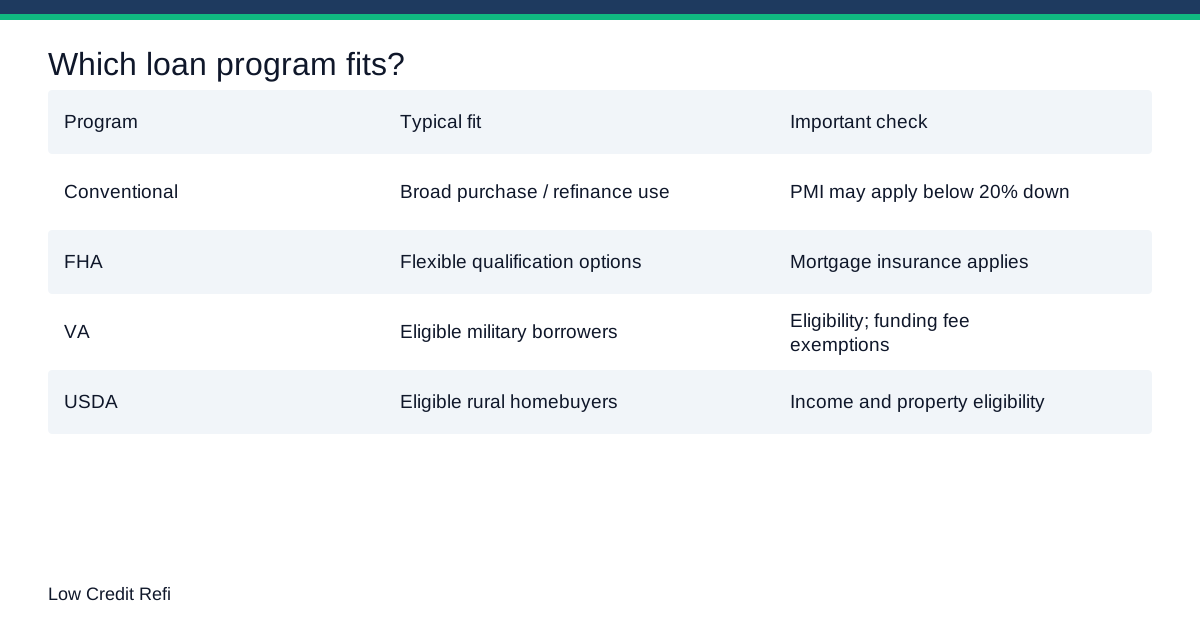
| Loan Program | Agency Credit Floor | Typical Lender Overlay | Min Down Payment | Mortgage Insurance / Guarantee Fee | Key Eligibility Restriction | Realistic at 590? |
|---|---|---|---|---|---|---|
| FHA Purchase or Rate/Term Refinance | 580 for 3.5% down; 500 for 10% down | 580–620 (varies by lender; many retail banks require 620+) | 3.5% at 580+ | 1.75% upfront MIP + 0.55% annual MIP (life of loan if LTV > 90%) | HUD county loan limits; DTI up to ~57% with compensating factors | Yes — shop multiple lenders; overlays vary significantly |
| FHA Cash-Out Refinance | 580 | 600–640 (stricter overlays than purchase loans) | N/A — must retain ≥ 20% equity; max 80% LTV after cash-out | 1.75% upfront MIP (resets) + 0.55% annual MIP (life of loan if LTV > 90%) | 12-month on-time payment history required; primary residence only | Possible — fewer lenders go to 580 for cash-out than for purchase |
| VA Loan (Purchase or IRRRL Refinance) | No official VA minimum credit score | 580–620 at most VA lenders | 0% with full VA entitlement | No monthly PMI; one-time funding fee (1.25%–3.3% depending on use and down payment; waived for disabled veterans) | Active duty, veteran, or eligible surviving spouse; Certificate of Eligibility required | Yes — strongest program available for eligible borrowers at 590 |
| USDA Guaranteed Loan | 640 for GUS automated approval; 580+ for manual underwriting | 640 automated; 580+ manual (limited lender pool for manual) | 0% (100% financing) | 1.0% upfront guarantee fee (rollable) + 0.35% annual fee — lower than FHA MIP | USDA-eligible rural/suburban area; household income ≤ 115% of area median income | Possible via manual underwriting — requires strong DTI and housing payment history |
| Non-QM / Portfolio Loan | No agency floor — lender-set, often 500+ | 500–580 typical minimum | 10–20% (lender-defined) | No standard MIP; rate premium of approximately 2–4 percentage points above agency loan rates | No income limits or geographic restrictions; not sold to Fannie Mae or Freddie Mac | Yes — higher-cost bridge strategy when agency programs are unavailable |
Compared Options: Loan Programs at 590
FHA Purchase Loan or Rate/Term Refinance
The FHA program, administered by HUD, is the most accessible government-backed mortgage at a 590 credit score and the default starting point for most borrowers in this tier. Under HUD Handbook 4000.1, Section II.A.1.b, the minimum credit score for a 3.5% down payment is 580 — your 590 score satisfies the agency requirement.
When considering 590 credit score mortgage, you should understand all available options.
Lender overlay reality: Private lenders originate FHA loans but bear short-term default risk until HUD pays any insurance claim. Many impose internal "overlays" that exceed HUD's minimum. A large portion of retail bank FHA channels require 620 or higher. However, mortgage brokers accessing wholesale lenders, credit unions, and non-bank mortgage companies are meaningfully more likely to approve FHA loans in the 580–619 range. Shopping a minimum of four to five lenders — and using a broker with wholesale access — is not optional at 590; it is the most important tactical decision you will make.
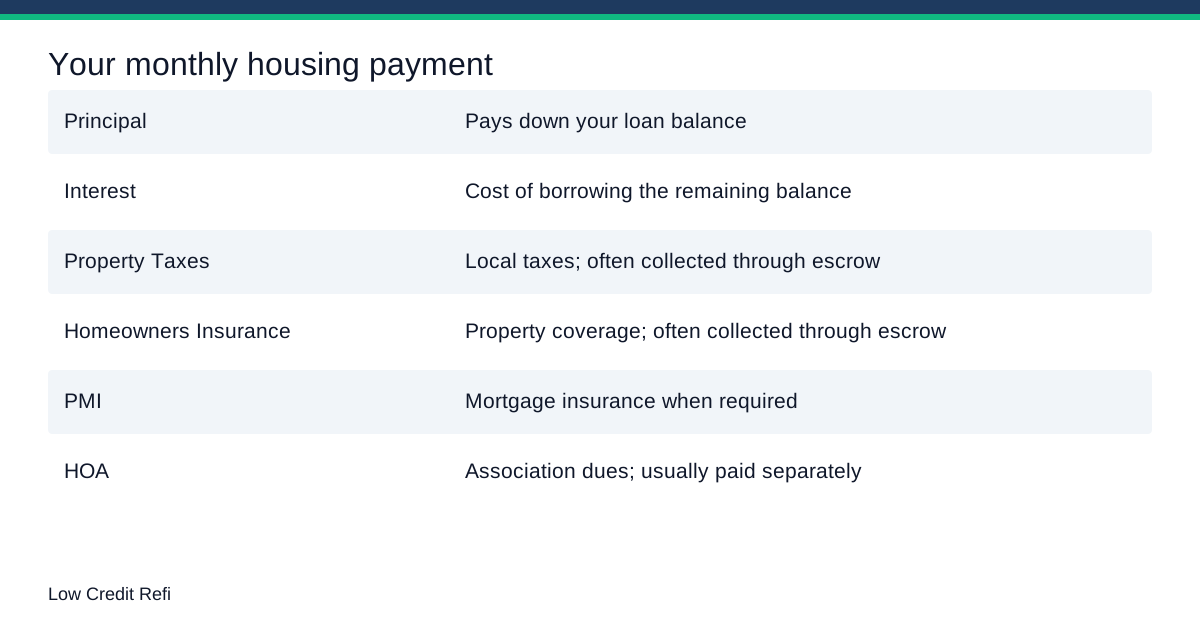
Mortgage insurance cost breakdown: FHA MIP has two components. The upfront MIP is 1.75% of the base loan amount, almost always rolled into the loan balance. The annual MIP for a 30-year loan with LTV above 95% is 0.55% per year (effective for case numbers assigned on or after March 20, 2023, per HUD Mortgagee Letter 2023-05). On a $280,000 loan, that is approximately $128 per month. Critically, if you put less than 10% down — which most 590-score borrowers do at 3.5% — the annual MIP remains for the life of the loan. Unlike private mortgage insurance, it does not automatically cancel when you reach 20% equity.
Pros: Lowest available down payment at this credit tier (3.5%); gift funds fully allowed for down payment; DTI tolerance up to approximately 57% with strong compensating factors; widely available program through many lender types.
Cons: Lifetime MIP at 3.5% down unless you refinance; MIP adds meaningful long-term cost versus conventional; lender overlays require active shopping; rates are typically above conventional equivalents.
Meaningful alternative: If your score reaches 620 before closing, switch to a conventional loan with cancellable PMI — the long-term savings are significant on a 30-year hold.
Want to find FHA lenders who work at 590? Get a free mortgage quote — no hard credit pull required.
Expert Tip
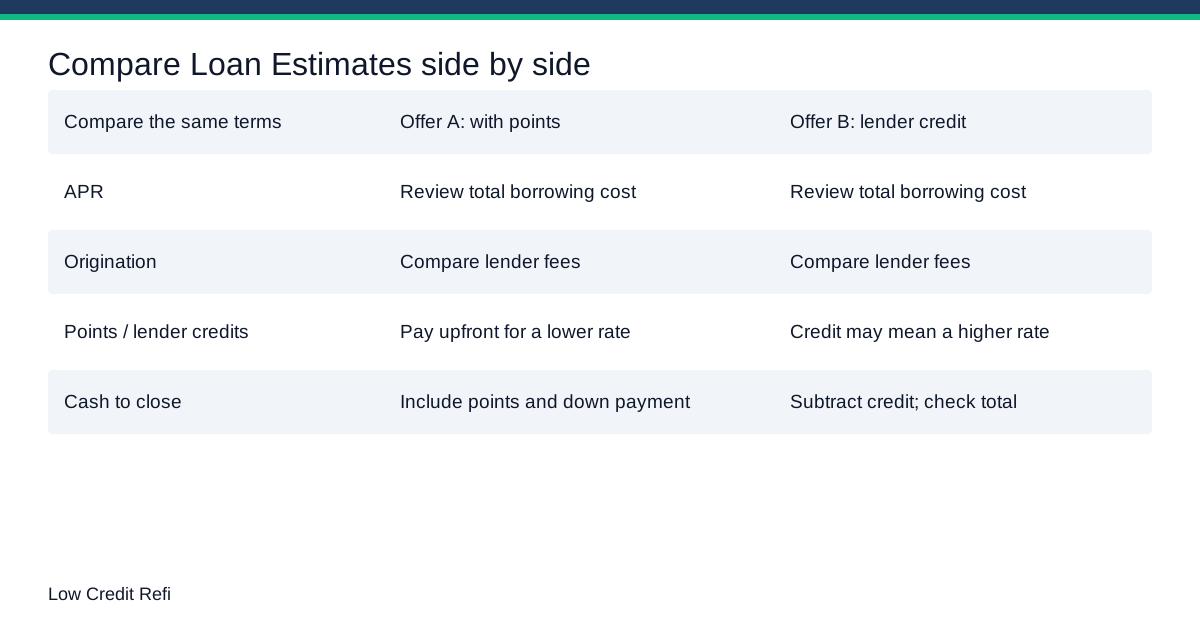
Compare Loan Estimates for the same loan type and term. Include closing costs when calculating whether refinancing saves money.
FHA Cash-Out Refinance at 590
Homeowners sitting on equity who need to access it via refinance have an FHA cash-out path available at 590 — but the conditions are stricter than for a purchase or rate/term refinance, and fewer lenders will go below 620 for this transaction type.
Structural rules under HUD 4000.1: The maximum LTV for an FHA cash-out refinance is 80%, meaning you must retain at least 20% equity in the property after the new loan closes. You must have an uninterrupted 12-month on-time payment history on the existing mortgage. The property must be your primary residence and must pass an FHA appraisal. Condominiums must be in FHA-approved projects.
MIP resets on a cash-out refinance: This is the most frequently overlooked cost. When you execute an FHA cash-out refinance, you trigger a new upfront MIP of 1.75% and restart your annual MIP clock. If your current loan is already an FHA loan, you are paying MIP twice in sequence. If your current loan is conventional and you had reached 20% LTV with no PMI, you are now adding ongoing MIP costs. Model this comparison before proceeding: the cash-out benefit must exceed the lifetime MIP cost on the new loan.
Pros: Access to home equity without needing a 620+ score; government-backed pricing; flexible DTI guidelines versus private lenders.
Cons: MIP resets fully; 80% LTV cap limits extractable cash; lender overlays stricter than purchase — expect 600–640 in practice at most lenders; appraisal required and must support value.
Meaningful alternative: A VA cash-out refinance (if eligible) allows up to 100% LTV and carries no monthly MIP, making it a substantially better option for veteran homeowners with adequate entitlement.
VA Loan (Purchase or IRRRL Refinance) at 590
For eligible veterans, active-duty service members, and surviving spouses, the VA loan is unambiguously the best mortgage program available at a 590 credit score. The VA does not publish an official credit score minimum — lenders must make their own creditworthiness determination per VA Pamphlet 26-7. In practice, most VA lenders set their internal minimum at 580–620, making 590 achievable at a meaningful number of VA-approved lenders.
No monthly mortgage insurance: VA loans carry no PMI or MIP of any kind. Instead, borrowers pay a one-time funding fee. Per the current VA fee schedule (always verify the current rate at VA.gov, as it is subject to change by Congress): first-time use with 0% down is 2.15% of the loan amount; with 5%+ down, 1.5%; with 10%+ down, 1.25%. Subsequent use with 0% down is 3.3%. Veterans with a service-connected disability rating of 10% or higher, Purple Heart recipients with active duty status, and certain surviving spouses are exempt from the funding fee entirely.
VA IRRRL for existing VA loan holders: The Interest Rate Reduction Refinance Loan (IRRRL) is a streamline refinance available only to borrowers who already have a VA-guaranteed loan. It requires no new appraisal and minimal documentation. The funding fee for an IRRRL is 0.5%, rollable into the loan. Some VA IRRRL lenders work with credit scores as low as 550, making this the most accessible refinance path for veterans with damaged credit. The interest rate must be lower than the existing rate (with limited exceptions for moving from ARM to fixed).
Pros: Zero down payment; no monthly mortgage insurance (massive long-term savings); competitive interest rates; IRRRL streamline path for existing VA borrowers; funding fee waived for disabled veterans; residual income analysis rather than rigid DTI cap.
Cons: Eligibility is required — not available to non-veterans; funding fee adds to loan balance; one active VA loan at a time per entitlement (generally); property must meet VA Minimum Property Requirements (MPRs).
Eligible veteran or service member with a 590 score? See if you qualify for a VA loan — get your free consultation today.
USDA Guaranteed Loan at 590
The USDA Single Family Housing Guaranteed Loan Program delivers 100% financing (no down payment required) for eligible rural and suburban properties. For a 590-score borrower, this program is viable but requires navigating a more demanding underwriting process.
Automated vs. manual underwriting — the critical split: USDA's GUS (Guaranteed Underwriting System) automated approval reliably requires 640+. A 590 score will generate a "Refer" finding, which mandates manual underwriting review. Under USDA HB-1-3555, Chapter 10, manual underwriting at 580–639 is permissible but requires: a documented 12-month rental or housing payment history with no late payments, no major derogatory credit events (collections, judgments, or late payments) in the prior 12 months, a housing payment-to-income ratio (PITI) at or below 29%, and a total debt-to-income ratio at or below 41% — absent documented compensating factors that lenders may apply selectively. Borrowers with thin traditional credit files must provide three non-traditional trade references.
Fee structure vs. FHA: USDA charges a 1.0% upfront guarantee fee (rollable into the loan) and a 0.35% annual fee. On a $220,000 loan, the annual fee is $770/year — approximately $64/month. This is substantially lower than FHA's 0.55% annual MIP on the same loan ($101/month), making USDA a better long-term value when the borrower and property qualify.
Eligibility constraints: The property must be in a USDA-designated eligible area. Many suburbs qualify. Verify your address using the USDA Property Eligibility Map. Household income — including all adults in the home — must generally be at or below 115% of the area median income for the county.
Pros: Zero down payment; lower ongoing fees than FHA; 100% financing allows entry without significant savings; available to non-veterans.
Cons: Geographic restriction excludes many urban properties; income limits apply; stricter DTI requirements than FHA; fewer lenders offer manual underwriting at 580–619; longer underwriting timelines.
Meaningful alternative: FHA with 3.5% down is available in all geographies and has more flexible DTI — if you have any down payment savings and are purchasing outside a USDA-eligible area, FHA is the practical choice.
Non-QM / Portfolio Loan at 590
Non-Qualified Mortgages are originated by portfolio lenders that retain the loan on their own balance sheet rather than selling to Fannie Mae or Freddie Mac. This gives them full flexibility to set their own credit standards — many accept scores as low as 500–540 — but borrowers pay a meaningful pricing premium for that flexibility.
The rate premium: Non-QM loans for sub-600-score borrowers typically carry interest rates 2–4 percentage points above conventional market rates. This is a direct function of lender credit risk rather than program structure. For a $250,000 loan, a 3-percentage-point rate premium translates to roughly $430 more per month and over $150,000 in additional interest over a 30-year term relative to a conventional loan. Non-QM is appropriate as a short-term bridge strategy — not as a permanent financing solution — unless agency programs are genuinely unavailable.
Common non-QM products at this tier: Bank statement loans (designed for self-employed borrowers), DSCR (debt-service coverage ratio) loans for investment properties, asset depletion/asset dissipation loans, and hard-money bridge loans for renovation or time-constrained purchases. Down payments typically start at 10–20% depending on LTV tier and credit tier.
Pros: Accessible when agency loans are unavailable; no income limits or geographic restrictions; flexible documentation options for non-W2 borrowers; can close quickly.
Cons: Substantially higher rate; higher down payment requirement; less regulatory protection than agency loans; carries real risk of payment shock if used as a permanent solution.
Meaningful alternative: Use non-QM only as a bridge — plan an 18–24 month credit improvement cycle and refinance into FHA or conventional once score and equity align.
What Matters Beyond the Headline Numbers
The Lender Overlay Problem Is the Central Challenge at 590
The most consequential concept for any 590-score applicant is the distinction between an agency guideline and a lender overlay. HUD publishes a 580 floor. The lender your real estate agent recommends may internally require 620. Both statements are simultaneously true and non-contradictory — lenders bear origination risk and can set their own minimums above the agency floor.
The practical implication is unambiguous: you must contact multiple lenders before concluding that FHA financing is unavailable at your score. Mortgage brokers with wholesale lender access, CDFIs (community development financial institutions), credit unions, and online non-bank lenders are consistently more likely to work at 580–619 than large retail bank branches. Getting a denial from one source is data — not a verdict on the entire market.
FICO Score vs. VantageScore: Which Score Actually Matters for Mortgages?
Mortgage lenders use mortgage-specific FICO score versions — FICO Score 2 (Experian), FICO Score 4 (TransUnion), and FICO Score 5 (Equifax). The lender pulls a tri-merge credit report and uses the middle score of the three for eligibility and pricing decisions. On joint applications, the lower of the two borrowers' middle scores controls.
The score you see on Credit Karma, your bank app, or most free monitoring services is typically VantageScore 3.0 or 4.0 — a different scoring model that can diverge from your mortgage FICO score by 20–40 points in either direction. A borrower who sees 605 on Credit Karma may have a mortgage FICO of 588, and vice versa. Before applying, obtain your actual mortgage FICO scores from myFICO.com or ask your lender to run a soft-pull pre-qualification that discloses the tri-merge FICO results.
Debt-to-Income Ratio: Your Second Most Important Number at 590
With a below-average credit score, your debt-to-income ratio becomes a critical compensating or disqualifying factor. FHA's automated approval supports up to 43% total DTI; with strong compensating factors — such as 3+ months of reserves, no increase in housing payment, or residual income above VA thresholds — FHA permits total DTI as high as approximately 57%. USDA manual underwriting caps total DTI at 41% without documented compensating factors. VA has no published hard DTI cap but requires positive "residual income" — monthly net income remaining after housing and all debt obligations. A 590-score borrower who is already at maximum DTI has significantly fewer available programs than one with a 38% DTI and some reserves, even at identical credit scores.
The 620 Threshold Decision: Wait or Proceed Now?
A borrower sitting at 590 is exactly 30 points from the conventional mortgage threshold — a distance that is bridgeable in 60–120 days with targeted action for many borrowers. The primary credit improvement levers are: (1) reducing revolving credit card utilization below 30% — ideally below 10% — which directly affects the second-most-weighted FICO factor; (2) disputing inaccurate items on the credit report, which can produce rapid point gains; and (3) becoming an authorized user on an established, low-balance account held by a family member.
The financial benefit of crossing 620 is not marginal. Conventional PMI cancels automatically at 80% LTV under the Homeowners Protection Act. FHA MIP at 3.5% down does not. On a $280,000 FHA loan with 0.55% annual MIP, you would pay approximately $1,540 per year in MIP until you refinance or sell — and if the loan runs for 15+ years without a refinance, the cumulative MIP cost is substantial. If your purchase or refinancing is not time-sensitive, the 60-to-120-day wait is frequently the most financially sound decision.
Authoritative Guidance & Official Standards
- HUD Single Family Housing Policy Handbook 4000.1 (HUD.gov) — the official governing document for all FHA-insured mortgages. Sets the published 580 credit score minimum for 3.5% down, defines MIP rate schedules, and establishes underwriting standards including DTI allowances and compensating factor criteria.
- CFPB Mortgage Tools & Resources (consumerfinance.gov) — the Consumer Financial Protection Bureau's mortgage comparison tools, rate checker, and borrower rights guides. Covers ECOA fair lending protections, TRID disclosure requirements, and HMDA data that benchmarks approval rates by credit tier.
- VA Home Loans (VA.gov) — official VA loan eligibility requirements, Certificate of Eligibility application portal, current funding fee schedule, VA lender locator, and program guidance for veterans, active-duty service members, and surviving spouses.
- USDA Guaranteed Loan Program (rd.usda.gov) — official program page with income limits by county, USDA property eligibility map, technical handbook links, and the list of USDA-approved lenders offering guaranteed loans.
- FTC: Understanding Your Credit Scores (FTC.gov) — Federal Trade Commission guidance on FICO scoring factors, your right to dispute inaccurate information under the Fair Credit Reporting Act, and free annual credit report access at AnnualCreditReport.com.
- FHFA Mortgage Market Data (FHFA.gov) — Federal Housing Finance Agency data on conforming loan limits by county, aggregate approval rates by credit tier, and Fannie Mae and Freddie Mac guideline updates that define the 620 conventional credit score floor.
Questions to Answer Before Deciding (FAQ)
Can I actually get approved for a mortgage with a 590 credit score in 2026?
Yes — but the process requires more active lender shopping than it does for borrowers above 620. FHA loans are available at 590 per HUD guidelines, and VA loans are available for eligible veterans at most VA lenders. The primary obstacle is lender overlays: individual lenders set their own internal minimums above the agency floor, and many mainstream FHA lenders require 620 or higher in 2026. HMDA data consistently records FHA loan approvals in the 580–599 credit score tier every year — the approvals happen, but they require finding the right lender channel. Contact at least four to five lenders including independent mortgage brokers before concluding the market is closed to you at 590.
What steps should I take to qualify for a 600+ credit score home loan if I'm currently at 590?
Six targeted actions can move many borrowers from 590 to 600–620 within 60–120 days. First, pull your actual mortgage FICO tri-merge scores (not VantageScore) and read the specific reason codes — these tell you exactly which factors are suppressing your score. Second, pay down revolving credit card balances to below 30% utilization on every card and below 10% on the card with the highest balance; this is typically the fastest-acting lever. Third, file disputes for any factually inaccurate items at AnnualCreditReport.com under FCRA Section 611 rights. Fourth, request a credit limit increase on existing cards without opening new accounts — this reduces your utilization ratio without a hard inquiry on some issuers. Fifth, ask a family member with excellent credit history to add you as an authorized user on a long-standing, low-balance account. Sixth, avoid all new credit applications for at least 90 days before your mortgage application, as hard inquiries suppress scores temporarily.
How much more will I pay in interest at a 590 score versus a 640 score?
The precise rate differential depends on current market conditions, lender, loan program, and loan size — all of which are volatile and should be quoted fresh at time of application. As a structural benchmark, FICO's published Loan Savings Calculator and CFPB research consistently show that each 20-point credit score band carries a measurable rate premium, with the gap widening below 640. On a 30-year loan of $280,000, a half-percentage-point rate difference (a conservative estimate of the 590-vs-640 spread in many lender pricing grids) equates to roughly $80–90 more per month and over $28,000 in additional total interest over the loan term. This is the mathematical case for spending 60–90 days on credit improvement before locking a rate if circumstances permit.
Will FHA mortgage insurance end up costing more than conventional PMI?
For most borrowers putting 3.5% down with a 590 score, yes — on a long-term hold, FHA MIP is more expensive than conventional PMI would be at a higher credit tier. The key structural difference: conventional PMI cancels automatically when LTV reaches 80% (Homeowners Protection Act, 12 U.S.C. § 4901 et seq.). FHA MIP on a loan with original LTV above 90% lasts for the life of the loan and can only be eliminated by refinancing into a conventional product. However, a 590-score borrower is unlikely to qualify for conventional PMI at competitive rates — so the practical comparison is FHA MIP now versus FHA MIP until refinance is possible. Model the break-even of an eventual conventional refinance by estimating how long it will take to reach 620+ credit and 20% equity, then weigh that against current closing costs of 2–5% to refinance.
Does adding a co-borrower with a higher credit score improve my approval odds?
Yes — with an important nuance that surprises many borrowers. A co-borrower's income does count toward the maximum qualifying loan amount, and their additional assets can strengthen the reserves picture. However, for FHA loan eligibility and rate determination, the lender uses the lower of the two borrowers' middle FICO scores as the controlling credit score. Per HUD Handbook 4000.1 Section II.A.1.b, if you have a 590 and your co-borrower has a 700, the 590 is the score used for MIP pricing and minimum credit qualification — the higher score does not average or offset the lower one. A co-borrower with a strong score helps most when their income is needed to satisfy DTI requirements or when their reserves are needed for compensating factors, not as a direct substitute for your own credit qualification.
Can I refinance out of FHA later to eliminate the mortgage insurance?
Yes — and for most 590-score borrowers who start with FHA at 3.5% down, this is exactly the long-term plan. Once your credit score reaches 620 or above and your LTV reaches 80% (through appreciation, principal paydown, or both), you can refinance into a conventional loan and eliminate MIP permanently. Many borrowers execute this transition in year three to year five of homeownership, depending on local appreciation rates. The key discipline: track your equity and credit score simultaneously, and begin shopping refinance rates as soon as you approach both thresholds. Closing costs for a refinance typically run 2–5% of the loan amount, so model the monthly savings against the upfront cost to identify your break-even timeline before committing.
Related Guides
- FHA Refinance with a 580 Credit Score: 2026 Requirements & Lender Guide — a deep dive into FHA rate/term and cash-out refinance requirements for borrowers at and near the agency credit floor, including which lenders realistically go below 620.
- VA Loan with a Low Credit Score: What Veterans Need to Know in 2026 — covers VA lender overlay ranges, IRRRL streamline eligibility for existing VA borrowers, funding fee waiver qualifications, and how to locate VA lenders who work at 580–619.
- Steps to Qualify for a 600 Credit Score Home Loan in 2026 — the tactical 90-day playbook for moving a score from 580–599 to 600–620 and unlocking better mortgage programs, including utilization management, dispute strategy, and authorized user timing.
- Mortgage Refinance Rates for Bad Credit: 2026 Comparison Guide — compares refinance rate premiums by credit tier across FHA, VA, USDA, and non-QM programs, with guidance on timing a refinance to minimize total cost.
The Bottom Line
A 590 credit score is a specific set of coordinates on the mortgage map — not a dead end. It qualifies you for FHA financing at 3.5% down (the most widely available path), for VA financing with no down payment and no monthly MIP if you served, and for USDA 100% financing if your property and income are in the eligible range. It does not qualify you for conventional Fannie Mae or Freddie Mac financing, which requires 620.
The most important strategic decision at 590 is whether to proceed now or invest 60–90 days in a targeted credit sprint to reach 620. If your situation is time-sensitive — a contract expiration, a refinance need to lower a high-rate loan, or rising property values in your target market — proceed immediately through FHA or VA and plan a future conventional refinance. If you have flexibility, the 30-point gap is worth closing first: conventional PMI is cancellable, FHA MIP at 3.5% down is not, and the rate differential compounds meaningfully over 30 years.
Either way, the most consequential action is the same: shop multiple lenders, including mortgage brokers with wholesale access, who are known to work at 580–619. A single bank's overlay is not the market's answer to your application.
Your next step: Get a free mortgage rate quote with no hard credit pull — find out which programs you qualify for based on your actual FICO score, income, and refinancing or purchase goals. It takes under five minutes and carries no obligation.
Key Takeaways
- Understanding your options for 590 credit score mortgage is the first step
- Getting pre-qualified helps you understand your real options