
Quick answer: For most borrowers with a 580–620 credit score, partnering with a licensed mortgage broker who has access to FHA wholesale lenders delivers the broadest lender coverage, the best chance of clearing a lender's internal credit overlay, and competitive pricing in a single application cycle. The core trade-off is that the resulting loan will be serviced by a lender you do not choose, and broker compensation (typically 1–2% of the loan, often lender-paid) adds to the closing cost picture. Veterans with an existing VA loan should bypass all other options and go directly to a VA-approved lender for an IRRRL — the VA's Interest Rate Reduction Refinance Loan — which carries a reduced 0.5% funding fee and rarely requires an appraisal. Borrowers who are already established credit union members should obtain that institution's offer before shopping further.
How We Evaluate & Compare Options
This guide evaluates five categories of mortgage refinancing providers using published data from the Consumer Financial Protection Bureau (CFPB), U.S. Department of Housing and Urban Development (HUD), the Department of Veterans Affairs (VA), and the National Credit Union Administration (NCUA). Each provider type is scored on six criteria that matter most to 580–620 credit score borrowers: minimum accepted credit score (including typical lender overlays), rate premium over prime, key upfront costs, underwriting flexibility, product availability, and practical access speed.
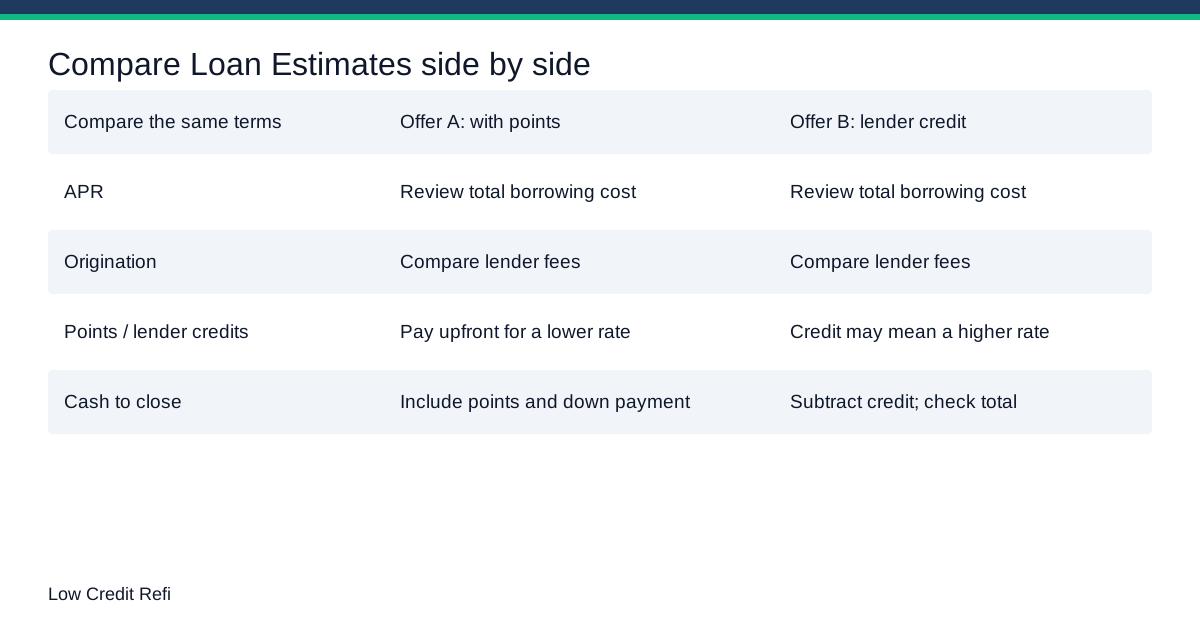
We do not conduct first-party loan applications, secret shopping, or lender audits. Rates quoted throughout reflect published credit-score-based pricing structures — Fannie Mae and Freddie Mac Loan-Level Price Adjustments (LLPAs) and HUD-published MIP schedules — not real-time market quotes, which shift daily. Before accepting any offer, request a Loan Estimate: the standardized three-page disclosure the CFPB requires every lender to provide within three business days of application. That document is your authoritative comparison tool, not a lender's verbal quote.
When considering how to choose the right mortgage refinancing provider, you should understand all available options.
| Provider Type | Minimum Credit Score (Typical Overlay) | Rate vs. Prime Borrower | Key Upfront Cost | Best For | Underwriting Flexibility |
|---|---|---|---|---|---|
| FHA-Approved Bank or Direct Lender | 580 per HUD; many lenders set internal overlay at 600–620 | +0.25–0.75% on rate; annual MIP of 0.55% adds to total cost | 1.75% upfront MIP financed into loan, plus standard closing costs | Borrowers who want a direct lender relationship and qualify under FHA DTI and equity guidelines | Moderate — FHA allows DTI up to 57% with documented compensating factors |
| VA-Approved Lender (IRRRL) | VA sets no minimum; most VA lenders require 580–620; disabled-veteran waiver on funding fee | Generally at or near prime rates; no MIP ever | 0.5% VA funding fee for IRRRL; waived entirely for veterans with service-connected disability | Veterans or active-duty service members with an existing VA loan seeking a lower rate or ARM-to-fixed conversion | High — no appraisal or income re-verification typically required for a streamline IRRRL |
| Non-QM / Portfolio Lender | 580+ with compensating factors; criteria vary widely by lender — confirm before applying | +1.0–2.5% above conforming rates; prepayment penalties possible — verify in writing | Origination fees and structures vary; prepayment penalties are legal on non-QM loans — always check | Borrowers outside agency guidelines: high DTI, self-employment, recent short sale or bankruptcy, or multiple investment properties | Very high — lender sets all criteria; alternative income documentation accepted |
| Credit Union | Varies by institution; many accept 580+ for established members with a relationship history | Typically 0.1–0.25% below comparable bank rates per NCUA published data | Origination fees often reduced or waived for long-standing members | Existing members with stable deposit history and a relationship that predates the loan application | Moderate to high — manual underwriting common; member banking history considered as compensating factor |
| Mortgage Broker (Multi-Lender Access) | 580+ — broker matches borrower to the lender whose overlay fits the specific profile | Competitive — broker shops wholesale lenders simultaneously; best price incentive is structural | 1–2% broker fee, often lender-paid; must be disclosed on Loan Estimate under Origination Charges | Borrowers with complex or non-prime profiles who need overlay-matched lender access in a single application cycle | Highest access — single application reaches 20–50+ wholesale lenders with varying overlays |
Compared Options
Option 1: FHA-Approved Bank or Direct Lender
FHA refinancing is the most widely accessible path for 580–620 borrowers in 2026. HUD's published guidelines permit a rate-and-term refinance at a minimum 580 FICO score up to a 97.75% loan-to-value ratio. For a cash-out FHA refinance, HUD caps the LTV at 80%, meaning you need at least 20% equity to extract cash.
Why FHA often beats conventional for this credit tier comes down to LLPA math. Fannie Mae and Freddie Mac apply Loan-Level Price Adjustments that add between 1.75 and 3.75 discount points (or their rate equivalent) for borrowers in the 580–619 credit range across various LTV bands. FHA's structure largely bypasses LLPAs. The offset is the Mortgage Insurance Premium (MIP): HUD currently charges 1.75% upfront (which can be financed) and 0.55% annually for most standard loan terms. On a $250,000 loan, the annual MIP is $1,375. Borrowers who put down less than 10% on the original FHA purchase loan cannot cancel MIP regardless of equity buildup — that cost persists for the loan's life unless you refinance out of FHA once your score improves.
Pros: Broadly available; standardized HUD guidelines reduce lender-to-lender variation; FHA Streamline Refinance reduces documentation burden for existing FHA borrowers; DTI flexibility up to 57% with compensating factors.
Cons: Lifetime MIP for most low-equity borrowers; lender overlays commonly push the practical minimum to 600 or 620; upfront MIP adds to loan balance.
Meaningful alternative: If your credit score reaches 620–640 before you close, pull conventional quotes alongside your FHA quote — at those thresholds the LLPA cost may be lower than the projected lifetime MIP you would pay under FHA.
Get your free FHA refinancing rate quote — no commitment, and no hard credit pull required to see initial rate estimates.
Expert Tip
Compare Loan Estimates for the same loan type and term. Include closing costs when calculating whether refinancing saves money.
Option 2: VA-Approved Lender (IRRRL)
For eligible borrowers, the VA IRRRL is categorically superior to every other refinancing product available in 2026. The VA does not set a credit score floor for the IRRRL; the program qualifies based on your on-time payment record on the existing VA loan — typically 12 consecutive on-time payments, or as few as six months for newer loans. Individual VA-approved lenders impose overlays (often 580–620), but the absence of an agency-mandated minimum means the practical threshold is negotiable through broker shopping.
The IRRRL's funding fee is 0.5% of the loan balance — compared to 2.15% for a first-time-use VA purchase loan — and it is waived entirely for veterans with a service-connected disability rating. No appraisal is required in most IRRRL transactions, and lenders may waive income and employment re-verification entirely, making this the fastest and lowest-cost streamline product in the market. There is no mortgage insurance premium, ever, on VA loans.
Pros: Near-prime rates with no MIP; funding fee waived for disabled veterans; minimal documentation; fastest closing path for existing VA loan holders.
Cons: Strictly limited to veterans, active-duty service members, and qualifying surviving spouses with an existing VA loan; a net tangible benefit must be documented (typically a lower rate or conversion from adjustable to fixed); cash-out transactions require a full VA Cash-Out Refinance, not an IRRRL.
Meaningful alternative: Veterans who need cash out or whose existing loan is not a VA loan should explore FHA refinancing alongside a VA Cash-Out Refinance quote, which does require full credit and income underwriting.
Check your VA IRRRL eligibility and get a free rate consultation — licensed VA loan specialists available now.
Option 3: Non-QM / Portfolio Lender
Non-Qualified Mortgage lenders hold loans on their own balance sheet rather than selling to Fannie Mae or Freddie Mac, which frees them from agency credit overlays and allows genuinely flexible underwriting. This makes them the practical option of last resort when a borrower has a 580–620 score compounded by additional risk factors: a debt-to-income ratio above 50%, income from self-employment or 1099 sources, a recent bankruptcy discharge within two years, or multiple financed investment properties.
The rate premium is real and should be modeled carefully. Non-QM rates typically run 1.0–2.5 percentage points above conforming rates. On a $250,000 balance at a 2% premium, that differential costs approximately $5,000 in additional interest annually. Before accepting a Non-QM offer, exhaust FHA manual underwriting (which allows up to 57% DTI with compensating factors) and credit union options. If Non-QM is the only viable path, verify the prepayment penalty clause on page one of your Loan Estimate under "Loan Terms" — these fees are legally permitted on non-QM loans under CFPB Regulation Z, can run 3–5% of the loan balance in year one, and are fully enforceable.
Pros: Most flexible underwriting available; bank-statement income programs accommodate self-employed borrowers; approves profiles that all agency options decline.
Cons: Significantly higher rates; potential prepayment penalties; less regulatory standardization means quality varies widely — due diligence on lender licensing is essential.
Meaningful alternative: If your core challenge is a high DTI rather than your credit score or income type, FHA manual underwriting should be attempted first — it is substantially cheaper for borrowers who qualify.
Option 4: Credit Union
Credit unions are member-owned financial cooperatives regulated by the NCUA. Because they are structured as not-for-profit entities, they return earnings to members through lower rates and reduced fees rather than distributing profits to outside shareholders. NCUA published data demonstrates that credit union first-mortgage rates average approximately 0.1–0.25 percentage points below comparable bank rates — a modest but meaningful advantage on a 30-year loan where every eighth of a point matters.
For borrowers in the 580–620 range, the distinctive credit union advantage is relationship underwriting. A credit union loan officer can incorporate your deposit history, direct-deposit tenure, and savings pattern into the credit decision as documented compensating factors — information that does not appear in a FICO score. This is especially useful when a low score reflects a single resolved medical collection or a discrete financial hardship rather than chronic mismanagement. Many credit unions also offer manual underwriting as a standard option, which explicitly allows a human underwriter to weigh factors outside the automated approval model.
Pros: Rate advantage over banks; manual underwriting common; relationship history used as a compensating factor; lower origination fees for established members.
Cons: Membership required (eligibility criteria vary by institution); product range narrower than large banks or brokers; not all credit unions offer FHA or VA loan programs.
Meaningful alternative: If you are not an existing member with at least 12 months of account history, the time required to establish membership eligibility makes a mortgage broker with FHA wholesale access a faster path to comparable flexibility and pricing.
Option 5: Mortgage Broker (Multi-Lender Access)
A licensed mortgage broker does not originate loans from its own capital. Instead, the broker submits your complete loan file to multiple wholesale lenders simultaneously, returns competing Loan Estimates, and helps you select the best offer. For 580–620 borrowers specifically, this model is structurally optimal because it solves the lender-overlay problem at scale. Lender overlays — the internal credit minimums lenders add above published FHA or VA floors — vary enormously and change frequently. One wholesale FHA lender may approve at 580 with a 52% DTI; a second lender may require 620 and cap DTI at 45%. A broker with 30+ wholesale relationships can identify which lenders are actively approving your exact profile on any given week.
CFPB research through its Owning a Home initiative documents that borrowers who obtained at least three competing mortgage quotes saved a median of approximately $1,500 in interest over the first five years of their loan compared to borrowers who accepted the first quote offered. Brokers deliver this comparison outcome in a single application process, without multiple hard credit pulls if all lender inquiries fall within the 45-day rate-shopping window that FICO models recognize as a single inquiry. Broker compensation is regulated: for QM loans, total origination charges are capped under CFPB Regulation Z, and the broker fee must be disclosed on your Loan Estimate under "Origination Charges."
Pros: Broadest market access in one application; best solution for overlay-matching; competitive pricing incentive is structural; can navigate complex profiles most direct lenders decline.
Cons: Loan serviced by a lender the borrower does not select; broker quality varies significantly — license verification is mandatory before sharing financial documents; broker fee may be marginally higher than going direct in straightforward cases.
Meaningful alternative: Borrowers who have an existing offer from their current loan servicer should bring that offer to a broker for a direct comparison before accepting — servicer retention offers are often not the institution's best available rate.
Request a free provider-matching consultation — a licensed specialist will review your credit tier, equity position, and loan goals at no cost or obligation.
What Matters Beyond the Headline Numbers
Lender Overlays: The Hidden Variable for 580–620 Borrowers
The single most consequential concept for credit-challenged refinance applicants to internalize is the lender overlay. FHA publishes a 580 minimum credit score, but the FHA does not underwrite individual loans — approved private lenders do, and they bear first-loss risk before FHA insurance activates. As a result, a large portion of FHA-approved lenders set internal minimums of 600 or 620 even on FHA products. This is why borrowers with 590 scores sometimes receive denials they interpret as FHA rejections: they are lender-specific rejections, not program rejections. The universe of lenders willing to approve at 580–599 exists and is accessible — primarily through brokers and by consulting HUD-approved housing counselors — but it requires active navigation that most borrowers are never told is necessary.
The Break-Even Point: Does Refinancing Make Financial Sense Right Now?
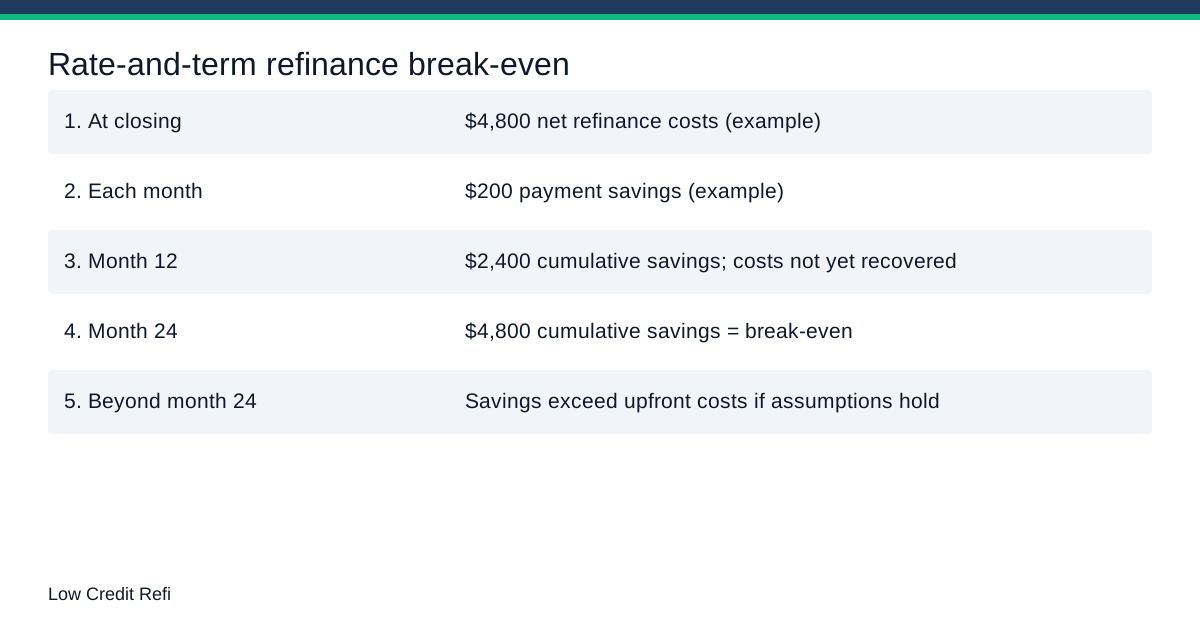
Every refinance incurs closing costs — typically 2–5% of the loan balance — and resets your amortization clock. On a $240,000 loan, closing costs of 3% amount to $7,200. If a new loan reduces your monthly payment by $180, your break-even is 40 months (three years and four months). If you plan to sell or move before that point, refinancing costs you money on a net basis. The CFPB's online rate explorer at consumerfinance.gov/owning-a-home/explore-rates/ includes a break-even modeling tool that lets you input your loan balance, current rate, projected new rate, and expected tenure to calculate whether the transaction makes financial sense before you apply anywhere.
Servicer Continuity and Prepayment Penalty Risk
The majority of refinanced loans are sold on the secondary market within 30–90 days of closing. Your new servicer may differ from the originating lender and may have different policies on escrow disbursement, payment grace periods, and hardship accommodations. For non-QM loans specifically, contractual prepayment penalties — fees charged if you pay off the loan within a defined period — are legally permitted and common. Under CFPB Regulation Z, prepayment penalties are prohibited after three years on QM loans and are capped in total fees, but non-QM loans operate under separate standards. Always verify the "Prepayment Penalty" field on page one of your Loan Estimate before signing any non-QM application. If a lender delays or obscures this disclosure, treat that behavior as a disqualifying red flag.
Steps to Qualify for a 600 Credit Score Home Loan Refinance
The credit score thresholds with the highest practical impact in 2026 are 580 (FHA program floor), 600 (the overlay threshold used by a large share of FHA lenders), and 620 (the conventional loan baseline). A borrower at 596 is closer to a meaningfully different lending universe than the raw distance of four points suggests. Three documented actions consistently move FICO scores 10–25 points within 30–45 days: disputing inaccurate or unverifiable negative tradelines through the major bureaus (Equifax, Experian, TransUnion) under FCRA rights, paying current revolving balances below 30% of each account's credit limit (targeting the amounts-owed component, which accounts for approximately 30% of a FICO score), and ensuring no accounts slip to 30-day-late status during the application window. For a borrower at 596 whose primary obstacle is a single lender's 600 overlay, these short-term actions frequently deliver the necessary points within a single billing cycle. The delay cost of waiting 45 days to apply at a better credit tier is often offset within months by a lower rate on a 30-year loan.
Authoritative Guidance & Official Standards
The following official sources directly govern mortgage refinancing eligibility, disclosures, and consumer rights for borrowers in the 580–620 credit tier:
- CFPB — Owning a Home: Explore Interest Rates: The CFPB's interactive tool visualizes how credit score tiers affect available rates using real lender data and explains the standardized Loan Estimate form every lender must deliver within three business days of application. Essential first stop for any refinance comparison.
- HUD — FHA Single Family Housing Policy Handbook: Governs all FHA loan eligibility requirements, including minimum credit scores, the current MIP schedule, DTI limits, streamline refinance parameters, and documentation standards. Use this to verify what HUD actually requires versus what a specific lender claims.
- VA.gov — Interest Rate Reduction Refinance Loan: Official VA guidance on IRRRL eligibility, net tangible benefit requirements, the current 0.5% funding fee schedule, and the disability waiver. Authoritative for any veteran evaluating a VA Streamline Refinance.
- NCUA — The Credit Union Difference: Explains the regulatory structure, member-ownership model, and published rate comparison data that underpins credit unions' position in the mortgage market. Useful for evaluating a credit union offer against bank and broker alternatives.
- FTC — Mortgage Consumer Information: Covers fair lending rights, prohibited discrimination under the Equal Credit Opportunity Act and Fair Housing Act, and how to identify predatory lending practices. Particularly relevant for 580–620 borrowers who may be targeted with above-market offers by less scrupulous lenders.
Questions to Answer Before Deciding (FAQ)
Does my credit score alone determine which lender type I should use?
Your credit score is the entry filter, not the full picture. A 602 score means very different things to a lender depending on your accompanying loan-to-value ratio, debt-to-income ratio, and the reason for the score's location. A 602-score borrower with a 58% LTV, stable W-2 employment, and one resolved medical collection presents a materially lower risk profile than a 602-score borrower with a 90% LTV and two currently delinquent accounts. The first borrower has real options across FHA lenders, credit unions, and brokers. The second may need a Non-QM lender or a period of credit repair before refinancing is cost-effective. Knowing why your score is where it is — and documenting it — is as important as the number itself.
Will applying to multiple lenders hurt my credit score?
No, if you apply within a 45-day window. FICO's scoring model treats multiple mortgage-related credit inquiries within a 45-calendar-day period as a single inquiry for scoring purposes, regardless of how many lenders pull your credit. This means you can apply to five, ten, or fifteen lenders in that window and your score will reflect only one inquiry event. CFPB research documents that borrowers who obtained five competing quotes rather than one saved a median of approximately $3,000 in interest over the first five years of their loan. The 45-day window exists specifically to encourage this kind of comparison shopping — use the full window aggressively.
What is a lender overlay, and how do I find out a lender's actual minimum credit score?
A lender overlay is an internal credit policy — typically a higher minimum credit score, lower maximum DTI, or additional reserve requirement — that a lender adds above a program's published guidelines. Because overlays are proprietary, lenders are not required to publish them, and they can change weekly based on the lender's capital position, secondary market conditions, or recent default experience. The most efficient way to identify overlay-friendly lenders for your specific credit profile is to work with a mortgage broker whose wholesale lender network spans 20 or more institutions. Alternatively, HUD-approved housing counselors (searchable at hud.gov) can identify FHA-approved lenders active in your credit tier at no cost to you.
Should I improve my credit score before refinancing, or apply now?
Apply the break-even test to both timelines simultaneously. If a targeted 10-point improvement (achievable in 30–45 days by reducing revolving utilization below 30%) would move your rate from 7.25% to 6.875% on a $230,000 loan, that difference saves approximately $805 per year. Against the cost of six months of payments at the higher rate before the improvement activates, the math strongly favors delaying by 30–45 days, not six months. The tipping-point actions with the fastest credit score payoff are: paying revolving balances below 30% of each card's limit, disputing inaccurate negative items through the credit bureaus, and ensuring zero new late payments during the application period. If you are more than 20 points below the threshold you need, work with a HUD-approved counselor who can build a realistic timeline before you spend money on application fees.
What documents do I need to refinance with a 580–620 credit score?
For a standard FHA rate-and-term refinance, expect to provide: two years of W-2s and federal tax returns, 30 days of current pay stubs, two months of bank and asset account statements (all pages), your current mortgage statement, homeowners insurance declaration page, and a government-issued photo ID. Self-employed borrowers and those using Non-QM bank-statement programs substitute 12–24 months of personal and business bank statements for the W-2s and pay stubs. FHA Streamline and VA IRRRL refinances require substantially less — in many cases only the current mortgage statement and proof of employment status — because they do not require full income re-underwriting. Clarify documentation requirements with each lender before investing time in a full application package, particularly for Non-QM programs where requirements vary significantly.
How do I verify a mortgage broker or lender is legitimately licensed before sharing my financial information?
Every mortgage loan originator operating in the United States must hold an active license under the Secure and Fair Enforcement for Mortgage Licensing Act (SAFE Act). You can verify any individual's or company's license status, state registrations, and disciplinary history at no cost through the NMLS Consumer Access database. Enter the originator's name or their NMLS ID number (which they are required to disclose on all advertising and loan documents). Confirm the license is active in your state and that no disciplinary actions are pending. The CFPB's consumer complaint portal at consumerfinance.gov/data-research/consumer-complaints/ and the FTC's complaint database allow you to research complaint history before you apply. Never provide your Social Security number, tax returns, or bank statements to an originator you have not verified through NMLS.
Related Guides
- 590 Credit Score Mortgage: Your Complete 2026 Guide to Loan Options — detailed breakdown of available loan programs, rate expectations, and lender landscape for borrowers at the 590 mark.
- Streamline Refinance No Credit Check: The Complete 2026 Guide — how FHA Streamline and VA IRRRL reduce documentation and credit requirements for borrowers who already hold a government-backed loan.
- Mortgage Refinancing Cost & Pricing Guide: The Complete 2026 Breakdown for 580–620 Credit Scores — every closing cost line item explained, with break-even calculation methodology for non-prime borrowers.
- Steps to Qualify for a 600 Credit Score Home Loan in 2026 — the targeted qualification roadmap for borrowers at or within striking distance of the 600 threshold, including credit-building timelines.
The Bottom Line
For the majority of 580–620 credit score borrowers seeking a mortgage refinance in 2026, the decisive recommendation is straightforward: start with a licensed mortgage broker who has FHA wholesale lender access. This single approach delivers the broadest overlay-matching coverage, eliminates the need for multiple separate applications, and introduces structural pricing competition — all benefits that matter more at this credit tier than at any other. The key trade-off remains servicer selection: you will not choose who collects your payment after closing, and broker quality varies — verify NMLS licensure before sharing a single financial document.
Veterans with an existing VA loan should treat the IRRRL as a non-negotiable first step before evaluating any other option. Its rate advantage, reduced funding fee, streamlined documentation, and permanent absence of mortgage insurance make it categorically superior for eligible borrowers regardless of where their credit score falls in the 580–620 range. Existing credit union members with a documented banking relationship should request that institution's offer as a benchmark, then compare it against a broker quote to confirm they are seeing the market's competitive rate.
The next concrete step costs nothing: pull your credit report for free at AnnualCreditReport.com — the only federally authorized free report source — identify any disputable negative items or high-utilization balances addressable within 30 days, then submit your refinancing applications within a single 45-day window to protect your score. Your first rate quote is free, takes minutes, and reveals exactly where you stand in today's lending environment.
Take the first step now: Get your free refinancing rate quote — no commitment, no hard credit pull to start, results in minutes from licensed specialists who work exclusively with 580–620 credit score borrowers.
Key Takeaways
- Understanding your options for how to choose the right mortgage refinancing provider is the first step
- Getting pre-qualified helps you understand your real options