Compare Live Mortgage & Home Equity Rates
Compare current APRs, points, fees, and estimated monthly payments from participating lenders below.
Mortgage rates
VA IRRRL vs FHA Streamline for Borrowers With Poor Credit: Your Complete Guide to Refinancing
Quick Answer: For borrowers with credit scores between 580 and 620, both VA IRRRL and FHA Streamline refinances offer accessible options. The VA IRRRL requires no minimum credit score from the VA, focusing on 12 months of on-time payments, while FHA Streamline accepts scores as low as 580. Your eligibility depends on your current loan type and payment history, not solely your credit score.
If you're comparing VA IRRRL vs FHA Streamline for Borrowers With Poor Credit, you need to understand one critical fact: both programs offer pathways to lower monthly payments even if your credit score sits between 580 and 620. The VA Interest Rate Reduction Refinance Loan (IRRRL) requires existing VA loan holders to have made on-time payments for the past 12 months but typically doesn't have a minimum credit score requirement. The FHA Streamline Refinance accepts credit scores as low as 580 for most lenders, requires six months of on-time payments, and doesn't require a new appraisal. Your eligibility depends on your current loan type, military service status, and payment history rather than your credit score alone. Both programs are specifically designed to help borrowers with imperfect credit reduce their interest rates and monthly payments without the stringent requirements of conventional refinancing.
Understanding Your Refinancing Options With a 580-620 Credit Score
When your credit score falls in the 580-620 range, conventional refinancing becomes significantly more challenging. Traditional lenders often require credit scores of 620 or higher, leaving you with limited options. This is precisely why the VA IRRRL and FHA Streamline programs exist—they're streamlined refinancing products designed to help existing borrowers improve their loan terms without jumping through the same hoops required for purchase loans or conventional refinances.
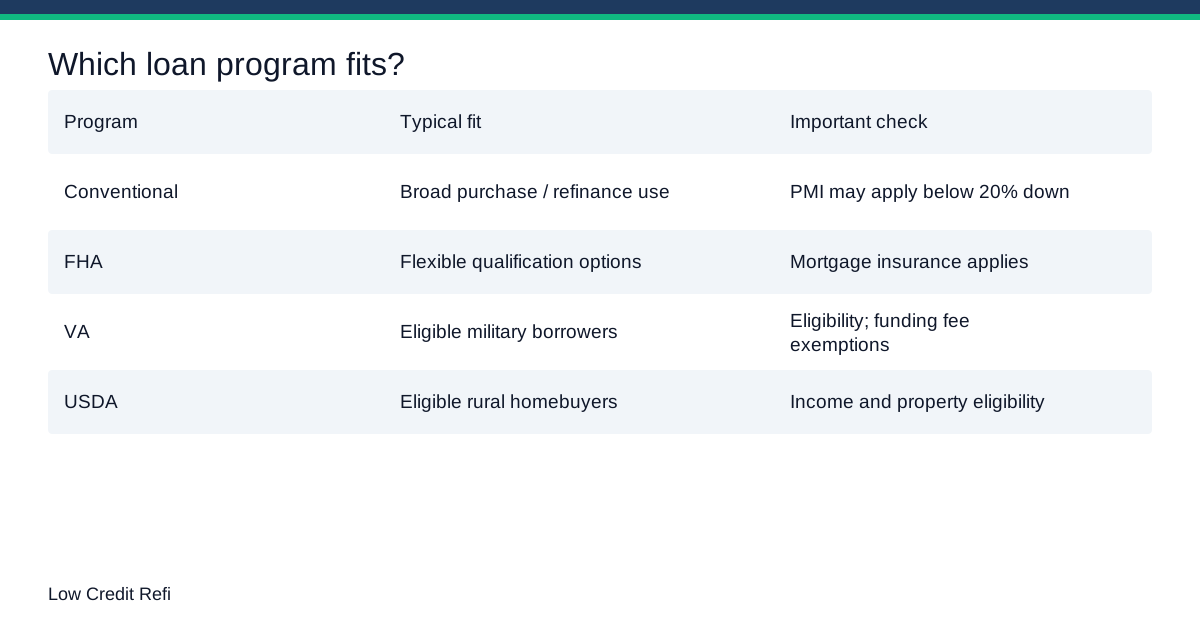
The VA IRRRL specifically serves veterans, active-duty service members, and eligible surviving spouses who currently have a VA loan. The FHA Streamline serves anyone with an existing FHA-insured mortgage. Neither program requires extensive income documentation, credit verification, or property appraisals in most cases, making them ideal for borrowers whose credit has suffered setbacks but who have maintained their mortgage payments.
The fundamental question isn't whether you can refinance with poor credit—it's which program matches your current loan type and offers the best long-term value for your specific situation.
VA IRRRL Requirements and Benefits for Low-Credit Borrowers
The VA IRRRL, sometimes called a "VA-to-VA refinance," is remarkably accessible for borrowers with credit challenges. Unlike purchase VA loans, the IRRRL focuses almost exclusively on your payment history rather than your credit score.
Key VA IRRRL Requirements
You must currently have a VA-backed home loan to use this program. The refinance must result in a lower interest rate (unless you're refinancing from an adjustable-rate to a fixed-rate mortgage). You need to certify that you previously occupied the property. Most importantly, you must have made your last 12 consecutive mortgage payments on time with no more than one 30-day late payment in the 12 months prior.
The VA doesn't set a minimum credit score for IRRRLs, though individual lenders may impose overlays ranging from 580 to 620. Many lenders will approve VA IRRRLs with credit scores in the low 600s or even high 500s if your payment history is strong.
Financial Benefits
The VA IRRRL typically doesn't require an appraisal, eliminating the $450-$650 appraisal cost. You can roll all closing costs into your new loan amount, meaning zero out-of-pocket expenses in most cases. The VA funding fee for an IRRRL is just 0.5% of the loan amount, compared to 2.15%-3.3% for purchase loans. For a $250,000 loan, that's only $1,250 versus potentially $8,250.
Expert Tip
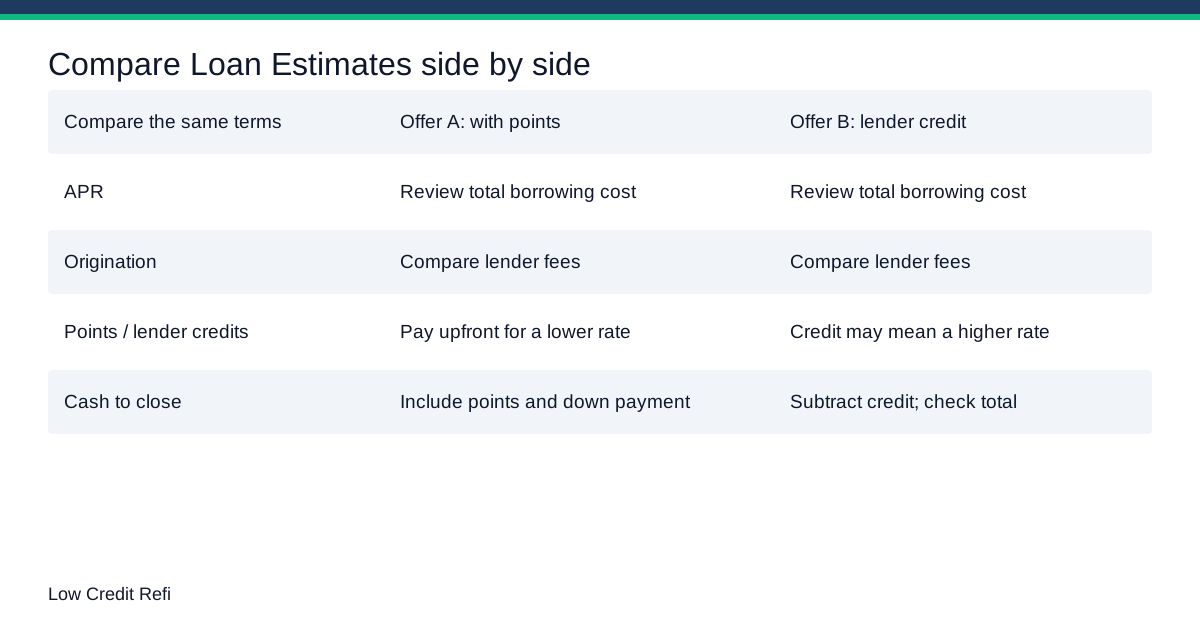
Compare Loan Estimates for the same loan type and term. Include closing costs when calculating whether refinancing saves money.
Veterans with service-connected disabilities are exempt from the funding fee entirely, creating even more savings. Between 2024 and 2026, average IRRRL closing costs range from $2,500 to $4,000 when you include lender fees, title fees, and the funding fee.
FHA Streamline Refinance: Your Alternative for Poor Credit
The FHA Streamline Refinance serves borrowers with existing FHA loans who want to reduce their monthly payments without the full documentation required for traditional refinancing. Like the VA IRRRL, this program emphasizes payment history over credit scores.
FHA Streamline Requirements
You must currently have an FHA-insured mortgage that's at least six months old, with at least six consecutive monthly payments made. The refinance must provide a "net tangible benefit," typically a minimum 0.5% interest rate reduction or switching from an adjustable to fixed rate. You cannot receive cash back at closing beyond $500.
Most FHA-approved lenders accept credit scores as low as 580 for Streamline refinances, though some may require 600 or higher. Your payment history matters significantly—lenders typically want to see no more than one 30-day late payment in the past 12 months.
FHA Streamline Costs and Considerations
FHA Streamline refinances require an upfront mortgage insurance premium (UFMIP) of 1.75% of the loan amount, which can be rolled into the loan. On a $250,000 mortgage, that equals $4,375. You'll also pay ongoing mortgage insurance premiums (MIP) for the life of the loan if your down payment was less than 10%, or for 11 years if you put down 10% or more.
Total closing costs for FHA Streamline refinances in 2026 typically range from $3,500 to $6,000, including the UFMIP, lender fees, title insurance, and recording fees. Unlike VA IRRRLs, there's no military service requirement, making this option available to all FHA borrowers.
Direct Comparison: VA IRRRL vs FHA Streamline for Borrowers With Poor Credit
| Feature | VA IRRRL | FHA Streamline |
|---|---|---|
| Minimum Credit Score | No official minimum (lender overlays 580-620) | 580 for most lenders |
| Current Loan Required | Existing VA loan | Existing FHA loan |
| Appraisal Required | No | No (in most cases) |
| Income Verification | Limited | Limited |
| Funding/Insurance Fee | 0.5% (waived for disabled veterans) | 1.75% UFMIP |
| Ongoing Insurance | None | MIP for 11 years to life of loan |
| Payment History Required | 12 months, max one 30-day late | 6 months, max one 30-day late |
| Typical Closing Costs | $2,500-$4,000 | $3,500-$6,000 |
| Cash-Out Option | No | No (max $500 back) |
| Rate Reduction Required | Yes (with exceptions for ARM to fixed) | 0.5% minimum or ARM to fixed |
This comparison reveals that the VA IRRRL generally offers lower costs and fewer restrictions for eligible veterans, while the FHA Streamline provides accessibility to non-military borrowers with existing FHA loans.
Step-by-Step Process for Refinancing With Poor Credit
Whether you choose the VA IRRRL or FHA Streamline path, the refinancing process follows a similar streamlined structure:
- Review Your Payment History (Week 1): Pull your mortgage statements for the past 12 months and verify you meet the on-time payment requirements. One late payment may be acceptable, but two or more will likely disqualify you.
- Check Your Credit Reports (Week 1): Obtain free credit reports from all three bureaus at AnnualCreditReport.com and review them for errors. Dispute any inaccuracies that might be dragging your score down unnecessarily.
- Calculate Your Break-Even Point (Week 1-2): Determine how long you plan to stay in your home and calculate whether the closing costs justify the monthly savings. If you're saving $150/month with $3,000 in closing costs, your break-even point is 20 months.
- Request Rate Quotes From Multiple Lenders (Week 2-3): Contact at least three VA or FHA-approved lenders. Ask about their credit score requirements, current interest rates, and total closing costs. Lenders may vary significantly in their willingness to work with credit scores below 620.
- Submit Your Streamline Application (Week 3-4): Once you've selected a lender, complete the streamlined application. You'll need basic employment information, but extensive documentation isn't required.
- Complete Minimal Documentation (Week 4-5): Provide recent pay stubs or proof of income if requested, though many streamline refinances require minimal documentation. You'll also need proof of homeowners insurance.
- Attend Closing (Week 6-8): Review your Closing Disclosure three days before closing, verify all fees match your quotes, and sign your documents. Many lenders offer mobile notary services for your convenience.
Maximizing Your Approval Chances With Poor Credit
Even with streamlined programs designed for accessibility, you can take specific steps to improve your approval odds and secure better rates despite your 580-620 credit score.
Focus on Payment History
Your mortgage payment history is the single most important factor. If you're currently caught up but had late payments in the past 12 months, consider waiting until those late payments fall outside the 12-month lookback period. Each month of on-time payments strengthens your application.
Address Credit Report Errors
Studies show that approximately 20% of credit reports contain errors that negatively impact scores. Dispute any inaccuracies related to accounts you never opened, incorrect late payment notations, or debts you've already paid. Correcting even one error could boost your score above important thresholds.
Reduce Your Debt-to-Income Ratio
While streamline refinances have relaxed DTI requirements, lower ratios improve your approval chances. If possible, pay down credit card balances or other consumer debt before applying. This demonstrates financial responsibility despite your lower credit score.
Choose Your Lender Strategically
Not all lenders maintain the same credit score requirements. Some VA-approved lenders specialize in working with lower-credit borrowers and may approve scores as low as 580, while others require 620 or higher. Research lender-specific requirements before applying to avoid unnecessary credit inquiries.
Consider Waiting for Rate Improvements
If current refinance rates don't provide enough savings to justify the costs, monitor rate trends. Even a 0.25% improvement in available rates can make refinancing worthwhile. Both VA IRRRL and FHA Streamline programs remain available whenever rates become favorable.
Long-Term Financial Impact: Making the Right Choice
Choosing between VA IRRRL vs FHA Streamline for borrowers with poor credit requires understanding not just immediate costs but long-term financial implications.
Total Cost Over Loan Life
An FHA borrower with a $250,000 loan paying 0.85% annual MIP will pay approximately $2,125 per year or $177 per month in mortgage insurance. Over a 30-year loan, that totals $63,750 in insurance premiums. VA IRRRL borrowers pay no ongoing mortgage insurance after the initial 0.5% funding fee, creating substantial long-term savings for eligible veterans.
If you're comparing a VA IRRRL with a 6.5% rate and no mortgage insurance against an FHA Streamline at 6.25% with mortgage insurance, the FHA loan's lower interest rate may be offset by the ongoing MIP cost, making the VA option more affordable despite the higher rate.
Exit Strategy Considerations
FHA mortgage insurance generally remains for the life of the loan if your original down payment was less than 10%. To eliminate it, you'd need to refinance to a conventional loan once your credit improves and you've built 20% equity. This means your FHA Streamline might be temporary, with another refinance in your future.
VA IRRRL borrowers can refinance again in the future without mortgage insurance concerns, maintaining this advantage throughout homeownership.
Building Toward Better Credit
Both refinancing options allow you to reduce your monthly payment, freeing up cash flow to address other debts and improve your credit score. A lower monthly housing payment combined with consistent on-time mortgage payments creates a foundation for credit recovery.
As your credit improves beyond 620, you'll eventually qualify for conventional refinancing with potentially better rates and terms. View your current streamline refinance as a stepping stone in your broader financial recovery strategy.
Frequently Asked Questions
Yes, most VA-approved lenders will approve a VA IRRRL with a 580 credit score if you have a perfect 12-month payment history on your current VA loan. The VA itself doesn't set a minimum credit score for IRRRLs, though individual lenders may have overlays. Your consistent payment history demonstrates creditworthiness more effectively than your score alone. Some lenders specialize in working with lower-credit borrowers and may offer approval where others won't.
Does FHA Streamline refinancing require income verification for borrowers with poor credit?
FHA Streamline refinances typically require minimal income documentation regardless of credit score. You may need to provide recent pay stubs or tax returns, but the process is significantly less intensive than traditional refinancing. Lenders focus primarily on your payment history and the net tangible benefit calculation. If you're employed in the same position as when you obtained your original FHA loan, documentation requirements are especially streamlined.
Which costs more overall: VA IRRRL or FHA Streamline for someone with a 600 credit score?
For eligible veterans, the VA IRRRL typically costs less both upfront and over the loan's life. The 0.5% VA funding fee is lower than the 1.75% FHA upfront mortgage insurance premium, and VA loans have no ongoing mortgage insurance while FHA loans require MIP for most of the loan term. On a $250,000 loan, the VA funding fee is $1,250 versus $4,375 for FHA UFMIP. Over 30 years, the absent MIP on VA loans saves tens of thousands of dollars compared to FHA loans.
How long after a late mortgage payment can I apply for a VA IRRRL or FHA Streamline?
For VA IRRRL, you generally need 12 consecutive months of on-time payments with no more than one 30-day late payment in that period. If you had a late payment 13 months ago, you're likely eligible now. For FHA Streamline, you need six months of on-time payments with no more than one 30-day late payment in the past 12 months. Both programs emphasize recent payment performance, so consistent on-time payments significantly improve your approval odds.
Can I refinance from FHA to VA or VA to FHA if I have poor credit?
VA IRRRL requires refinancing an existing VA loan to another VA loan—you cannot refinance an FHA loan to VA through the IRRRL program. Similarly, FHA Streamline refinancing requires an existing FHA loan. If you have an FHA loan and qualify for VA benefits, you could potentially do a standard VA cash-out refinance (not IRRRL), but this requires meeting full VA loan requirements including appraisal and more stringent credit standards. With poor credit, you're better served by the streamline program matching your current loan type.
Take the Next Step Toward Lower Mortgage Payments
Understanding VA IRRRL vs FHA Streamline for borrowers with poor credit is your first step toward reducing your monthly housing costs and improving your financial stability. Whether you're a veteran with an existing VA loan or a homeowner with an FHA mortgage, these streamlined refinancing programs provide accessible pathways to better loan terms despite credit challenges in the 580-620 range.
Your credit score doesn't define your refinancing options—your payment history and current loan type create opportunities that traditional refinancing can't offer. With closing costs potentially rolled into your new loan and no appraisal required, you can start saving money with minimal upfront investment.
Ready to discover how much you could save each month? Request your free, no-obligation refinancing consultation today. Our lending specialists work with borrowers in your exact credit situation and can provide personalized rate quotes for VA IRRRL or FHA Streamline refinancing within 24 hours. Complete our simple online form or call to speak with a refinancing expert who understands the unique opportunities available to borrowers with poor credit. Your path to lower payments and improved financial flexibility starts with a single conversation—reach out now to get started.
Frequently Asked Questions
What credit score is needed for a VA IRRRL with poor credit?
The VA does not set a minimum credit score for the IRRRL. However, individual lenders may require scores between 580 and 620. The program emphasizes a 12-month history of on-time mortgage payments rather than credit score alone.
Can I refinance with an FHA Streamline if my credit score is 580?
Yes, the FHA Streamline Refinance accepts credit scores as low as 580 from most lenders. You must have an existing FHA loan and have made at least six months of on-time payments. No new appraisal is typically required.
Which refinance program is better for borrowers with a 600 credit score?
The better program depends on your current loan type. If you have a VA loan, the IRRRL is ideal due to its flexible credit requirements. If you have an FHA loan, the FHA Streamline is designed for low-credit borrowers. Both avoid strict credit checks.
Do VA IRRRL and FHA Streamline require an appraisal for low-credit borrowers?
Generally, neither program requires a new appraisal. The VA IRRRL typically waives appraisals, and the FHA Streamline also does not require one in most cases. This saves borrowers with poor credit from potential appraisal-related hurdles.
Key Takeaways
- Understanding your options for va irrrl vs fha streamline for borrowers with poor credit is the first step
- Getting pre-qualified helps you understand your real options