Compare Live Mortgage & Home Equity Rates
Compare current APRs, points, fees, and estimated monthly payments from participating lenders below.
Mortgage rates
Should You Pay Points to Lower Rate With Bad Credit Refinance
Quick Answer: Whether to pay points on a bad credit refinance depends on your break-even timeline. Points lower your rate but cost upfront. If you plan to stay in your home long enough to recoup that cost through monthly savings, they can be worthwhile. For borrowers with 580-620 credit, higher starting rates mean points may save more in absolute dollars, but you need sufficient cash reserves.
When you're refinancing a mortgage with a credit score between 580 and 620, one of the most important decisions you'll face is whether to pay discount points upfront to secure a lower interest rate. The short answer: it depends on how long you plan to stay in your home and whether you have enough cash reserves to cover the upfront costs without depleting your emergency fund. For borrowers with bad credit, paying points can reduce your monthly payment by $50-$150 or more, but you'll need to remain in the home for 3-5 years on average to recoup your initial investment through monthly savings. This article will help you understand exactly when paying points makes financial sense for your situation and when you should keep your cash for other purposes.
Understanding Discount Points and How They Work With Poor Credit Scores
Discount points, also called mortgage points, are fees you pay directly to your lender at closing in exchange for a reduced interest rate on your loan. Each point typically costs 1% of your total loan amount and generally reduces your interest rate by approximately 0.125% to 0.25%, though this can vary significantly based on your credit profile and the current lending environment.
When considering should you pay points to lower rate with bad credit refinance, you should understand all available options.
For borrowers with credit scores in the 580-620 range, the mechanics work the same way as they do for prime borrowers, but the baseline rates you're starting from are considerably higher. If you're looking at a 7.5% rate without points, paying two points might bring that down to 7.0% or 6.875%. While that might not seem like a dramatic reduction, the monthly payment difference on a $250,000 loan would be approximately $90-$110, which adds up to $1,080-$1,320 annually.
The Math Behind Break-Even Points
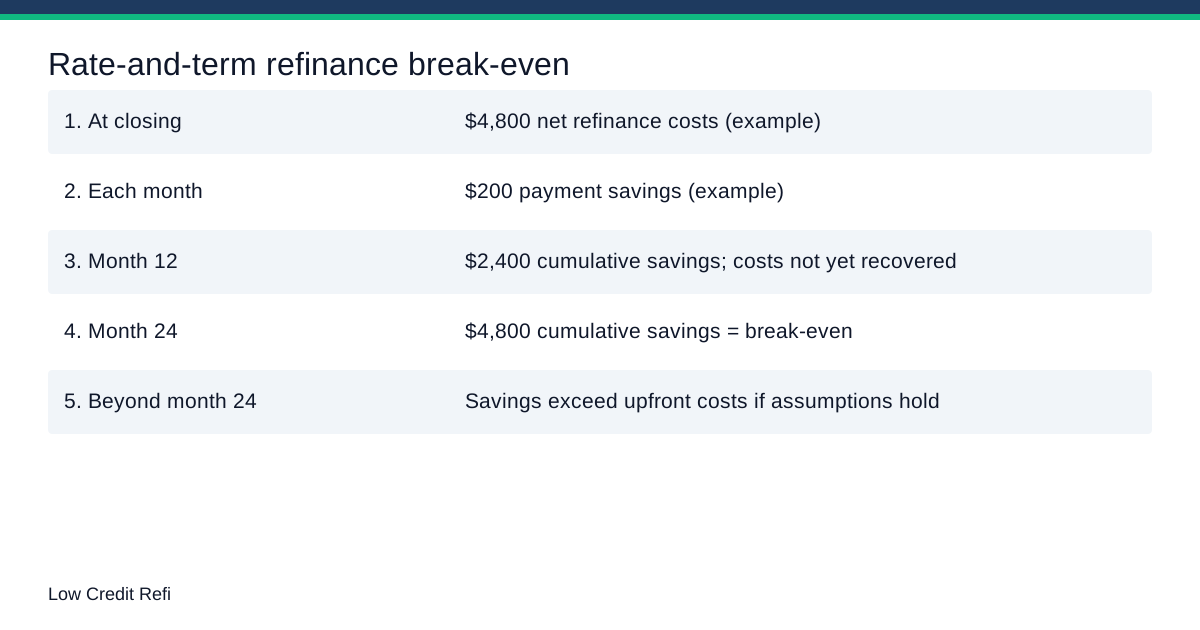
The break-even calculation is straightforward: divide the total cost of points by your monthly savings to determine how many months you need to stay in the home to recover your investment. For example, if you pay $5,000 in points and save $100 per month, your break-even point is 50 months, or just over four years.
However, this calculation becomes more nuanced when you factor in the opportunity cost of the cash you're spending on points, potential investment returns from that money, and the likelihood that you might refinance again when your credit improves.
The Current Rate Environment for Bad Credit Refinance Borrowers in 2026
As of 2026, borrowers with credit scores between 580 and 620 typically face interest rates that are 1.5% to 3.5% higher than conventional prime rates. While prime borrowers might secure rates around 6.0-6.5%, those with challenged credit are more commonly seeing offers in the 7.5-9.5% range, depending on additional factors like loan-to-value ratio, debt-to-income ratio, and documentation strength.
In this environment, the value proposition of paying points becomes more compelling for some borrowers. A 0.25% rate reduction on an 8.5% loan represents a 2.9% relative reduction in your rate, whereas the same 0.25% reduction on a 6.5% prime loan represents a 3.8% relative reduction. However, because your monthly payment is higher to begin with, the absolute dollar savings can still be substantial.
Lenders are generally more willing to offer point options to bad credit borrowers because it reduces their risk. A lower rate means lower monthly payments, which statistically reduces default probability. This creates a situation where point purchases may be available with more favorable rate reductions than you might expect.
Expert Tip
Compare Loan Estimates for the same loan type and term. Include closing costs when calculating whether refinancing saves money.
Cost Comparison: Paying Points vs. No Points on Common Loan Amounts
| Loan Amount | Points Paid | Upfront Cost | Rate Without Points | Rate With Points | Monthly Payment (No Points) | Monthly Payment (With Points) | Monthly Savings | Break-Even (Months) |
|---|---|---|---|---|---|---|---|---|
| $150,000 | 0 | $0 | 8.25% | 8.25% | $1,127 | $1,127 | $0 | N/A |
| $150,000 | 1 point | $1,500 | 8.25% | 7.875% | $1,127 | $1,088 | $39 | 38 months |
| $150,000 | 2 points | $3,000 | 8.25% | 7.50% | $1,127 | $1,049 | $78 | 38 months |
| $250,000 | 0 | $0 | 8.25% | 8.25% | $1,878 | $1,878 | $0 | N/A |
| $250,000 | 1 point | $2,500 | 8.25% | 7.875% | $1,878 | $1,814 | $64 | 39 months |
| $250,000 | 2 points | $5,000 | 8.25% | 7.50% | $1,878 | $1,748 | $130 | 38 months |
| $350,000 | 0 | $0 | 8.25% | 8.25% | $2,630 | $2,630 | $0 | N/A |
| $350,000 | 1 point | $3,500 | 8.25% | 7.875% | $2,630 | $2,540 | $90 | 39 months |
| $350,000 | 2 points | $7,000 | 8.25% | 7.50% | $2,630 | $2,448 | $182 | 38 months |
Note: Monthly payments include principal and interest only, based on 30-year fixed-rate mortgages. Actual rates and point costs vary by lender, credit profile, and market conditions.
When Paying Points Makes Sense for Your Situation
You Plan to Stay in Your Home Long-Term
If you're confident you'll remain in your home for at least 5-7 years, paying points typically provides excellent value. Given that most break-even periods for bad credit refinances fall in the 3-4 year range, you'll enjoy several years of savings after recovering your initial investment.
You Have Sufficient Cash Reserves
Paying points only makes sense if you can do so without depleting your emergency fund or creating financial stress. Financial advisors generally recommend maintaining 3-6 months of expenses in liquid savings even after paying closing costs. If paying points would leave you cash-poor, the risk outweighs the reward.
Your Credit Recovery Timeline is Long
If you're realistically 4-6 years away from improving your credit enough to refinance into a prime rate, paying points now can maximize your savings during that period. However, if you're actively working on credit repair and expect to qualify for significantly better rates within 18-24 months, you might be better off keeping your cash and refinancing again sooner.
The Interest Savings Exceed Your Investment Return Potential
Consider what else you could do with the money you'd spend on points. If you're carrying credit card debt at 22% APR, paying that down provides a guaranteed 22% return, which almost certainly beats the effective return from purchasing points. Conversely, if your only alternative is a savings account earning 2.5%, the 8%+ rate reduction from points offers superior value.
When You Should Skip Paying Points
There are equally compelling scenarios where keeping your cash makes more sense than buying down your rate, particularly for borrowers in the 580-620 credit score range who are actively working on financial recovery.
Your Credit is Improving Rapidly
If you've recently resolved major credit issues—bankruptcy discharge, paid off collections, removed errors from your credit report—and your score is trending upward, you may qualify for a significantly better refinance within 12-24 months. In this case, paying thousands in points for a marginal rate reduction makes little sense when a future refinance could drop your rate by a full percentage point or more.
You're Uncertain About Your Housing Timeline
Job uncertainty, potential relocation, family changes, or other life circumstances might mean you won't stay in the home long enough to recoup your point investment. If there's a reasonable chance you'll sell or refinance within three years, preserving your cash offers more flexibility.
The Property Might Appreciate Significantly
In markets with strong appreciation potential, preserving cash for potential improvements, repairs, or to maintain a lower loan-to-value ratio might provide more strategic value than rate reduction. Every 5% in additional equity you build makes you eligible for better refinance terms and potentially eliminates mortgage insurance requirements.
You Need Cash for Credit Repair Strategies
Sometimes the best use of available cash is directly attacking the credit issues keeping your score low. Paying off collections, settling charged-off accounts, or even strategic credit card balance reductions could improve your score enough within 6-12 months to refinance again at substantially better terms without points.
Alternative Strategies to Consider Alongside Point Decisions
Lender Credits vs. Discount Points
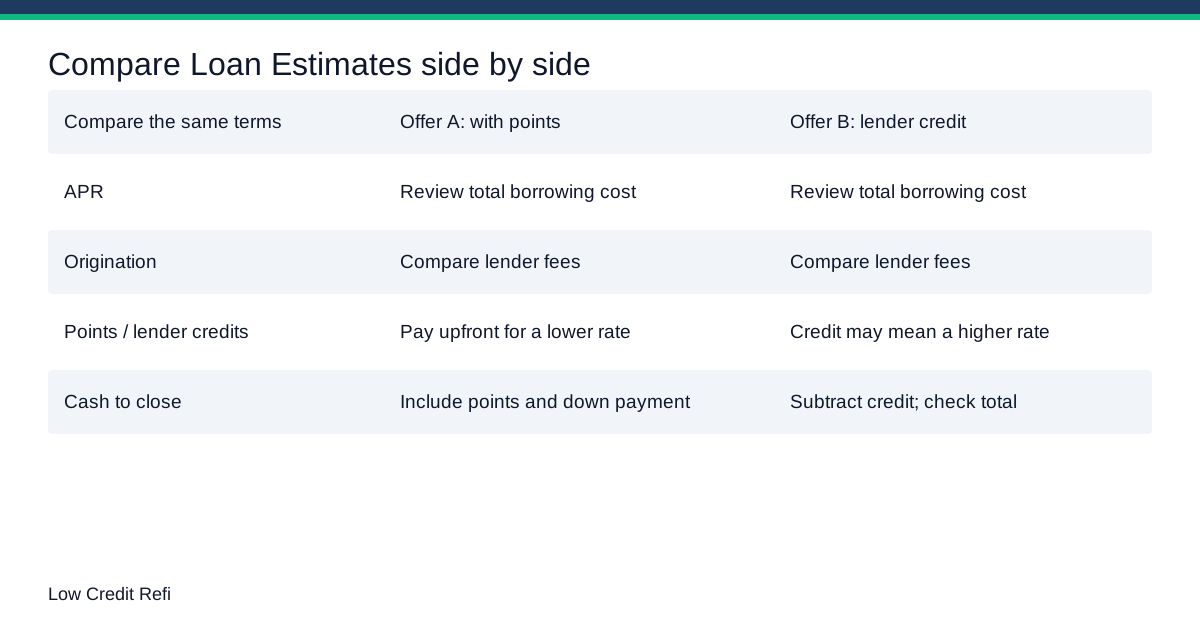
Some lenders offer the inverse option: accepting a slightly higher rate in exchange for lender credits that cover some or all of your closing costs. For borrowers with limited cash, this creates a zero-cost or low-cost refinance option. While your rate will be higher than the no-point baseline, you preserve cash and can refinance again when your credit improves without having sunk thousands into your previous loan.
Hybrid Approach: Paying Partial Points
You don't have to choose between paying zero points or maximum points. Purchasing a single point instead of two, or even half a point, can provide meaningful rate reduction while preserving more cash reserves. This middle-ground approach often makes sense for borrowers who have some excess cash but want to maintain liquidity.
Combining Refinancing With Credit Repair Services
Rather than spending $5,000 on discount points, consider allocating $1,000-$2,000 toward professional credit repair services while keeping the remainder as reserves. If these services can help you improve your score by 40-60 points over 12-18 months, your next refinance could save you far more than the point purchase would have.
Step-by-Step Process for Deciding Whether to Pay Points
- Calculate your true break-even period by dividing the total point cost by your monthly savings, then adding 6-12 months to account for the time value of money and opportunity costs.
- Honestly assess your housing timeline by considering employment stability, family plans, and regional economic factors that might influence how long you'll keep the property.
- Evaluate your complete financial picture including emergency fund adequacy, other debt obligations, and upcoming major expenses that might require cash reserves.
- Project your credit recovery timeline by reviewing your credit report, identifying remaining negative items, understanding when they'll age off, and estimating when you might qualify for significantly better rates.
- Get quotes for multiple point scenarios from at least 3-5 lenders, comparing zero points, one point, and two points to see the actual rate reductions and costs specific to your situation.
- Calculate the total interest savings over your expected holding period rather than just monthly savings, which provides a clearer picture of the actual financial benefit.
- Consider tax implications with your tax advisor, as mortgage interest remains deductible for many homeowners, though the Tax Cuts and Jobs Act has limited this benefit for some.
- Run stress-test scenarios asking yourself whether the decision still makes sense if you had to sell one year early, if rates dropped significantly, or if unexpected expenses arose.
Frequently Asked Questions
A: Most lenders allow borrowers with credit scores as low as 580 to purchase discount points on refinance transactions. In fact, some lenders actively encourage point purchases for lower-credit borrowers because the reduced rate decreases default risk. However, you may find that the rate reduction per point is slightly less generous than what prime borrowers receive, and you'll need to demonstrate sufficient verified income and assets to cover both the points and closing costs.
Q: How does paying points on a bad credit refinance compare to waiting 6-12 months to improve my credit score before refinancing?
A: This depends entirely on your current rate and how much improvement is realistically achievable. If you're currently paying 9.5% and could potentially refinance at 7.5% with better credit, waiting often makes more sense than paying points to reduce 9.5% to 9.125%. However, if your credit challenges are severe and recovery will take 3+ years, paying points now captures immediate savings. Calculate the total interest cost of waiting versus the cost of points plus reduced-rate interest to make an informed decision.
Q: Are discount points tax deductible when refinancing with bad credit?
A: Discount points paid on a refinance must generally be deducted over the life of the loan rather than in the year paid, unlike points on a purchase mortgage. For example, on a 30-year refinance, you'd deduct 1/30th of the points each year. However, tax situations vary considerably, and recent tax law changes have reduced the benefit of mortgage interest deductions for many households, so consult a tax professional about your specific circumstances.
Q: If I pay points to lower my rate and then refinance again in two years when my credit improves, do I lose the money I spent on points?
A: Yes, you essentially lose the unrecovered portion of your point investment if you refinance or sell before reaching your break-even period. This is why honest assessment of your likely refinance timeline is crucial. If there's a strong possibility you'll refinance within 2-3 years as your credit improves, paying points rarely makes financial sense unless the monthly savings are substantial enough to recover most of the cost even in that shortened timeframe.
Q: Should You Pay Points to Lower Rate With Bad Credit Refinance if you're already paying PMI or MIP?
A: Borrowers paying mortgage insurance should carefully weigh their priorities. If you're close to the 80% loan-to-value threshold where PMI drops off, using available cash to make a principal payment to eliminate PMI might save more money than purchasing points. However, if you're significantly above 80% LTV and will be paying mortgage insurance for years regardless, points can still provide value. Calculate both scenarios: rate reduction through points versus principal reduction to eliminate mortgage insurance, and choose the option with the greatest total monthly savings.
Get a Personalized Rate Quote for Your Situation
The decision about whether to pay points to lower your rate with bad credit refinance is deeply personal and depends on factors unique to your financial situation, goals, and timeline. While the guidelines and calculations in this article provide a framework for decision-making, there's no substitute for personalized analysis based on actual rate quotes and your specific circumstances.
Our network of specialized lenders works specifically with borrowers in the 580-620 credit score range and can provide detailed comparisons showing exactly how much you'd save with different point scenarios. Request your free, no-obligation consultation today to receive customized rate quotes with zero points, one point, and two points, along with a detailed break-even analysis.
Within 24 hours, you'll have the specific information you need to make an informed decision about Should You Pay Points to Lower Rate With Bad Credit Refinance that maximizes your financial benefit. Complete the simple form to connect with a refinance specialist who understands the unique challenges and opportunities for borrowers with challenged credit—because the right refinance strategy can save you thousands in interest while helping you rebuild your financial foundation.
Frequently Asked Questions
How do discount points work for borrowers with bad credit?
Discount points are upfront fees paid to your lender at closing to reduce your interest rate. Each point typically costs 1% of your loan amount and lowers your rate by about 0.125% to 0.25%. For borrowers with credit scores 580-620, starting rates are higher, so the same point purchase can result in larger absolute monthly savings compared to prime borrowers.
What is the break-even point for paying points on a refinance?
The break-even point is the time it takes for your monthly savings from the lower rate to equal the upfront cost of the points. Divide the total cost of points by your monthly savings. For example, if points cost $5,000 and you save $100 per month, your break-even is 50 months. Staying in the home beyond that period makes paying points financially beneficial.
Should I pay points if I plan to refinance again soon?
If you expect to refinance again within a few years—perhaps because your credit score may improve—paying points may not be wise. You might not reach the break-even point before refinancing, meaning you lose the upfront investment. In that case, it's often better to keep your cash and accept a higher rate now, then refinance later when your credit is better.
Can paying points help me qualify for a refinance with bad credit?
Paying points does not directly help you qualify for a loan, but it can lower your monthly payment, which may improve your debt-to-income ratio. A lower DTI can make it easier to meet lender requirements. However, you still need to meet other criteria like income, assets, and loan-to-value. Points are a rate reduction tool, not a qualification fix.
Key Takeaways
- Understanding your options for should you pay points to lower rate with bad credit refinance is the first step
- Getting pre-qualified helps you understand your real options