Compare Live Mortgage & Home Equity Rates
Compare current APRs, points, fees, and estimated monthly payments from participating lenders below.
Mortgage rates
Refinance Loan Limits for FHA Borrowers Under 620 Credit Score: Your Complete Guide to Getting Approved
Quick Answer: For FHA borrowers with credit scores under 620, refinance loan limits in 2026 range from $498,257 to $1,149,825 depending on county housing costs. The FHA Streamline Refinance is accessible with scores as low as 580, while cash-out refinancing typically requires 600-620. These limits allow borrowers with lower credit to refinance and potentially lower payments or access equity.
If you're searching for information about refinance loan limits for FHA borrowers under 620 credit score, you're likely facing the challenge of refinancing with less-than-perfect credit. The good news is that FHA refinance programs remain accessible even with credit scores in the 580-620 range. FHA loan limits for 2026 range from $498,257 to $1,149,825 depending on your county's housing costs, and these same limits apply to refinancing. While conventional lenders typically require credit scores of 640 or higher, FHA-backed refinance options provide a lifeline for borrowers with lower scores who want to reduce their monthly payments, access equity, or switch from an adjustable-rate to a fixed-rate mortgage.
Understanding FHA Refinance Options for Credit Scores Below 620
The Federal Housing Administration backs several refinance programs specifically designed to help borrowers with challenged credit profiles. Unlike conventional refinancing that often requires pristine credit, FHA refinance loans acknowledge that life happens—medical bills, job loss, or financial setbacks can temporarily impact your credit score without reflecting your current ability to make mortgage payments.
Understanding refinance loan limits for fha borrowers under 620 credit score can help you compare your options and make a confident, informed decision.
For borrowers with credit scores between 580 and 620, two primary FHA refinance options exist: the FHA Streamline Refinance and the FHA Cash-Out Refinance. Each serves different purposes and comes with distinct credit requirements and documentation needs.
The FHA Streamline Refinance is the most accessible option for current FHA borrowers. This program requires minimal documentation and doesn't mandate a new appraisal in most cases. Most importantly, many lenders will approve FHA Streamline refinances for borrowers with credit scores as low as 580, though some may require 600 or above as an internal policy.
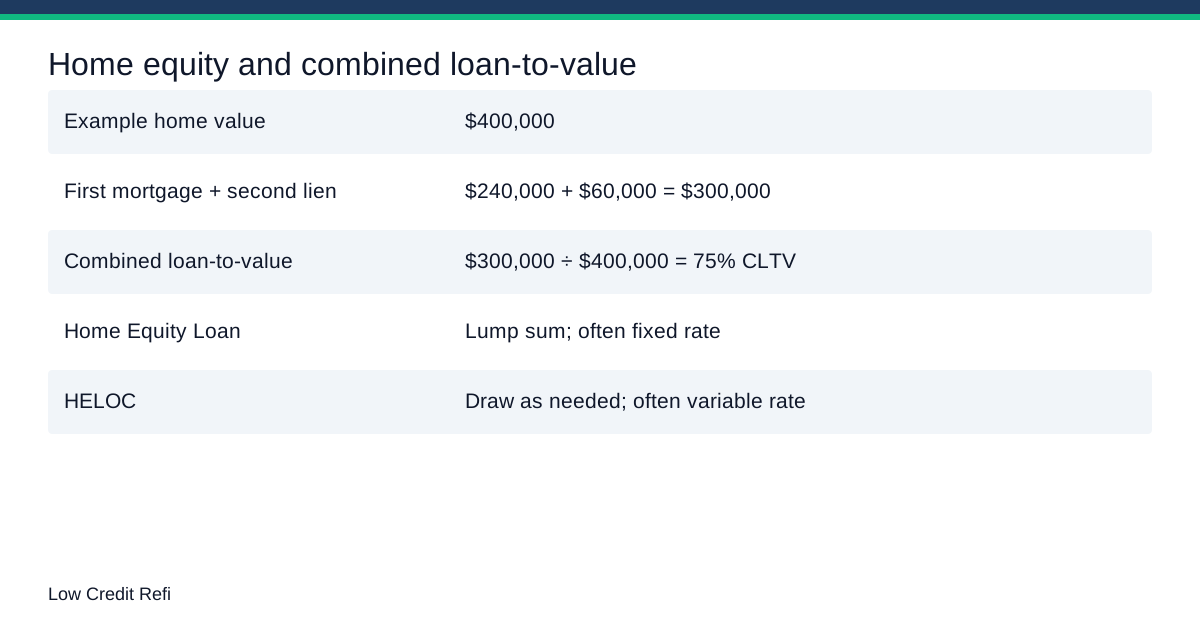
The FHA Cash-Out Refinance allows you to tap into your home equity while refinancing. This option typically requires more stringent credit requirements, with most lenders setting their minimum at 600-620 for borrowers who want to take cash out. The trade-off is worth considering: you can access funds for debt consolidation, home improvements, or other financial needs while potentially securing a lower interest rate.
2026 FHA Refinance Loan Limits Explained
Understanding the maximum loan amounts available through FHA refinancing is crucial for planning your financial strategy. The Department of Housing and Urban Development adjusts these limits annually based on housing market conditions.
For 2026, the FHA floor limit for low-cost counties stands at $498,257. This applies to areas where housing costs remain below the national median. Most borrowers will encounter this baseline limit when refinancing in more affordable housing markets.
High-cost counties see substantially higher limits, with the ceiling reaching $1,149,825 for single-family homes. These elevated limits apply to areas with above-average housing costs, enabling borrowers in expensive markets to access FHA refinancing despite lower credit scores.
Expert Tip
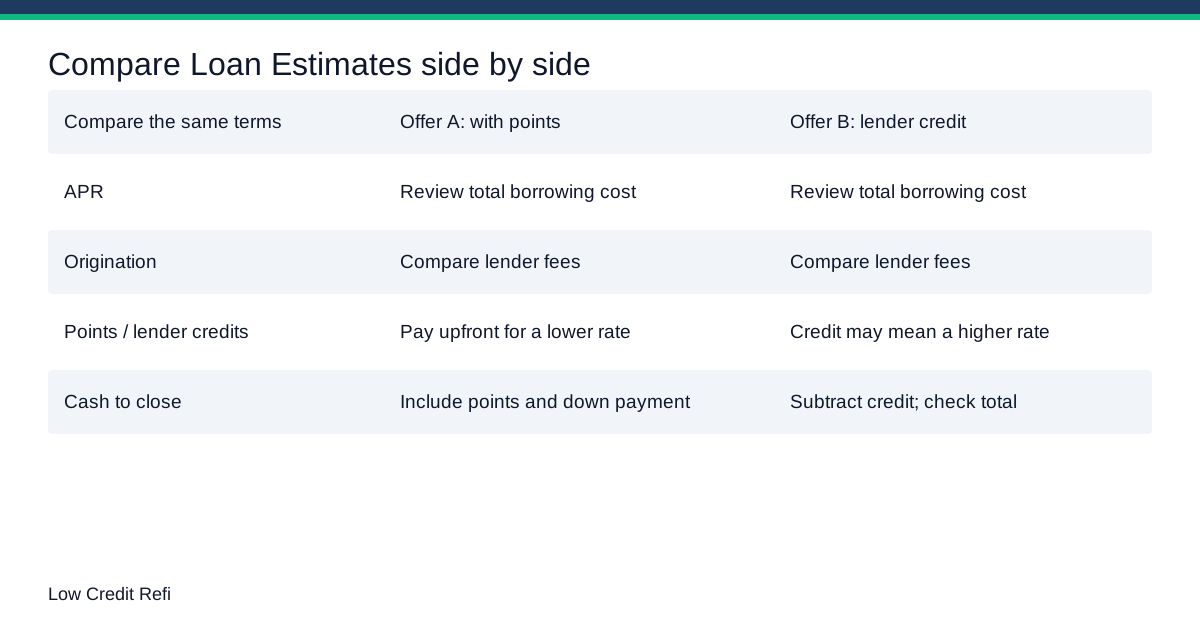
Compare Loan Estimates for the same loan type and term. Include closing costs when calculating whether refinancing saves money.
Your specific county's loan limit falls somewhere between these two figures. Importantly, when refinancing with an FHA Cash-Out option, you can borrow up to 80% of your home's appraised value, not exceeding the county loan limit. For Streamline refinances, the loan amount generally cannot exceed your current mortgage balance plus closing costs and allowable prepaid items.
Step-by-Step Process for FHA Refinancing with Under 620 Credit
Navigating the refinance process with a challenged credit score requires preparation and understanding of what lenders expect. Follow this structured approach to maximize your approval chances:
- Check your credit reports from all three bureaus - Obtain free reports from Equifax, Experian, and TransUnion. Review for errors, disputes, or accounts that might be incorrectly reported. Even raising your score by 10-20 points can improve your interest rate.
- Gather 12-24 months of on-time mortgage payment history - FHA Streamline refinances place heavy emphasis on your recent payment track record. Late mortgage payments in the past 12 months significantly reduce approval odds, while a clean payment history strengthens your application despite a lower credit score.
- Calculate your debt-to-income ratio - Add up all monthly debt obligations (car payments, credit cards, student loans, proposed mortgage payment) and divide by your gross monthly income. FHA guidelines allow up to 56.9% DTI in some cases, but staying below 43% improves approval likelihood.
- Document your income and employment - Prepare recent pay stubs (typically last 30 days), W-2 forms from the past two years, and tax returns. Self-employed borrowers need two years of tax returns and may require a year-to-date profit and loss statement.
- Contact multiple FHA-approved lenders - Not all lenders maintain the same credit score requirements. Some may require 600 minimum, while others work with 580 scores. Comparing at least three lenders helps you find the best terms available for your credit profile.
- Complete the loan application and pay for appraisal - Once you select a lender, you'll complete a formal application (Form 1003) and pay for the appraisal if required. FHA Streamline refinances often waive this requirement, reducing upfront costs.
- Undergo underwriting review - The lender's underwriter examines your credit, income, assets, and property details. They may request additional documentation or explanations for credit issues. Respond promptly to all requests to avoid delays.
- Schedule your closing - After final approval, you'll receive a Closing Disclosure at least three days before closing. Review all numbers carefully, then attend closing to sign documents and finalize your new loan.
Cost Breakdown: What to Expect When Refinancing with Lower Credit
Understanding the full cost picture helps you determine whether refinancing makes financial sense for your situation. Below is a comprehensive comparison of typical costs for FHA refinancing in 2026:
| Cost Component | FHA Streamline Refinance | FHA Cash-Out Refinance | Notes |
|---|---|---|---|
| Upfront Mortgage Insurance Premium | 1.75% of loan amount | 1.75% of loan amount | Can be financed into loan balance |
| Annual Mortgage Insurance (PMI) | 0.55%-0.80% of loan amount | 0.55%-0.80% of loan amount | Required for life of loan on most FHA loans |
| Appraisal Fee | $0-$550 | $450-$650 | Often waived for Streamline |
| Credit Report | $25-$75 | $25-$75 | Per borrower |
| Origination Fee | 0%-1% of loan amount | 0.5%-1.5% of loan amount | Varies by lender |
| Title Insurance & Search | $800-$1,500 | $1,000-$2,500 | Depends on loan amount and location |
| Recording Fees | $50-$250 | $50-$250 | Government charges |
| Total Estimated Costs | $2,500-$7,000 | $4,500-$12,000 | Based on $250,000 loan |
Borrowers with credit scores under 620 should expect interest rates approximately 0.5%-1.25% higher than those offered to borrowers with 740+ credit scores. On a $250,000 30-year mortgage, this translates to an additional $75-$200 in monthly payments. However, if you're refinancing from a much higher rate or an adjustable-rate mortgage, the savings may still be substantial.
Why Your Credit Score Below 620 Doesn't Disqualify You
The mortgage industry has evolved significantly since the 2008 financial crisis. While credit standards tightened initially, FHA programs specifically exist to serve borrowers who don't fit conventional lending boxes. Your credit score tells only part of your financial story.
Lenders evaluating refinance loan limits for FHA borrowers under 620 credit score applications look at compensating factors that demonstrate creditworthiness beyond the three-digit number. A stable employment history spanning several years shows reliability. Significant cash reserves—having 3-6 months of mortgage payments saved—proves you can handle financial emergencies without defaulting.
Low debt-to-income ratios compensate for lower credit scores. If you're using less than 30% of your gross income for all debt payments, lenders view you as a lower risk despite past credit challenges. Similarly, making a large down payment (for purchase) or having substantial equity (for refinancing) reduces lender risk and can offset credit concerns.
The most powerful compensating factor for refinancing is your mortgage payment history. If you've made every payment on time for the past 12-24 months, you demonstrate that regardless of other credit issues, you prioritize your housing payment. This track record carries enormous weight with underwriters.
Common Obstacles and How to Overcome Them
Borrowers with credit scores in the 580-620 range frequently encounter specific challenges during the refinance process. Anticipating these obstacles and preparing solutions increases your approval odds.
Recent late payments represent the most significant barrier. A single 30-day late mortgage payment in the past 12 months can disqualify you from an FHA Streamline Refinance. The solution is simple but requires patience: wait until you have 12 consecutive months of on-time payments before applying. Use this time to address other credit issues and potentially raise your score.
High debt-to-income ratios cause many applications to stall. If your DTI exceeds 50%, consider paying down credit card balances or personal loans before applying. Alternatively, if you're married or have a co-borrower, ensure the person with the highest income relative to debts is the primary applicant.
Insufficient home equity affects cash-out refinance applicants. FHA requires you to maintain at least 20% equity after refinancing, meaning you can only access 80% of your home's value. If you've owned your home for less than five years or if property values have declined, you may not have enough equity. Consider a Streamline Refinance instead, which doesn't require equity beyond your current loan balance.
Collection accounts and charge-offs on your credit report concern underwriters, but they don't automatically disqualify you. FHA guidelines don't require you to pay off collections before refinancing, though some lenders maintain stricter internal policies. If collections total more than $2,000, some lenders may require payment arrangements or full satisfaction before closing.
Employment gaps or recent job changes can complicate income verification. If you changed jobs within the same field and maintained or increased your salary, most lenders accept this. However, switching careers or having unemployment gaps requires written explanations and may require you to wait until you have longer tenure in your current position.
Interest Rate Expectations for Sub-620 Credit Scores
Understanding realistic interest rate expectations helps you evaluate refinance offers and avoid predatory lending. As of early 2026, national average rates for FHA refinances vary significantly based on credit scores.
Borrowers with credit scores of 580-599 typically receive interest rates 1.0%-1.5% above prime FHA rates. If the baseline FHA rate for excellent credit hovers around 6.25%, you might receive quotes between 7.25%-7.75%. While higher than prime rates, these still often beat the rates on older mortgages originated when rates were higher, making refinancing worthwhile.
Those with 600-620 credit scores fare somewhat better, with rate premiums of 0.75%-1.25% above prime. Using the same baseline, expect rates of 7.00%-7.50%. The difference between a 599 and 600 credit score can mean 0.25% in interest rate, translating to approximately $35 monthly on a $250,000 loan—providing strong motivation to improve your score before applying.
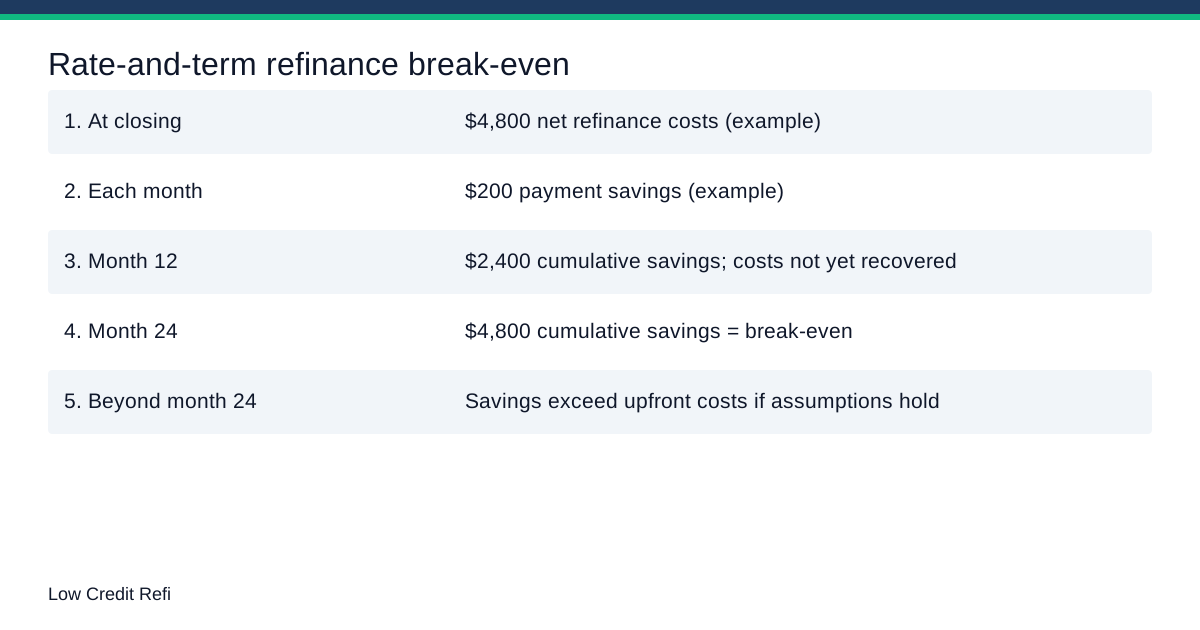
Points and rate buydowns remain available to borrowers with lower credit scores. Paying 1-2% of the loan amount upfront can reduce your interest rate by 0.25%-0.50%. Run break-even calculations to determine whether the upfront cost justifies the monthly savings based on how long you plan to keep the mortgage.
Improving Your Approval Odds Before Applying
Strategic preparation before submitting your application significantly improves both approval likelihood and the terms you'll receive. Even small improvements in your credit profile can yield substantial savings over the life of your loan.
Time your application strategically. Credit scoring models heavily weight recent payment history. If you had credit challenges 18-24 months ago but have maintained perfect payments since, waiting another few months allows those older negative items to age further, potentially boosting your score by 10-30 points.
Reduce credit card balances below 30% utilization. Credit utilization—the percentage of available credit you're using—accounts for roughly 30% of your credit score. If you have $10,000 in total credit limits, keep balances below $3,000 total. Paying down balances just before applying can provide a quick score boost.
Avoid new credit applications for 6 months before refinancing. Each credit inquiry can temporarily lower your score by 3-5 points, and multiple recent inquiries suggest financial stress to underwriters. Hard inquiries remain on your report for two years but impact your score most significantly in the first six months.
Become an authorized user on a well-managed account. If a family member has a credit card with a long positive history and low utilization, ask them to add you as an authorized user. Many scoring models will add this positive history to your credit profile, potentially raising your score.
Dispute inaccurate information immediately. Credit reporting errors are surprisingly common. If you spot accounts that don't belong to you, incorrect late payments, or outdated information, dispute them with the credit bureaus. Successful disputes can provide significant score improvements.
Frequently Asked Questions
FHA guidelines technically allow refinancing with credit scores as low as 500, but in practice, finding a lender willing to work with scores below 580 is extremely difficult. For FHA Streamline refinances, most lenders set their minimum at 580-600, while FHA Cash-Out refinances typically require 600-620 minimum. Your best strategy is contacting multiple FHA-approved lenders, as each maintains different internal credit score requirements beyond the FHA baseline.
Can I refinance an FHA loan to remove mortgage insurance with a 600 credit score?
Removing FHA mortgage insurance through refinancing requires converting to a conventional loan, which presents challenges with a 600 credit score. Most conventional refinance programs require minimum credit scores of 620-640, and you'll need at least 20% equity to eliminate mortgage insurance. If your primary goal is removing mortgage insurance, focus on improving your credit score above 640 and building equity before pursuing conventional refinancing. Alternatively, if you have an FHA loan originated before June 2013, your mortgage insurance may already drop off at 80% loan-to-value without refinancing.
How much can I borrow through FHA cash-out refinance with a 610 credit score?
With a 610 credit score, FHA Cash-Out Refinance programs allow you to borrow up to 80% of your home's current appraised value, not exceeding your county's FHA loan limit. For example, if your home appraises for $350,000 and your county limit is $498,257, you could potentially borrow up to $280,000 (80% of $350,000). After paying off your existing mortgage and closing costs, the remainder comes to you as cash. Lenders will also ensure your total debt-to-income ratio remains below 50% (preferably below 43%) including the new mortgage payment.
Will late payments from 18 months ago prevent me from getting an FHA Streamline Refinance?
Late payments from 18 months ago will affect your credit score but won't automatically disqualify you from an FHA Streamline Refinance if your recent payment history is strong. FHA Streamline programs focus primarily on the past 12 months of mortgage payment history. If you've made every mortgage payment on time for the past year, many lenders will approve your application despite older late payments. However, those late payments will likely result in a higher interest rate than you'd receive with perfect payment history. Each lender maintains different policies, so shopping among multiple FHA-approved lenders remains important.
Are there programs to refinance with bad credit if I don't currently have an FHA loan?
Yes, you can refinance a conventional, VA, or USDA loan into an FHA loan even with credit scores between 580-620. This is called an FHA Cash-Out or Rate-and-Term Refinance (not a Streamline, which requires an existing FHA loan). The process requires full documentation including appraisal, income verification, and credit review. You'll pay the 1.75% upfront mortgage insurance premium and ongoing annual mortgage insurance, but you'll gain access to FHA's more flexible credit requirements. Some borrowers strategically refinance from conventional to FHA specifically because of credit challenges, accepting the mortgage insurance cost in exchange for approval and potentially better rates than they'd receive through conventional bad-credit programs.
Take the Next Step Toward Your FHA Refinance
Understanding refinance loan limits for FHA borrowers under 620 credit score represents just the beginning of your refinancing journey. While your credit score presents challenges, it doesn't prevent you from accessing the benefits of FHA refinancing—lower monthly payments, predictable fixed-rate terms, or cash to consolidate higher-interest debt.
The refinance landscape changes constantly, with lenders adjusting their credit requirements, interest rates fluctuating, and your personal financial situation evolving. What seems impossible today might become achievable in three to six months with strategic credit improvement and mortgage payment consistency.
Don't navigate this complex process
Frequently Asked Questions
What is the minimum credit score for an FHA Streamline Refinance?
Many lenders approve FHA Streamline Refinances for borrowers with credit scores as low as 580, though some may require 600 or above as an internal policy. This program requires minimal documentation and no new appraisal in most cases, making it the most accessible option for current FHA borrowers with lower credit scores.
Can I do a cash-out refinance with a credit score under 620?
Yes, but requirements are stricter. Most lenders set a minimum credit score of 600-620 for FHA Cash-Out Refinances. You can borrow up to 80% of your home's appraised value, not exceeding the county loan limit. This option allows you to access equity for debt consolidation or home improvements while refinancing.
How are FHA refinance loan limits determined for 2026?
FHA refinance loan limits are set annually by HUD based on housing market conditions. For 2026, the floor limit for low-cost counties is $498,257, and the ceiling for high-cost counties is $1,149,825 for single-family homes. Your specific county's limit falls between these figures and applies to both purchase and refinance loans.
What documentation is needed for an FHA refinance with a credit score below 620?
For an FHA Streamline Refinance, documentation is minimal—typically no new appraisal or income verification is required. For cash-out refinances, lenders generally require proof of income, employment verification, and a property appraisal. Credit score requirements may vary by lender, so it's advisable to compare options.
Key Takeaways
- Understanding your options for refinance loan limits for fha borrowers under 620 credit score is the first step
- Getting pre-qualified helps you understand your real options