Compare Live Mortgage & Home Equity Rates
Compare current APRs, points, fees, and estimated monthly payments from participating lenders below.
Mortgage rates
Refinance From Conventional to FHA With 600 Credit Score Guide
Quick Answer: Yes, you can refinance from a conventional mortgage to an FHA loan with a 600 credit score. FHA loans accept credit scores as low as 580, making them accessible for borrowers who may not qualify for conventional refinancing. You'll need to meet requirements like a debt-to-income ratio below 50%, a new appraisal, and at least 3.5% equity in your home.
If you're carrying a conventional mortgage but your credit score has dropped to around 600, you might feel trapped in an unfavorable loan situation. The good news is that the Refinance From Conventional to FHA With 600 Credit Score Guide shows that FHA refinancing offers a viable path forward for borrowers in exactly your position. FHA loans are specifically designed to accommodate borrowers with credit scores as low as 580, making them an accessible option when conventional refinancing isn't available. This guide walks you through the complete process of switching from a conventional mortgage to an FHA loan with a 600 credit score, including eligibility requirements, costs, documentation needs, and strategies to maximize your approval chances while securing the best possible terms.
Understanding Why FHA Refinancing Works for 600 Credit Scores
The Federal Housing Administration (FHA) backs loans that conventional lenders might consider too risky, which creates opportunities for borrowers whose credit has suffered setbacks. While conventional refinancing typically requires credit scores of 620 or higher—and often 680+ for competitive rates—FHA loans accept scores as low as 580 for their standard programs.
When considering refinance from conventional to fha with 600 credit score guide, you should understand all available options.
With a 600 credit score, you fall into what lenders call the "subprime" or "near-prime" category. Conventional lenders view this range skeptically, often declining applications outright or offering terms with prohibitively high interest rates. FHA lenders, by contrast, evaluate your complete financial picture rather than focusing solely on your credit score.
The FHA's approach considers your payment history over the past 12-24 months more heavily than older credit issues. If you've maintained consistent mortgage payments despite credit challenges, this demonstrates the financial responsibility that FHA underwriters value. This broader perspective is why borrowers with 600 credit scores often find FHA refinancing more accessible and affordable than conventional options.
The Credit Score Impact on Your Interest Rate
Your 600 credit score will influence your interest rate, but the impact is less severe with FHA loans than conventional mortgages. As of 2026, borrowers with 600 credit scores can expect FHA refinance rates approximately 0.75% to 1.5% higher than borrowers with 740+ scores. While this translates to higher monthly payments, it's typically still more favorable than the rates you'd receive on a conventional loan with the same credit score—if you could even qualify.
FHA Refinance Options: Which Program Fits Your Situation
The FHA offers two primary refinance programs, and choosing the right one depends on your current loan type and goals.
FHA Simple Refinance (For Non-FHA Mortgages)
Since you currently have a conventional mortgage, you'll use the FHA Simple Refinance program (sometimes called a "non-streamline" refinance). This program allows you to refinance from a conventional, VA, USDA, or other non-FHA loan into an FHA mortgage.
The Simple Refinance requires:
Expert Tip
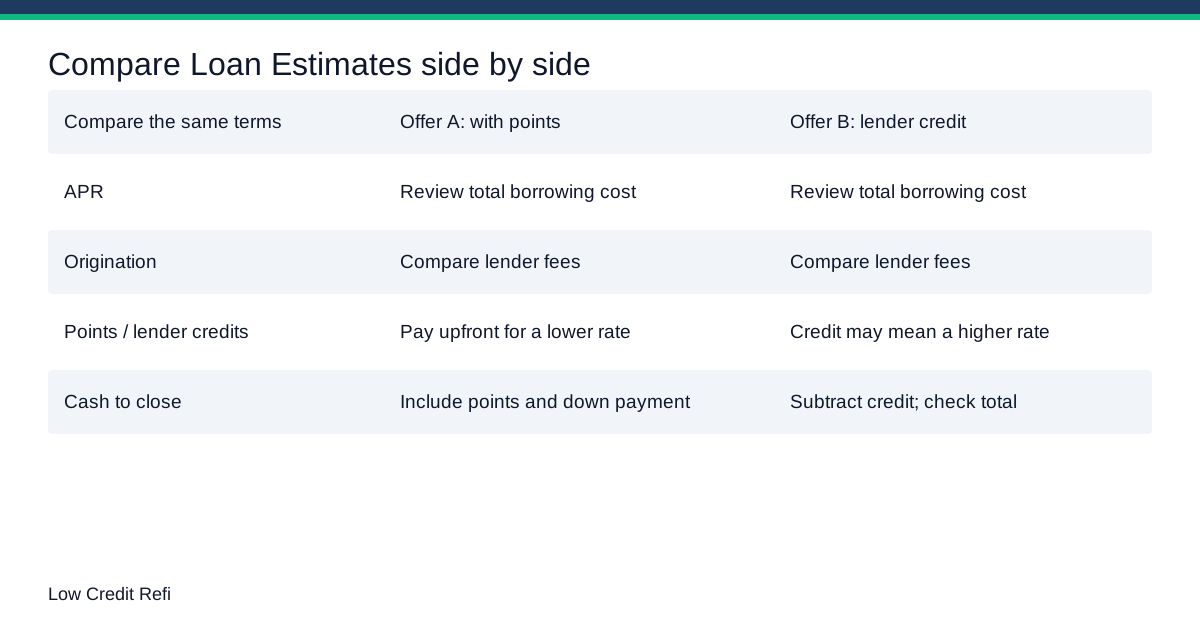
Compare Loan Estimates for the same loan type and term. Include closing costs when calculating whether refinancing saves money.
- Full income and employment verification
- Complete credit review and minimum 580 credit score
- New home appraisal
- Debt-to-income ratio generally below 50%
- Documentation of all assets and liabilities
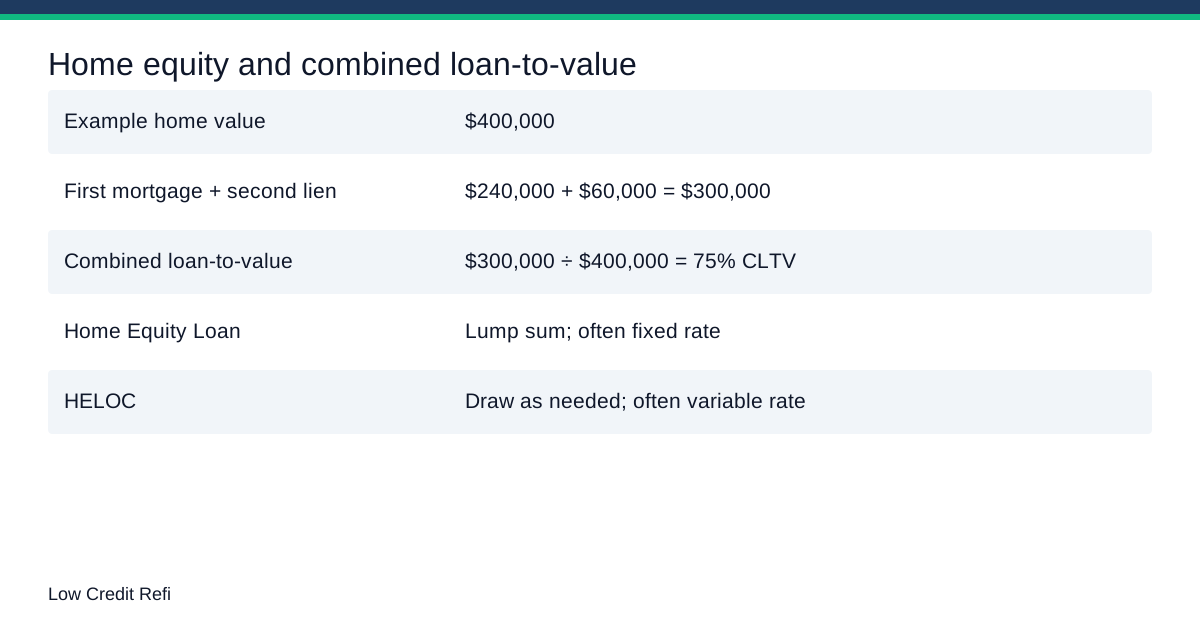
- At least 3.5% equity in your home (96.5% maximum loan-to-value ratio)
Cash-Out Versus Rate-and-Term Refinancing
Within the Simple Refinance program, you can choose between two approaches:
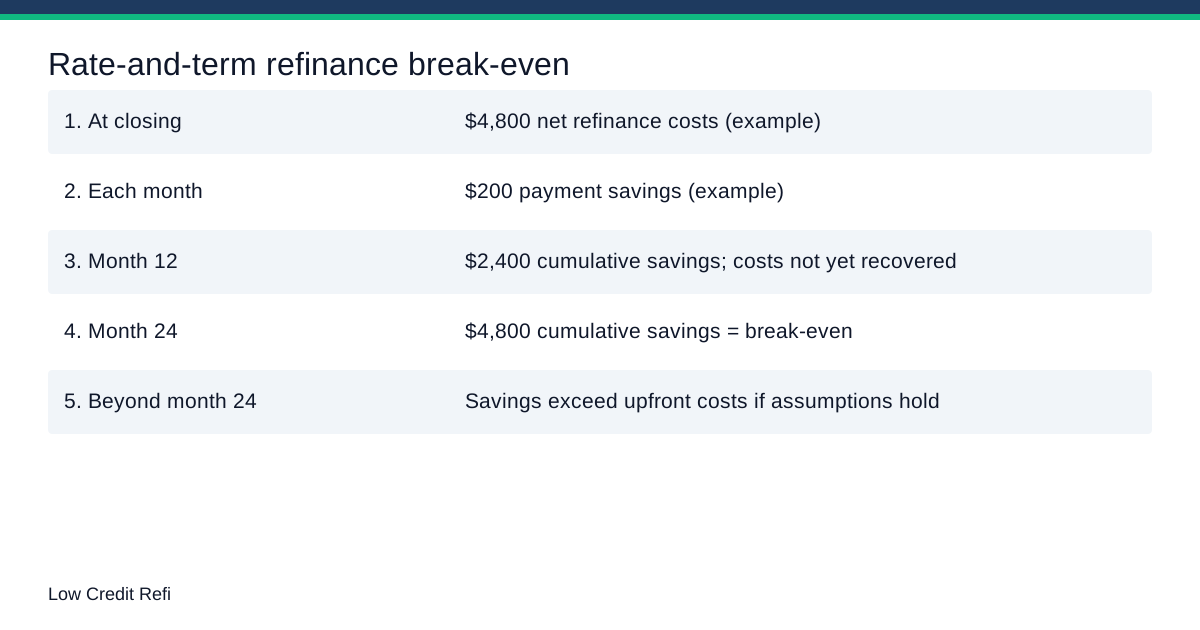
Rate-and-Term Refinance: You're simply replacing your existing conventional loan with an FHA loan, potentially lowering your rate, changing your term length, or switching from an adjustable to a fixed-rate mortgage. This option requires less equity and generally offers better rates.
Cash-Out Refinance: You're refinancing for more than you currently owe, taking the difference in cash. FHA cash-out refinances are limited to 80% loan-to-value ratio and face stricter qualification requirements. With a 600 credit score, you'll likely receive better terms with a rate-and-term refinance unless you have significant equity and a compelling need for cash.
Step-by-Step Process for Refinancing to FHA With a 600 Credit Score
Following this systematic approach increases your approval odds and helps you secure the most favorable terms available for your credit profile.
Step 1: Review Your Credit Reports
Obtain free credit reports from all three bureaus (Equifax, Experian, TransUnion) through AnnualCreditReport.com. Carefully review for errors, which appear on approximately 20% of credit reports. Dispute any inaccuracies immediately, as removing even one negative item could boost your score above 600, potentially improving your rate.
Step 2: Calculate Your Debt-to-Income Ratio
FHA lenders typically require debt-to-income ratios below 50%, though many prefer 43% or lower. Calculate your DTI by dividing your total monthly debt payments (including the proposed new mortgage payment, property taxes, insurance, HOA fees, credit cards, auto loans, student loans, and other obligations) by your gross monthly income.
If your DTI exceeds 50%, focus on paying down smaller debts before applying. Even reducing your DTI from 49% to 46% can significantly improve your approval odds and potentially lower your interest rate.
Step 3: Gather Required Documentation
Assemble these documents before contacting lenders:
- Two years of tax returns with all schedules
- Two recent pay stubs showing year-to-date income
- Two months of bank statements for all accounts
- Current mortgage statement
- Homeowners insurance declaration page
- Documentation explaining any credit issues (late payments, collections, etc.)
- If self-employed: Profit and loss statements for the current year
Not all mortgage lenders offer FHA loans, and among those that do, underwriting standards and rate competitiveness vary significantly. Contact at least 3-5 FHA-approved lenders to compare:
- Interest rates and annual percentage rates (APR)
- Upfront mortgage insurance premiums
- Annual mortgage insurance premiums
- Origination fees and closing costs
- Underwriting requirements specific to 600 credit scores
- Processing timelines
Once you've selected a lender, complete the formal application. The lender will order your credit report, verify your employment, and request the documentation you've assembled. They'll also order an appraisal to determine your home's current value.
Step 6: Navigate the Underwriting Process
The underwriter reviews your complete application, often requesting additional documentation or clarification. With a 600 credit score, expect extra scrutiny around:
- Reasons for credit score decline
- Recent payment history (especially mortgage payments)
- Employment stability
- Cash reserves after closing
Step 7: Close Your Loan
Once approved, you'll receive a Closing Disclosure at least three business days before your closing date. Review it carefully to ensure all terms match what you expected. At closing, you'll sign the final documents and pay any required closing costs not rolled into your new loan.
Cost Analysis: What to Expect When Refinancing
Understanding the complete cost picture helps you evaluate whether FHA refinancing makes financial sense for your situation.
| Cost Category | Typical Range (2026) | Notes for 600 Credit Score Borrowers |
|---|---|---|
| Upfront Mortgage Insurance Premium (UFMIP) | 1.75% of loan amount | Can be financed into loan; on $250,000 loan = $4,375 |
| Annual Mortgage Insurance Premium | 0.55% - 1.05% of loan balance annually | Higher credit risk = higher premiums; typically 0.85% for 600 scores |
| Appraisal Fee | $400 - $750 | Required for all FHA Simple Refinances |
| Origination Fee | 0% - 1.5% of loan amount | Average $1,500 - $3,000; negotiate this |
| Title Search and Insurance | $800 - $2,000 | Varies by loan amount and property value |
| Credit Report Fee | $30 - $100 | Covers all three bureaus |
| Underwriting Fee | $400 - $900 | May be higher for credit-challenged borrowers |
| Recording Fees | $100 - $400 | County/jurisdiction dependent |
| Prepaid Items | Varies | Property taxes, homeowners insurance, prepaid interest |
| Total Estimated Closing Costs | $7,000 - $15,000 | On a $250,000 refinance; includes UFMIP |
The Mortgage Insurance Consideration
Unlike conventional loans, which allow you to remove private mortgage insurance (PMI) once you reach 20% equity, FHA annual mortgage insurance premiums remain for the life of loans with less than 10% down payment. If you put down less than 10% on your original purchase (or are refinancing with less than 10% equity), this permanent mortgage insurance significantly increases your long-term costs.
Calculate your break-even point by comparing:
- Current conventional mortgage payment (principal, interest, taxes, insurance, PMI)
- Proposed FHA mortgage payment (principal, interest, taxes, insurance, FHA mortgage insurance)
- Upfront costs to refinance
Improving Your Approval Odds Despite a 600 Credit Score
While 600 credit scores qualify for FHA refinancing, these strategies strengthen your application and may improve your terms.
Demonstrate Recent Payment Responsibility
FHA underwriters weigh recent payment history heavily. If you've made all mortgage payments on time for the past 12 months—even if older credit issues dragged down your score—highlight this in your application. Consider providing a letter of explanation that contextualizes past credit problems (medical emergency, divorce, job loss) while emphasizing your current financial stability.
Increase Your Down Payment or Equity Position
While FHA allows refinancing up to 96.5% loan-to-value, borrowers with stronger equity positions receive more favorable treatment. If possible, time your refinance when you have at least 10% equity, or consider making a lump-sum principal payment before refinancing to improve your LTV ratio.
Reduce Your Debt-to-Income Ratio
Every percentage point you lower your DTI improves your application strength. Strategies include:
- Paying off small debts entirely to eliminate monthly obligations
- Increasing income through overtime, second jobs, or freelance work (must be documented and consistent)
- Refinancing high-payment debts (like credit cards) to lower-payment installment loans
- Having non-purchasing co-borrowers removed from joint debts if they can qualify independently
Build Cash Reserves
FHA underwriters view cash reserves—liquid assets remaining after closing—as a safety cushion. While not always required, demonstrating 2-6 months of mortgage payments in savings strengthens applications from borrowers with 600 credit scores. These reserves reassure underwriters that temporary income disruptions won't immediately lead to default.
Common Challenges and How to Overcome Them
Borrowers with 600 credit scores face predictable obstacles during FHA refinancing. Anticipating these issues helps you address them proactively.
Low Appraisal Values
If your home appraises for less than expected, your loan-to-value ratio increases, potentially disqualifying you or requiring a larger down payment. In declining markets or areas with few comparable sales, this becomes more likely. If you receive a low appraisal, you can:
- Challenge the appraisal with documentation of comparable sales the appraiser missed
- Pay down your loan balance to lower your LTV ratio
- Bring additional cash to closing to meet equity requirements
- Postpone refinancing until market conditions improve
Recent Derogatory Credit Events
FHA requires specific waiting periods after major credit events. If your 600 score reflects recent issues, you may need to wait:
- Bankruptcy: 2 years after Chapter 7 discharge; 12 months into Chapter 13 with court permission
- Foreclosure: 3 years from completion
- Short sale or deed-in-lieu: 3 years from completion
Employment Gaps or Income Irregularity
FHA underwriters prefer 2+ years of consistent employment in the same field. If you've changed jobs recently, have irregular income, or are self-employed, expect additional documentation requirements. Provide:
- Detailed explanation of employment changes
- Evidence that job changes represented career advancement
- If self-employed, a year-to-date profit and loss statement prepared by a CPA
- Multiple years of tax returns showing stable or increasing income
Frequently Asked Questions
A: Yes, FHA's minimum credit score is 580, though you'll face stricter requirements and higher interest rates than borrowers with 600+ scores. Some lenders implement overlays requiring 600+ scores, so you may need to contact multiple lenders to find one willing to work with 580 scores. Expect to provide extensive documentation justifying any credit issues and demonstrating current financial stability.
Q: How much will my interest rate differ between a 600 credit score and a 640 credit score on an FHA refinance?
A: The difference typically ranges from 0.25% to 0.625%, depending on the lender and current market conditions. On a $250,000 30-year mortgage, a 0.5% rate difference translates to approximately $75-80 in additional monthly payment and $27,000-29,000 in extra interest over the loan's life. If you're close to 620 or 640, spending 2-3 months improving your score before applying can generate substantial savings.
Q: Will refinancing from conventional to FHA with a 600 credit score hurt my credit score further?
A: The refinance process typically causes a temporary 5-10 point credit score drop due to the hard inquiry and potential increase in credit utilization if you close accounts. However, if refinancing lowers your monthly obligations significantly, your improved debt-to-income ratio may help your score recover within 3-6 months. The long-term impact depends on maintaining consistent, on-time payments on your new FHA loan.
Q: Can I remove FHA mortgage insurance later if my credit score improves?
A: FHA mortgage insurance cannot be removed based on credit score improvement alone. For loans with less than 10% down payment (or 10% equity at refinancing), FHA annual mortgage insurance continues for the loan's entire term. Your only option to eliminate it is refinancing again to a conventional loan once you have 20% equity and your credit score reaches conventional lending standards (typically 620-680+). Many borrowers use FHA as a stepping stone, refinancing to conventional after 2-3 years of improving their credit and building equity.
Q: What's the minimum time I need to wait after getting my current conventional mortgage before refinancing to FHA?
A: FHA doesn't impose a specific waiting period between refinances, but most lenders require at least 6-12 months of payment history on your current mortgage before approving a refinance. This waiting period serves two purposes: it demonstrates your ability to manage the mortgage payment, and it prevents rapid refinancing that might indicate financial instability. If you've had your conventional mortgage less than 6 months, focus on making on-time payments and improving your credit score before applying for FHA refinancing.
Take the Next Step Toward FHA Refinancing
The Refinance From Conventional to FHA With 600 Credit Score Guide demonstrates that your current credit challenges don't eliminate your refinancing options. FHA programs specifically accommodate borrowers in your situation, offering a practical path to potentially lower payments, better terms, or access to equity.
Every month you delay could mean hundreds of dollars in unnecessary interest payments or continued struggle with an unmanageable conventional mortgage. Our network of FHA-approved lenders specializes in working with borrowers who have credit scores between 580-620, and they understand the unique documentation and qualification strategies that maximize your approval chances.
Request your free, no-obligation FHA refinancing consultation today. We'll connect you with experienced loan officers who will review your specific situation, provide personalized rate quotes, and create a customized refinancing strategy designed for your 600 credit score. There's no cost for the initial consultation, and you'll receive clear answers about whether FHA refinancing makes financial sense for your unique circumstances. Complete the brief form above or call now to start your journey toward more manageable mortgage payments and greater financial flexibility.
Frequently Asked Questions
What credit score do I need to refinance from conventional to FHA?
FHA loans require a minimum credit score of 580 for standard refinancing. With a 600 credit score, you meet this requirement. However, individual lenders may set higher overlays, so it's wise to shop around for a lender that accepts scores in your range.
Can I refinance from conventional to FHA if I have little equity?
Yes, FHA allows loan-to-value ratios up to 96.5%, meaning you need at least 3.5% equity in your home. If your home's value has declined, you may still qualify as long as you meet this equity threshold and other requirements.
How does a 600 credit score affect my FHA refinance interest rate?
With a 600 credit score, you can expect an interest rate about 0.75% to 1.5% higher than borrowers with excellent credit. However, FHA rates are generally more favorable than conventional rates for similar credit profiles, making this a cost-effective option.
What documents do I need for an FHA refinance with a 600 credit score?
You'll typically need pay stubs, W-2s or tax returns, bank statements, a government-issued ID, and your current mortgage statement. Lenders will also review your credit report and may require a home appraisal to confirm the property's value.
Key Takeaways
- Understanding your options for refinance from conventional to fha with 600 credit score guide is the first step
- Getting pre-qualified helps you understand your real options