Compare Live Mortgage & Home Equity Rates
Compare current APRs, points, fees, and estimated monthly payments from participating lenders below.
Mortgage rates
How to Compare Lender Paid vs Borrower Paid Mortgage Insurance
Quick Answer: To compare lender-paid (LPMI) vs borrower-paid mortgage insurance (BPMI), calculate the total cost over your expected time in the loan. BPMI adds a monthly premium (higher for 580-620 credit scores) but may be tax-deductible and cancellable. LPMI eliminates the monthly payment but increases your interest rate, costing more over time if you keep the loan long-term. Use a mortgage calculator to compare monthly payments and total interest.
When you're exploring mortgage refinancing options with a credit score between 580 and 620, understanding how to compare lender paid vs borrower paid mortgage insurance becomes crucial to your financial success. Mortgage insurance (MI) protects lenders when borrowers make down payments below 20%, and for borrowers in the 580-620 credit range, this requirement is nearly universal. The fundamental difference is simple: with borrower-paid mortgage insurance (BPMI), you pay a monthly premium added to your mortgage payment, while lender-paid mortgage insurance (LPMI) involves your lender covering the insurance cost in exchange for a higher interest rate. This decision impacts your monthly budget, tax deductions, long-term costs, and refinancing flexibility for years to come. For borrowers with challenged credit seeking to refinance, choosing the right mortgage insurance structure can mean the difference between affordable payments and financial strain.
Understanding Your Mortgage Insurance Options as a 580-620 Credit Borrower
Mortgage insurance exists because lenders face higher risk when borrowers have lower credit scores or smaller down payments. With a credit score between 580 and 620, you're in what lenders classify as a "subprime" or "near-prime" category, which means mortgage insurance isn't optional—it's a requirement that opens the door to homeownership and refinancing opportunities.
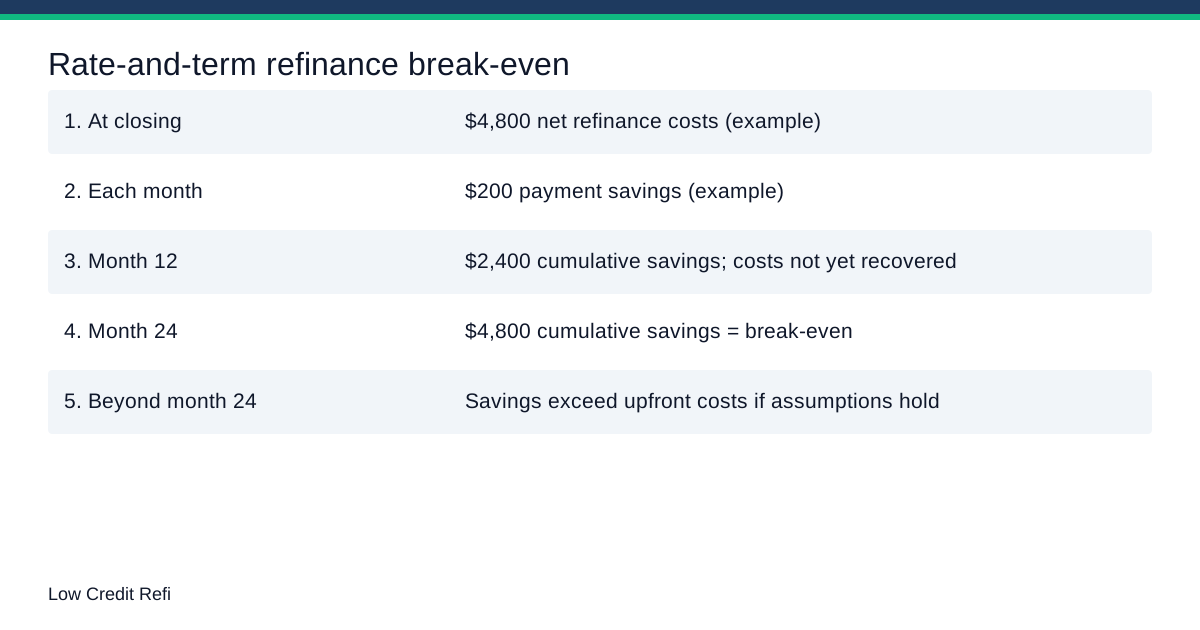
The two primary structures for mortgage insurance serve the same protective function for lenders but create dramatically different financial scenarios for you as the borrower. Borrower-paid mortgage insurance (BPMI) appears as a separate line item on your monthly statement, typically ranging from 0.85% to 1.95% of your loan amount annually for borrowers in your credit range. On a $250,000 refinance loan, this translates to approximately $177 to $406 per month added to your payment.
Lender-paid mortgage insurance (LPMI) removes that monthly charge entirely but compensates through a higher interest rate—typically 0.25% to 0.75% higher than you'd receive with BPMI. This seemingly small percentage increase compounds significantly over a 30-year loan term, which is why understanding how to compare lender paid vs borrower paid mortgage insurance requires looking beyond the immediate monthly payment.
For refinancing borrowers with 580-620 credit scores, mortgage insurance typically cannot be removed until you reach 20% equity through either payments or appreciation, and with LPMI, you're locked into that higher rate unless you refinance again.
Breaking Down Borrower-Paid Mortgage Insurance (BPMI)
Borrower-paid mortgage insurance functions as a straightforward monthly expense added to your mortgage payment. Your lender arranges the insurance through a private mortgage insurance company, and you pay the premium directly. For borrowers with credit scores in the 580-620 range, BPMI rates are significantly higher than those offered to borrowers with excellent credit, but they still provide valuable benefits.
BPMI Cost Structure for 580-620 Credit Scores
The premium you'll pay depends on several factors: your exact credit score, loan-to-value ratio (LTV), loan amount, and the specific insurer your lender uses. As of 2026, expect these ranges:
- 580-599 credit score: 1.65% to 1.95% of loan amount annually
- 600-620 credit score: 1.20% to 1.65% of loan amount annually
- LTV above 95%: Rates at the higher end of these ranges
- LTV 90-95%: Mid-range rates
- LTV 85-90%: Lower rates within your credit band
Key Advantages of BPMI
The transparency of BPMI serves borrowers well. You can see exactly what you're paying each month, and most importantly, you can request cancellation once you reach 20% equity in your home—either through regular payments, extra principal payments, or property appreciation. Federal law requires automatic termination at 22% equity for most loans.
Expert Tip
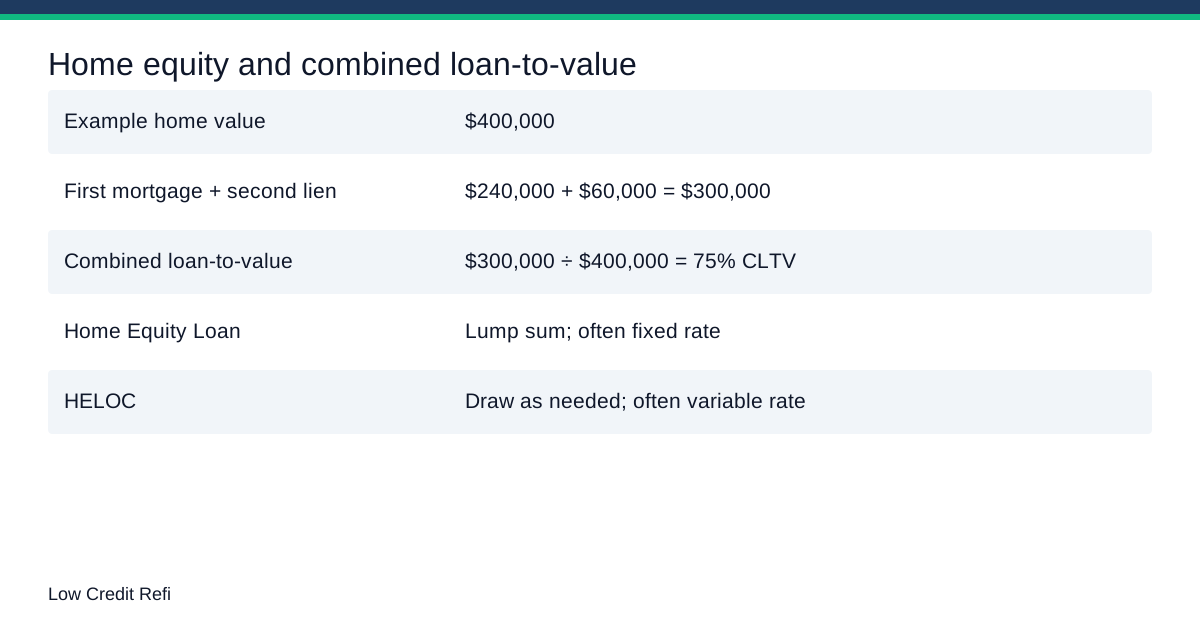
Compare Loan Estimates for the same loan type and term. Include closing costs when calculating whether refinancing saves money.
For borrowers with improving credit, BPMI provides flexibility. If your credit score rises from 605 to 680 over three years, you might refinance into a conventional loan without mortgage insurance once you have sufficient equity, eliminating this cost entirely. This escape route makes BPMI particularly attractive for borrowers actively working on credit repair.
Additionally, BPMI premiums may be tax-deductible depending on your income level and tax situation, though this benefit has been subject to legislative changes and should be verified with a tax professional for your specific circumstances.
Analyzing Lender-Paid Mortgage Insurance (LPMI)
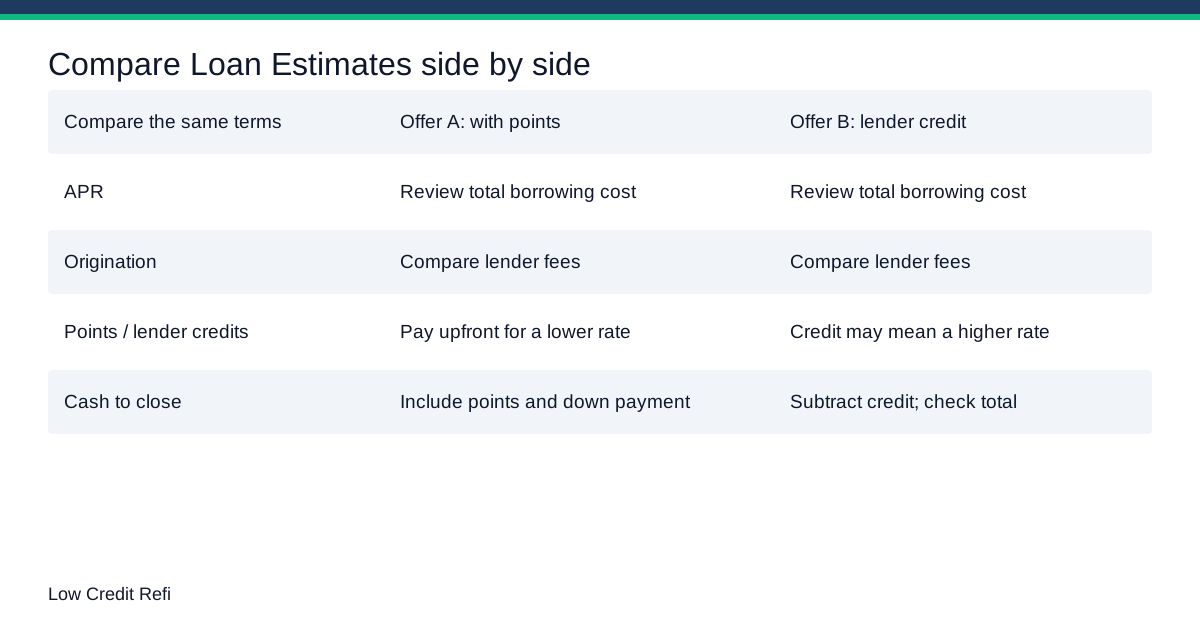
Lender-paid mortgage insurance creates a completely different financial arrangement. Your lender pays the mortgage insurance premium upfront or through ongoing fees to the insurer, then recoups this cost by charging you a higher interest rate—typically 0.25% to 0.75% more than you'd pay with BPMI.
LPMI Interest Rate Adjustments
For borrowers with 580-620 credit scores, the rate adjustment tends toward the higher end of this spectrum. If your BPMI loan would carry a 7.25% interest rate, your LPMI option might come with a 7.75% to 8.00% rate. This difference seems modest but creates substantial long-term cost implications.
The Monthly Payment Advantage
The immediate appeal of LPMI is the lower monthly payment compared to BPMI. Without that separate insurance premium, your required monthly payment drops, which can help you qualify for a larger loan or simply ease your monthly budget constraints. For borrowers with tight debt-to-income ratios—common among those with 580-620 credit scores—this reduced payment requirement can mean the difference between loan approval and denial.
The Hidden Long-Term Cost
The critical disadvantage emerges when you examine total costs over time. That higher interest rate applies to your entire loan balance every month for the life of the loan unless you refinance. Unlike BPMI, which you can eventually eliminate, the higher interest rate with LPMI remains permanent for that particular loan.
Consider a $250,000 refinance loan over 30 years. With BPMI at $300/month for an estimated 10 years before cancellation (assuming regular appreciation and payments), you'd pay approximately $36,000 in mortgage insurance premiums. With LPMI incorporating a 0.50% higher interest rate, you'd pay approximately $27,000 more in the first 10 years, but critically, you'd continue paying that premium indefinitely—totaling roughly $81,000 in additional interest over 30 years if you never refinance.
Cost Comparison Table: BPMI vs LPMI for Different Scenarios
| Scenario Details | BPMI Option | LPMI Option | 10-Year Total Cost | 30-Year Total Cost |
|---|---|---|---|---|
| $200K loan, 605 score, 90% LTV | 7.25% rate + $242/mo MI | 7.75% rate, no MI | BPMI: $29,040 MI / LPMI: $21,600 extra interest | BPMI: $29,040 MI / LPMI: $64,800 extra interest |
| $250K loan, 590 score, 95% LTV | 7.50% rate + $352/mo MI | 8.25% rate, no MI | BPMI: $42,240 MI / LPMI: $40,500 extra interest | BPMI: $42,240 MI / LPMI: $121,500 extra interest |
| $300K loan, 615 score, 88% LTV | 7.00% rate + $305/mo MI | 7.50% rate, no MI | BPMI: $36,600 MI / LPMI: $32,400 extra interest | BPMI: $36,600 MI / LPMI: $97,200 extra interest |
| $175K loan, 600 score, 92% LTV | 7.375% rate + $219/mo MI | 8.00% rate, no MI | BPMI: $26,280 MI / LPMI: $23,625 extra interest | BPMI: $26,280 MI / LPMI: $70,875 extra interest |
Assumptions: BPMI removed after 10 years; rates and insurance costs reflect 2026 market conditions for 580-620 credit range; actual costs vary by lender and specific borrower profile.
Key Decision Factors for Your Refinance Situation
Understanding how to compare lender paid vs borrower paid mortgage insurance requires evaluating your personal financial situation against these critical factors:
Your Expected Timeline in the Home
If you plan to refinance again within 3-5 years as your credit improves, LPMI might serve you well since you'll escape the higher rate through refinancing before long-term costs accumulate significantly. Borrowers actively working on credit repair who expect to jump from 605 to 680+ within a few years often benefit from LPMI's lower monthly payment without suffering the full long-term cost penalty.
Conversely, if you expect this to be your permanent loan or plan to stay in the home for 10+ years without refinancing, BPMI almost always proves less expensive in total costs.
Your Current Budget Constraints
For borrowers with 580-620 credit scores, monthly cash flow often presents the primary challenge. If qualifying for the loan requires the lowest possible monthly payment, LPMI's elimination of the separate mortgage insurance premium might be your only viable path to approval. Your debt-to-income ratio calculation includes the BPMI premium but treats the LPMI rate increase as part of your base payment, sometimes creating qualification advantages.
Potential for Credit Score Improvement
Your credit trajectory matters enormously. If you're at 590 due to temporary financial setbacks but have a clear path to 700+ credit within 18-24 months, LPMI provides a short-term solution before you refinance into a conventional loan without mortgage insurance. However, if your credit challenges are ongoing without clear resolution, BPMI's eventual cancellation option becomes more valuable.
Tax Deduction Considerations
BPMI premiums may be tax-deductible depending on your income and current tax legislation, while the additional interest from LPMI is generally deductible as mortgage interest. The practical difference depends on your tax bracket and itemization status. For most borrowers with 580-620 credit scores, income levels typically allow mortgage insurance deductions when available, making BPMI slightly more attractive from a tax perspective.
Property Appreciation Expectations
If you're refinancing in a market with strong appreciation trends, BPMI becomes more attractive because you'll reach 20% equity faster, allowing earlier cancellation. In flat or declining markets, the timeline to 20% equity extends significantly, making LPMI's lower monthly payment potentially more valuable despite higher long-term costs.
The Refinancing Process with 580-620 Credit Scores
Securing mortgage refinancing with a credit score between 580 and 620 requires understanding lender requirements and preparing accordingly:
- Review your credit reports thoroughly - Dispute any errors that might be suppressing your score, as even a 10-point increase can improve your rate and mortgage insurance costs significantly.
- Calculate your home equity position - Lenders need you to have sufficient equity (typically at least 10% but preferably 15-20% for better terms) to approve refinancing with your credit profile.
- Document stable income - Two years of consistent employment or self-employment income helps offset credit concerns in lender underwriting models.
- Minimize debt-to-income ratio - Pay down credit cards and other revolving debt before applying to present the strongest possible financial profile.
- Compare multiple lender offers - Different lenders have varying risk tolerances and mortgage insurance arrangements, making comparison shopping essential for finding your best terms.
- Ask specifically about both BPMI and LPMI options - Not all lenders offer both structures, and some may not present both options unless you request them directly.
- Get detailed cost projections - Request good faith estimates showing total costs over 5, 10, and 30 years for both insurance structures to make informed comparisons.
Common Mistakes to Avoid When Choosing Your Mortgage Insurance Structure
Borrowers with 580-620 credit scores frequently make preventable errors when evaluating how to compare lender paid vs borrower paid mortgage insurance:
Focusing solely on monthly payment - The lowest monthly payment today often means the highest total cost over time. Always examine total cost projections over your expected loan timeline.
Ignoring future refinance opportunities - Your credit score won't remain at 605 forever if you're working on improvement. Factor realistic credit progression into your decision, as this affects whether LPMI's escape-through-refinancing strategy makes sense.
Forgetting about BPMI cancellation - Many borrowers don't realize they can request BPMI cancellation at 20% equity or that automatic cancellation occurs at 22% equity, making them underestimate BPMI's value compared to permanent LPMI rate increases.
Accepting the first offer - Lenders vary dramatically in their mortgage insurance pricing and rate adjustments, particularly for borrowers with challenged credit. The first offer you receive is rarely your best available option.
Overlooking hybrid strategies - Some lenders offer split-premium options or other creative structures that blend BPMI and LPMI characteristics, potentially providing middle-ground solutions worth exploring.
Frequently Asked Questions
Yes, you can refinance at any time to escape LPMI's higher interest rate. Once your credit score reaches 640 or higher and you have at least 20% equity, you may qualify for a conventional refinance without any mortgage insurance. However, refinancing involves closing costs (typically $3,000-$6,000 nationally), so calculate whether your savings from the lower rate exceed these costs within your planned timeline. For borrowers whose scores improve from 605 to 680, refinancing often makes sense within 2-3 years.
Will choosing BPMI instead of LPMI help me build equity faster?
Not directly. Both options require the same principal payments toward your loan balance, which is what builds equity. However, BPMI creates a lower total monthly obligation in some scenarios, potentially allowing you to make extra principal payments with money saved from the lower interest rate. The real equity advantage comes from eventually eliminating BPMI once you reach 20% equity, while LPMI's rate premium continues forever unless you refinance.
What happens to my mortgage insurance if property values decline?
With BPMI, declining property values prevent you from reaching 20% equity and therefore delay your ability to cancel mortgage insurance. With LPMI, property values don't affect your higher interest rate—it remains constant regardless of home value changes. In declining markets, this makes LPMI's predictable cost structure somewhat advantageous, though both options continue functioning normally despite value fluctuations.
Do FHA loans offer better mortgage insurance options than conventional loans for 580-620 credit scores?
FHA loans accept credit scores as low as 580 with 3.5% down, but their mortgage insurance structure differs significantly from conventional BPMI and LPMI. FHA charges an upfront mortgage insurance premium (1.75% of the loan amount) plus annual premiums (0.55%-0.85%) that typically cannot be removed unless you put down at least 10% initially and wait 11 years. For borrowers with 600+ credit scores and 10% equity, conventional BPMI or LPMI often costs less long-term than FHA insurance despite the higher credit standards.
Can I switch from BPMI to LPMI or vice versa without refinancing?
No, your mortgage insurance structure is locked at origination and cannot be changed without refinancing into a new loan. This permanence makes your initial choice crucial. However, you can eliminate BPMI by reaching 20% equity through payments and appreciation, or escape LPMI's higher rate by refinancing to a loan with better terms once your credit improves. Some borrowers strategically choose LPMI for immediate qualification, then refinance to a BPMI loan once their credit score increases, eventually canceling BPMI when they reach sufficient equity.
Take the Next Step Toward Your Refinancing Goals
Deciding how to compare lender paid vs borrower paid mortgage insurance becomes clearer when you receive personalized quotes reflecting your specific credit profile, property value, and financial goals. With a credit score between 580 and 620, your mortgage insurance choice significantly impacts both your immediate budget and your long-term financial health.
The right mortgage insurance structure depends on your unique situation: your timeline for credit improvement, monthly budget constraints, property appreciation expectations, and plans for staying in your home. What works perfectly for one borrower in your credit range might be completely wrong for another.
Request your free, no-obligation refinancing consultation today. Our specialized lending partners work specifically with borrowers in the 580-620 credit range and can provide side-by-side comparisons of BPMI and LPMI options tailored to your situation. You'll receive detailed cost projections, rate quotes from multiple lenders, and expert guidance on which mortgage insurance structure positions you for both immediate approval and long-term savings.
Don't let mortgage insurance confusion prevent you from accessing the refinancing benefits you deserve. Complete our simple 2-minute form to connect with
Frequently Asked Questions
What is the main difference between lender-paid and borrower-paid mortgage insurance?
With borrower-paid mortgage insurance (BPMI), you pay a monthly premium added to your mortgage payment. With lender-paid mortgage insurance (LPMI), the lender covers the insurance cost but charges a higher interest rate. BPMI can be canceled when you reach 20% equity, while LPMI is permanent for the loan term.
Which is better for borrowers with a 580-620 credit score: LPMI or BPMI?
It depends on your plans. If you expect to refinance or sell within a few years, BPMI may be better because you avoid a permanently higher rate. If you plan to stay long-term and want a lower monthly payment, LPMI could work, but the higher rate increases total interest. Compare total costs using a mortgage calculator.
Can I deduct borrower-paid mortgage insurance on my taxes?
Borrower-paid mortgage insurance premiums may be tax-deductible as mortgage interest, subject to income limits and IRS rules. Lender-paid mortgage insurance is not deductible because the cost is built into your interest rate. Consult a tax professional for your specific situation.
How does my credit score affect mortgage insurance costs for refinancing?
With a credit score between 580 and 620, mortgage insurance rates are higher than for borrowers with better credit. BPMI premiums typically range from 1.20% to 1.95% of the loan amount annually. LPMI results in a rate increase of 0.25% to 0.75% above the standard rate. Your exact costs depend on your lender and loan details.
Key Takeaways
- Understanding your options for how to compare lender paid vs borrower paid mortgage insurance is the first step
- Getting pre-qualified helps you understand your real options