Compare Live Mortgage & Home Equity Rates
Compare current APRs, points, fees, and estimated monthly payments from participating lenders below.
Mortgage rates
How Much Income Do You Need to Refinance With Low Credit
Quick Answer: The income needed to refinance with low credit (580-620) depends on your debt-to-income ratio and loan type. Lenders typically require total monthly debts not exceed 43-50% of gross monthly income. For example, with $2,500 in monthly debts, you'd need at least $5,000-$5,800 monthly ($60,000-$70,000 annually). Government-backed loans may allow higher DTIs.
If you're wondering how much income do you need to refinance with low credit, the answer depends on your debt-to-income ratio and loan type. Most lenders require that your total monthly debt payments—including your new mortgage—don't exceed 43-50% of your gross monthly income. For borrowers with credit scores between 580-620, expect stricter income verification and potentially higher income requirements to offset credit risk. For example, if your total monthly debts equal $2,500, you'll typically need to earn at least $5,000-$5,800 monthly ($60,000-$70,000 annually) to qualify for refinancing with low credit.
Refinancing your mortgage when your credit score falls in the 580-620 range presents unique challenges, but understanding the income requirements can significantly improve your approval odds. This comprehensive guide explains exactly what lenders look for, how to calculate whether your income qualifies, and strategies to strengthen your refinance application even with less-than-perfect credit.
When considering how much income do you need to refinance with low credit, you should understand all available options.
Understanding Debt-to-Income Requirements for Low-Credit Refinancing
Your debt-to-income ratio (DTI) represents the percentage of your gross monthly income that goes toward debt obligations. This metric becomes especially critical when your credit score is below 620, as lenders view you as higher risk and compensate by enforcing stricter DTI limits.
Front-End Ratio (Housing Ratio): This includes only your housing expenses—principal, interest, property taxes, homeowners insurance, and HOA fees if applicable. Most lenders cap this at 28-31% for low-credit borrowers, though some programs allow up to 35%.
Back-End Ratio (Total DTI): This encompasses all monthly debt obligations, including your mortgage payment, car loans, student loans, credit cards, and personal loans. For borrowers with 580-620 credit scores, conventional lenders typically require DTI below 43%, while government-backed programs may allow up to 50% with compensating factors.
Calculating Your Qualifying Income
To determine the minimum income needed, use this formula:
Required Monthly Income = Total Monthly Debts ÷ Maximum DTI Ratio
For instance, if your proposed mortgage payment is $1,800 and you have $700 in other monthly debts ($2,500 total), with a maximum 43% DTI:
Expert Tip
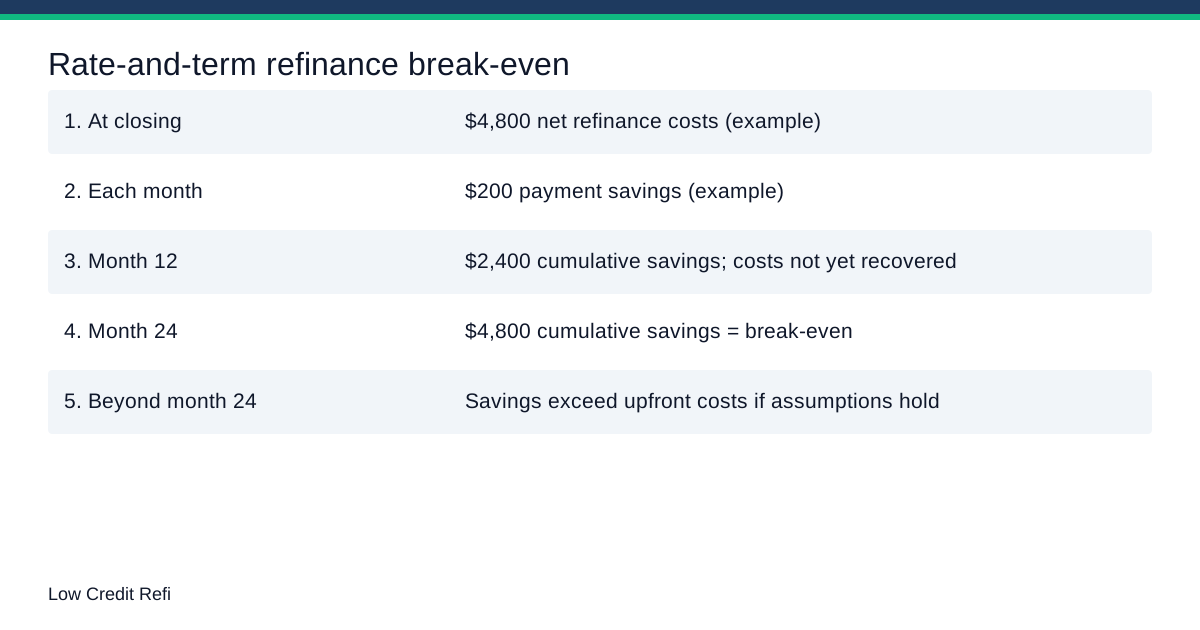
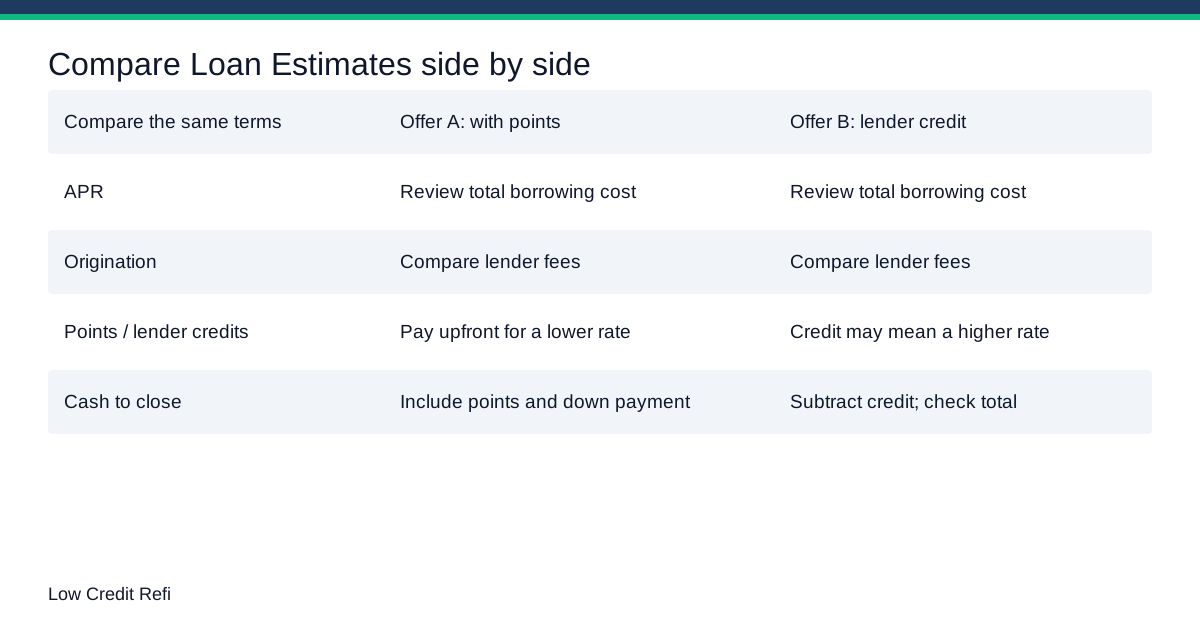
Compare Loan Estimates for the same loan type and term. Include closing costs when calculating whether refinancing saves money.
$2,500 ÷ 0.43 = $5,814 minimum monthly gross income (approximately $69,768 annually)
With a more conservative 38% DTI requirement some lenders impose on low-credit applicants:
$2,500 ÷ 0.38 = $6,579 minimum monthly gross income (approximately $78,948 annually)
Types of Income Lenders Consider
When evaluating your refinance application with a credit score between 580-620, lenders scrutinize income stability and verifiability more carefully. Understanding which income sources count—and how they're calculated—can help you maximize your qualifying income.
Fully Qualifying Income Sources
W-2 Employment Income: The most straightforward income type. Lenders average your last two years of earnings, with greater weight on recent paystubs. If your income has increased consistently, this works in your favor.
Self-Employment Income: Requires two years of tax returns. Lenders calculate your qualifying income by averaging your net profit after business expenses and adding back non-cash deductions like depreciation. This often results in lower qualifying income than your actual cash flow, making it challenging for self-employed borrowers with low credit.
Social Security and Pension Income: Counted at full value with proof of continuity. These stable income sources are particularly valuable for borrowers with challenged credit, as they demonstrate reliability.
Disability and VA Benefits: Fully counted if documentation shows payments will continue for at least three years beyond the refinance date.
Partially Qualifying Income Sources
Rental Income: Typically 75% of documented rental income counts toward qualification, accounting for vacancy and maintenance. You'll need lease agreements and two years of tax returns showing rental activity.
Bonus and Commission Income: Averaged over two years and may be discounted if declining or inconsistent. For low-credit borrowers, lenders often exclude this income unless it shows a clear upward trend.
Investment and Dividend Income: Counts if you can demonstrate continuity, usually requiring two years of tax returns and recent statements showing the income source remains intact.
Program-Specific Income Requirements for Low-Credit Borrowers
Different refinance programs offer varying flexibility for borrowers with 580-620 credit scores, each with distinct income verification standards.
FHA Streamline Refinance
The FHA streamline refinance provides the most lenient path for borrowers with existing FHA loans and credit scores as low as 580. Maximum DTI ratios extend to 50% with automated underwriting approval, potentially reducing income requirements.
Minimum Income Example: With $2,200 in total monthly debts, you'd need approximately $4,400 monthly income ($52,800 annually) at the 50% DTI threshold. However, credit scores below 600 may trigger manual underwriting, which often imposes a 43% DTI cap, raising the requirement to roughly $5,116 monthly ($61,392 annually).
2026 Cost Considerations: FHA refinances require upfront mortgage insurance of 1.75% of the loan amount (often rolled into the loan) plus annual mortgage insurance premiums of 0.55-0.85% for most loan amounts, adding $150-$300+ monthly to payment requirements on a $250,000 loan.
VA Interest Rate Reduction Refinance Loan (IRRRL)
Veterans with existing VA loans can access the IRRRL program regardless of credit score, with no minimum credit requirement at many lenders. Income verification is minimal—you simply need to demonstrate you can afford the new payment.
Income Advantage: The VA doesn't impose strict DTI limits on IRRRLs, though lenders may apply overlays. Residual income requirements (ensuring sufficient funds remain after debts for living expenses) replace traditional DTI calculations, which can benefit borrowers with higher incomes relative to family size.
Conventional 97 LTV Refinance
Conventional refinancing with credit scores in the 580-620 range faces the strictest income requirements. Most lenders set credit score floors at 620 for conventional loans, though some portfolio lenders accept 580+ with compensating factors, including higher income.
Income Requirements: Expect DTI limits of 36-43%, with the lower end more common for sub-620 scores. On $2,500 in monthly debts, you'd need $5,814-$6,944 monthly income ($69,768-$83,328 annually).
2026 Costs: Conventional refinancing with low credit scores triggers risk-based pricing adjustments, adding 2.5-3.5% to your loan costs—approximately $6,250-$8,750 on a $250,000 loan, which can be financed but increases your payment and therefore income requirements.
Step-by-Step Process to Determine Your Income Qualification
Follow this systematic approach to assess whether your income meets lender requirements for refinancing with a 580-620 credit score:
- Pull your credit reports from all three bureaus and verify your middle score falls within the 580-620 range, as this determines which programs and rate tiers you'll access.
- Calculate your proposed mortgage payment using current interest rates (factor in your low credit pricing), estimated property taxes, homeowners insurance, and mortgage insurance if applicable. For a $250,000 loan at 7.25% (typical 2026 rate for 600 credit), expect approximately $1,706 monthly principal and interest, plus $400-600 for taxes and insurance, totaling $2,100-2,300.
- List all monthly debt obligations that appear on your credit report: minimum credit card payments, auto loans, student loans, personal loans, and any other installment debts. Include child support or alimony if applicable.
- Add your proposed mortgage payment to your monthly debts to determine total monthly obligations.
- Calculate the minimum income requirement by dividing total monthly debts by your maximum allowable DTI ratio (0.43 for most conventional and FHA refinances, 0.50 for FHA streamline with automated approval).
- Document all income sources using the standards outlined above, gathering paystubs, W-2s, tax returns, and benefit statements as needed.
- Compare your documented income to the minimum requirement. If you fall short, explore strategies in the next section to strengthen your application.
Strategies to Meet Income Requirements With Challenged Credit
When your initial calculations show insufficient income, several approaches can help you qualify for refinancing despite a 580-620 credit score.
Pay Down Debt to Improve DTI
Reducing your monthly debt obligations directly lowers the income requirement. Paying off a car loan with a $400 monthly payment, for example, reduces your qualifying income need by approximately $930 at a 43% DTI requirement ($400 ÷ 0.43).
Prioritize debts with the highest monthly payments relative to balance. A $5,000 personal loan with a $300 monthly payment provides more DTI relief than paying down a $10,000 credit card with a $200 minimum payment.
Add a Co-Borrower
Including a spouse or family member who will live in the home adds their income to your application. Their credit score will also factor into the loan decision—if their score exceeds 620, you may access better terms and looser income requirements.
Both borrowers' debts count toward DTI, so this strategy works best when the additional borrower has high income relative to their debt obligations.
Increase Your Down Payment or Equity Position
While this doesn't directly change income requirements, a lower loan-to-value ratio (higher equity) can persuade lenders to approve borderline DTI cases. Bringing the LTV below 80% also eliminates mortgage insurance requirements on conventional loans, reducing your monthly payment and therefore the income needed to qualify.
For a cash-out refinance, reducing the cash you're taking out achieves the same result.
Consider Non-QM Lenders
Non-qualified mortgage lenders use alternative income verification methods, including bank statement programs that calculate income from deposits rather than tax returns. These work particularly well for self-employed borrowers whose tax returns show lower income than their actual cash flow.
Expect higher interest rates—typically 1-3% above conventional rates in 2026—but more flexible income calculation methods that may help you qualify. Non-QM lenders also often accept credit scores as low as 580 with adequate income documentation.
Wait and Improve Your Credit Score
Sometimes the best strategy is patience. Improving your credit score from 600 to 640 over 6-12 months can reduce your interest rate by 0.5-0.75%, lower your monthly payment by $75-125 on a $250,000 loan, and reduce the income needed to qualify. It also opens access to conventional programs with more flexible income requirements.
Focus on payment history (making all payments on time), credit utilization (keeping balances below 30% of limits), and correcting any errors on your credit report.
Income Documentation Requirements for Low-Credit Refinancing
Lenders impose more rigorous documentation standards on borrowers with 580-620 credit scores. Expect to provide:
For W-2 Employees: Recent paystubs covering 30 days, W-2 forms from the past two years, and written verification of employment. Lenders will contact your employer to verify continued employment and income.
For Self-Employed Borrowers: Personal and business tax returns (all schedules) for two years, year-to-date profit and loss statement, business bank statements for 2-3 months, and a CPA-prepared financial statement in some cases.
For Rental Income: Lease agreements for all properties, Schedule E from tax returns for two years, and documentation of property ownership. Some lenders also require an appraisal to verify the property values.
For Government Benefits: Award letters or benefit statements showing payment amounts and duration, plus bank statements demonstrating regular deposit of benefits.
Incomplete documentation causes most low-credit refinance denials. Gather everything upfront and respond quickly to additional requests to keep your application moving forward.
Comparing Income Requirements Across Refinance Scenarios
| Refinance Type | Credit Score | Max DTI | Monthly Debts | Minimum Monthly Income | Minimum Annual Income |
|---|---|---|---|---|---|
| FHA Streamline (Auto) | 580-620 | 50% | $2,500 | $5,000 | $60,000 |
| FHA Streamline (Manual) | 580-620 | 43% | $2,500 | $5,814 | $69,768 |
| VA IRRRL | 580-620 | Varies | $2,500 | $4,500-5,500 | $54,000-66,000 |
| Conventional | 580-620 | 38% | $2,500 | $6,579 | $78,948 |
| Non-QM Bank Statement | 580-620 | 45% | $2,500 | $5,556 | $66,672 |
VA uses residual income standards rather than strict DTI Estimates based on typical residual income requirements for family size
Frequently Asked Questions
There's no universal minimum income to refinance with a 600 credit score—it depends entirely on your debt-to-income ratio. With no other debts and a $1,500 monthly mortgage payment, you might qualify with as little as $3,000-3,950 monthly income ($36,000-47,400 annually) depending on the loan program. However, most borrowers carry additional debts, pushing income requirements to $50,000-70,000+ annually for typical refinance scenarios.
Can you refinance with a 580 credit score and low income?Yes, refinancing with a 580 credit score and low income is possible through FHA streamline refinance (if you have an existing FHA loan) or VA IRRRL (for veterans with VA loans). These programs offer the most flexible debt-to-income ratios, potentially allowing approval with income as low as $45,000-55,000 annually if your debts are minimal. Conventional refinancing rarely accepts credit scores below 620.
Do refinance lenders verify income for borrowers with bad credit?Absolutely—lenders verify income more thoroughly for borrowers with bad credit (580-620 range), not less. Expect full documentation requirements including recent paystubs, tax returns, and direct employer verification. The only exception is VA IRRRL programs, which often waive income verification entirely, though your payment history on the existing loan must demonstrate ability to pay.
How does self-employment affect refinancing with low credit scores?Self-employment significantly complicates refinancing with credit scores between 580-620. Lenders average your net business income from two years of tax returns, which often shows less income than you actually bring home due to business deductions. You'll typically need 20-30% higher actual earnings to qualify compared to W-2 employees. Non-QM bank statement programs offer an alternative, calculating income from 12-24 months of business bank deposits, though rates run 1-3% higher.
What if my income is too low to refinance with a 590 credit score?If your income falls short for refinancing with a 590 credit score, you have several options: pay down debts to lower your DTI ratio, add a qualified co-borrower with additional income, reduce your loan amount by bringing cash to closing, wait to improve your credit score (which loosens income requirements), or explore non-QM lenders with more flexible standards. Additionally, verify that your lender is calculating income correctly—rental income, disability benefits, and non-taxed income sources are sometimes undercounted.
Get Your Free Refinance Consultation Today
Understanding
how much income do you need to refinance with low credit is just the first step. Every borrower's situation is unique, with different debt profiles, income sources, and refinancing goals that affect qualification standards.Our network of refinance specialists works exclusively with borrowers in the 580-620 credit score range, helping you navigate income requirements, documentation standards, and program selection to maximize your approval odds. We'll review your complete financial picture, calculate your exact income requirements, and match you with lenders who offer the most competitive terms for your situation.
Request your free, no-obligation refinance consultation now. Within 24 hours, a licensed loan officer will contact you to discuss your options, answer your questions, and provide a customized income analysis. There's no cost for the consultation, no impact to your credit score for the initial review, and no pressure—just expert guidance to help you make an informed refinancing decision.
Complete our simple online form or call our toll-free number to get started. Take control of your mortgage costs today, even with challenged credit.
Frequently Asked Questions
What is the minimum debt-to-income ratio for refinancing with a credit score of 580?
For borrowers with credit scores between 580-620, conventional lenders typically require a back-end DTI below 43%, while government-backed programs like FHA may allow up to 50% with compensating factors. The front-end ratio (housing expenses only) is usually capped at 28-31% for low-credit borrowers.
Can I use self-employment income to qualify for a low-credit refinance?
Yes, but lenders require two years of tax returns and average your net profit after business expenses. Non-cash deductions like depreciation can be added back. Self-employment income may result in lower qualifying income than actual cash flow, making it more challenging to meet DTI requirements.
How do lenders verify income for refinancing with bad credit?
Lenders verify income through paystubs, W-2s, tax returns, and bank statements. For W-2 employees, they average the last two years of earnings. Self-employed borrowers need two years of tax returns. Lenders scrutinize stability and consistency more carefully for low-credit applicants.
What compensating factors can help offset low credit when refinancing?
Compensating factors include a lower DTI, larger down payment, substantial cash reserves, stable employment history, or a co-borrower with stronger credit. Government-backed loans like FHA may allow higher DTIs if you have significant savings or a history of on-time rent payments.
Key Takeaways
- Understanding your options for how much income do you need to refinance with low credit is the first step
- Getting pre-qualified helps you understand your real options