Compare Live Mortgage & Home Equity Rates
Compare current APRs, points, fees, and estimated monthly payments from participating lenders below.
Mortgage rates
How Co-Borrower Impacts Refinance Approval for Low Credit Scores
Quick Answer: Adding a co-borrower with stronger credit and income can improve your refinance approval odds when your credit score is 580-620. Lenders consider combined income and assets, which may lower your debt-to-income ratio and offset the risk of a low score. This strategy can help you qualify for better terms or programs like FHA refinancing.
If you're exploring mortgage refinancing with a credit score between 580 and 620, understanding how co-borrower impacts refinance approval for low credit scores can be the difference between rejection and approval. A co-borrower—typically a spouse, family member, or partner—becomes equally responsible for the loan and can significantly strengthen your refinance application. When your credit score falls in the 580-620 range, lenders view you as a higher-risk borrower, which often results in higher interest rates, larger down payment requirements, or outright denials. Adding a co-borrower with stronger credit, stable income, or lower debt-to-income ratio can offset these concerns, potentially qualifying you for better terms, lower rates, and higher approval odds. This strategy has helped thousands of borrowers with challenged credit successfully refinance their mortgages in 2026's competitive lending environment.
Why Low Credit Scores Challenge Refinance Applications
Credit scores between 580 and 620 place borrowers in the "subprime" category, which triggers several barriers during the refinance process. Lenders use credit scores as predictive tools to assess the likelihood of timely repayment. When your score falls below conventional lending thresholds (typically 620-640), you'll face:
Understanding how co-borrower impacts refinance approval for low credit scores can help you compare your options and make a confident, informed decision.
Higher interest rate pricing: Borrowers in this credit range typically encounter interest rates 1.5% to 3.5% higher than those with scores above 740. On a $250,000 refinance, this translates to an additional $300-$700 in monthly payments.
Limited lender options: Many conventional lenders won't consider applications below 620. You'll primarily qualify for FHA refinancing programs, which require minimum scores of 580 for cash-out refinances or 500 for rate-and-term refinances (with 10% equity).
Increased scrutiny: Underwriters examine every aspect of your financial profile more carefully, including employment stability, income documentation, and payment history on your existing mortgage.
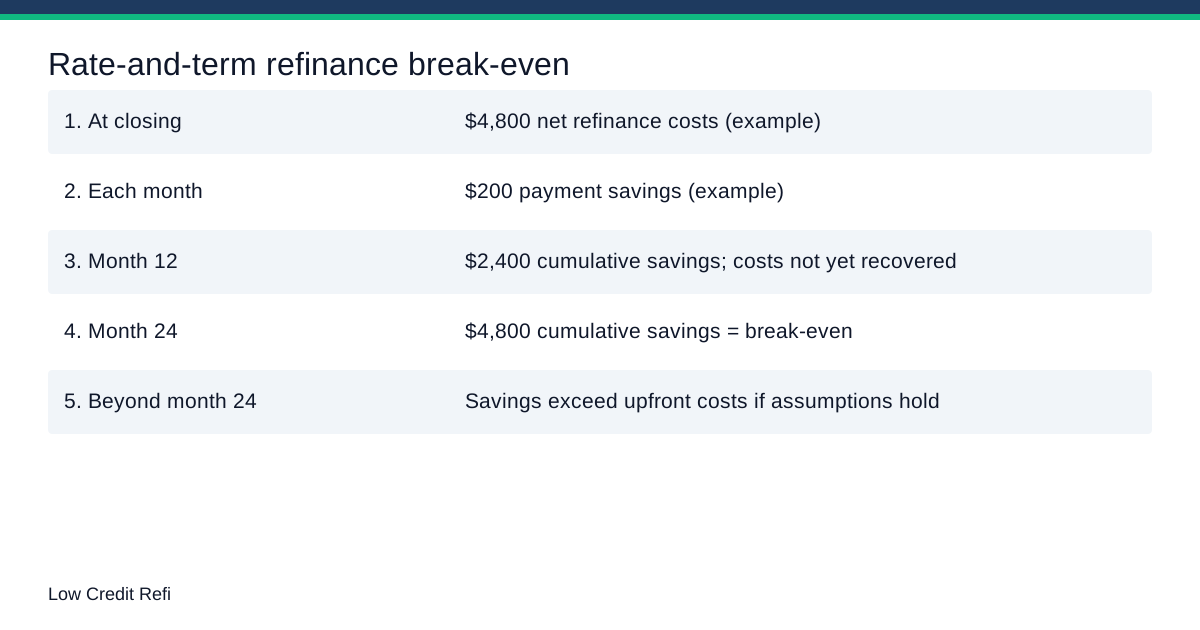
Higher fees and costs: Expect to pay risk-based pricing adjustments, which can add 1.5-3.0 points to your closing costs—approximately $3,750-$7,500 on a $250,000 loan.
Understanding these challenges helps you recognize why strategic use of a co-borrower becomes so valuable for approval success.
The Strategic Advantage of Adding a Co-Borrower
A co-borrower fundamentally changes how lenders evaluate your refinance application. Unlike a co-signer who simply guarantees the debt, a co-borrower has ownership interest in the property and equal responsibility for the mortgage. This distinction matters significantly during underwriting.
Expert Tip
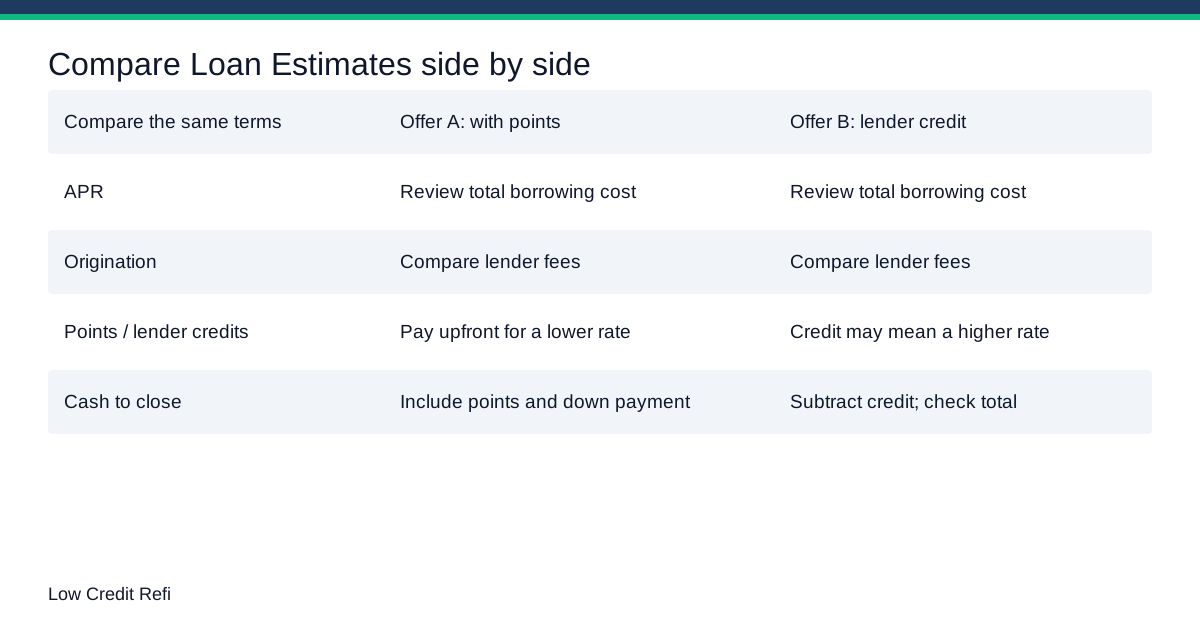
Compare Loan Estimates for the same loan type and term. Include closing costs when calculating whether refinancing saves money.
How Lenders Evaluate Co-Borrower Applications
When you add a co-borrower to your refinance application, underwriters don't simply average your credit scores. Instead, they typically use the middle score of the lower-scored borrower for qualification purposes. However, the co-borrower's financial strength impacts approval through multiple channels:
Combined income calculation: Your household income increases, improving your debt-to-income (DTI) ratio. If you earn $4,500 monthly and carry $2,200 in debt obligations, your DTI sits at 49%—above most lenders' 43-45% thresholds. A co-borrower earning an additional $3,000 monthly reduces your combined DTI to approximately 29%, well within acceptable ranges.
Compensating factors: Even when lenders use your lower credit score for pricing, the co-borrower's stronger credit history, substantial savings, or extended employment creates compensating factors that reduce perceived risk.
Asset aggregation: Combining bank accounts, retirement savings, and other reserves demonstrates greater financial stability and ability to withstand economic disruptions.
Credit Score Scenarios and Their Impact
| Your Credit Score | Co-Borrower's Score | Likely Qualification Score Used | Approval Probability | Estimated Rate Impact |
|---|---|---|---|---|
| 590 | 750 | 590 | High | Moderate reduction (0.25-0.75%) |
| 605 | 680 | 605 | Very High | Significant reduction (0.50-1.25%) |
| 580 | 620 | 580 | Moderate | Minimal reduction (0.125-0.25%) |
| 615 | 800 | 615 | Very High | Substantial reduction (0.75-1.50%) |
These scenarios demonstrate that while you won't receive your co-borrower's excellent interest rate, their participation still improves your overall application strength.
Step-by-Step: Adding a Co-Borrower to Your Refinance Application
Successfully incorporating a co-borrower requires careful planning and documentation. Follow this systematic approach:
- Evaluate potential co-borrowers: Identify someone willing to share property ownership and debt responsibility. Typically spouses, domestic partners, or family members who already live in the home make ideal candidates. They must have legal status to own property in the United States.
- Review their credit reports: Obtain credit reports for your potential co-borrower from all three bureaus. Ensure no recent negative items, collections, or judgments appear that could create additional complications. Scores above 650 provide meaningful benefits.
- Calculate combined debt-to-income ratios: Document all current monthly debt obligations for both parties (car loans, student loans, credit cards, child support). Add your proposed mortgage payment and divide by your combined gross monthly income. Target a DTI below 43%.
- Gather comprehensive documentation: Prepare two years of tax returns, two months of bank statements, recent pay stubs, W-2s, and verification of any additional income sources for both borrowers. Self-employed co-borrowers need two years of business tax returns and profit/loss statements.
- Address property ownership: If your co-borrower isn't currently on the deed, understand they'll be added during the refinance. Consult an attorney about estate planning implications, particularly if the co-borrower is a parent or non-spouse family member.
- Compare multiple lender offers: Submit applications to at least three lenders within a 14-day period (to minimize credit inquiry impact). FHA-approved lenders, credit unions, and specialized subprime mortgage companies often provide the most competitive options for scores between 580-620.
- Lock your interest rate: Once approved, lock your rate immediately. In 2026, rates for borrowers in this credit range typically fall between 7.25%-9.75% depending on loan type, loan-to-value ratio, and specific compensating factors.
- Prepare for closing: Refinancing with a co-borrower typically requires 30-45 days to close. Budget $3,500-$8,500 for closing costs on a $250,000 loan, including appraisal ($500-$700), title insurance ($1,000-$2,000), origination fees (0.5-1.5%), and other lender charges.
FHA Streamline and Non-Streamline Refinance Options
For borrowers with credit scores between 580-620, FHA refinance programs offer the most accessible pathways, and co-borrowers can maximize these opportunities.
FHA Rate-and-Term Refinance
This standard refinance option allows you to adjust your interest rate or loan term without taking cash out. Requirements include:
- Minimum 580 credit score (500-579 requires 10% equity)
- Maximum 96.5% loan-to-value ratio
- Debt-to-income ratio up to 50% with compensating factors
- Current mortgage payments up-to-date (no 30-day late payments in past 12 months)
FHA Cash-Out Refinance
If you need to access equity while refinancing, cash-out options remain available with 580+ credit scores. However, these require:
- Maximum 80% loan-to-value ratio
- Stricter income documentation
- Six-month seasoning period on current mortgage
- Higher closing costs due to increased underwriting requirements
FHA Streamline Refinance
If you currently have an FHA loan, streamline refinancing offers the fastest, easiest path—even with challenged credit. Benefits include:
- No credit score minimum (though individual lenders may impose overlays)
- No income verification required
- No appraisal necessary
- Reduced documentation requirements
Common Pitfalls When Using Co-Borrowers
While adding a co-borrower creates significant advantages, several mistakes can derail your application:
Failing to address the co-borrower's debt: Many borrowers overlook that the co-borrower's existing debts now count against your combined application. If your potential co-borrower carries $800 monthly in student loans and $450 in auto payments, this $1,250 gets added to your debt calculations, potentially worsening rather than improving your DTI ratio.
Ignoring income documentation challenges: Co-borrowers who are self-employed, work on commission, or have irregular income require extensive documentation that can delay closing. Some lenders won't count income that can't be verified through tax returns spanning two full years.
Misunderstanding credit score usage: Some borrowers mistakenly believe their rate will improve to match their co-borrower's excellent credit. While their participation helps, you'll still face pricing based on the lower middle score between both applicants.
Overlooking legal and estate implications: Adding a parent or sibling as a co-borrower gives them ownership interest in your property, which affects inheritance, divorce proceedings, and creditor claims. Always consult a real estate attorney before proceeding.
Assuming all lenders treat co-borrowers equally: Some lenders offer more favorable co-borrower policies than others. Credit unions and portfolio lenders often provide more flexibility than large banks when evaluating applications with significant credit score disparities between borrowers.
Alternative Strategies to Strengthen Refinance Applications
If adding a co-borrower isn't feasible or desirable, consider these complementary approaches for borrowers with 580-620 credit scores:
Credit score improvement: Dedicating 6-12 months to credit repair can yield substantial benefits. Pay down credit card balances below 30% utilization, dispute inaccuracies on credit reports, and avoid new credit inquiries. Every 20-point increase in your score can reduce your interest rate by approximately 0.25%-0.50%.
Larger down payments: If you're refinancing into a conventional loan, increasing your equity position to 25-30% can offset low credit scores. Consider making a principal payment before refinancing or exploring a cash-in refinance where you bring funds to closing.
Professional letter of explanation: Work with your lender to craft a compelling explanation for credit issues, especially if caused by medical emergencies, divorce, or temporary unemployment. Documented hardships followed by 12-24 months of perfect payment history create powerful compensating factors.
Non-qualified mortgage lenders: Some portfolio lenders and non-QM specialists work with borrowers in the 580-620 range without requiring co-borrowers, though expect rates 2-4% higher than conventional options. These can serve as bridge loans while you improve your credit.
Delayed refinancing: If current mortgage rates don't offer sufficient savings to justify refinancing costs, waiting 12-18 months while improving your credit profile may yield better long-term results than refinancing immediately with suboptimal terms.
Expected Costs and Payment Comparisons
Understanding the complete financial picture helps you determine whether how co-borrower impacts refinance approval for low credit scores justifies the effort and expense:
Typical 2026 refinance costs for 580-620 credit scores:
- Origination fees: 1.0-2.0% ($2,500-$5,000 on $250,000 loan)
- Appraisal: $500-$700
- Title search and insurance: $1,000-$2,200
- Credit reports: $75-$150 (both borrowers)
- Flood certification: $15-$25
- Recording fees: $125-$350
- Attorney fees (where required): $500-$1,500
- Prepaid property taxes and insurance: $2,000-$5,000
- FHA mortgage insurance funding fee: 1.75% if applicable ($4,375 on $250,000)
Monthly payment comparison (30-year fixed, $250,000 loan):
- At 9.25% (solo borrower, 590 score): $2,057/month
- At 8.50% (with co-borrower, improved terms): $1,922/month
- Monthly savings: $135
- Annual savings: $1,620
Frequently Asked Questions
No, the only way to remove a co-borrower from a mortgage is through another refinance transaction or by selling the property. However, you can remove them from the property deed through a quitclaim deed, though they'll still remain obligated to the debt. Once your credit improves into the 680+ range, typically after 24-36 months of consistent payments, you can refinance solely in your name at better rates.
Will my co-borrower need to live in the property being refinanced?
For FHA refinancing, the co-borrower doesn't need to occupy the property as their primary residence—they can be a non-occupant co-borrower. However, you as the primary borrower typically must occupy the home as your primary residence. Conventional refinancing usually requires all borrowers to be either occupants or non-occupants; mixing creates complications with certain lenders.
How does adding my spouse as a co-borrower affect our refinance if they have even worse credit than mine?
If your spouse has a credit score below 580 or significant negative items (recent bankruptcy, foreclosure, collections), adding them may harm rather than help your application. In community property states, some lenders require spouse participation regardless. Consult with a mortgage professional about whether your spouse should participate based on your specific credit profiles and state laws.
Can I use a co-borrower who has recently co-signed on another mortgage?
Yes, but lenders will count that other mortgage payment in your combined debt-to-income calculations, even if the primary borrower on that loan makes all payments. Your co-borrower needs sufficient income to support both mortgage obligations plus all other debts while maintaining acceptable DTI ratios—typically below 50% for FHA loans.
Does adding a co-borrower help if I've had a recent bankruptcy or foreclosure?
A co-borrower provides minimal benefit for absolute disqualifying factors like recent major credit events. FHA requires three years post-bankruptcy discharge and three years post-foreclosure before refinancing eligibility. During these waiting periods, even a co-borrower with perfect credit won't circumvent these timeframes. However, once you're past the waiting period, a co-borrower helps overcome the credit score depression that accompanies these events.
Take the Next Step Toward Refinance Approval
Understanding how co-borrower impacts refinance approval for low credit scores empowers you to make strategic decisions about your mortgage refinancing journey. If your credit score falls between 580 and 620, the right co-borrower can transform a likely rejection into an approval, potentially saving you thousands of dollars annually through improved interest rates and terms.
The refinancing landscape in 2026 offers multiple pathways for borrowers with challenged credit, but navigating these options requires expertise and careful planning. Every borrower's situation differs based on income stability, existing debt obligations, equity position, and specific credit circumstances.
Ready to explore your refinancing options with a co-borrower? Our network of experienced mortgage professionals specializes in helping borrowers with credit scores between 580 and 620 secure refinancing approval. We'll evaluate your complete financial picture, identify the strongest co-borrower strategies for your situation, and connect you with lenders who offer competitive rates for your credit profile.
Request your free, no-obligation refinancing consultation today. We'll provide a personalized analysis of how adding a co-borrower could impact your approval odds, estimated interest rates, monthly payments, and long-term savings. Take control of your mortgage costs and start your refinancing journey with expert guidance tailored to your unique circumstances.
Frequently Asked Questions
How does a co-borrower affect my debt-to-income ratio for refinancing?
When you add a co-borrower, the lender combines both incomes and debts to calculate your debt-to-income (DTI) ratio. If the co-borrower has stable income and low debts, your combined DTI may drop below typical lender thresholds of 43-45%, making approval more likely even with a low credit score.
Will the lender use the co-borrower's credit score instead of mine?
No, lenders typically use the middle credit score of the borrower with the lowest score for qualification. However, the co-borrower's stronger credit can serve as a compensating factor, and their income and assets can help meet underwriting requirements, potentially leading to approval.
What are the risks of adding a co-borrower to my refinance?
The co-borrower becomes equally responsible for the mortgage and has ownership interest in the property. If you default, their credit is affected, and the lender can pursue them for payment. Both parties should understand these obligations before proceeding.
Can I remove a co-borrower from my refinance later?
Removing a co-borrower typically requires refinancing again or meeting specific lender requirements, such as proving you can afford the loan alone. This process may involve credit and income checks, and it is not automatic. Consult your lender for options.
Key Takeaways
- Understanding your options for how co-borrower impacts refinance approval for low credit scores is the first step
- Getting pre-qualified helps you understand your real options