Compare Live Mortgage & Home Equity Rates
Compare current APRs, points, fees, and estimated monthly payments from participating lenders below.
Mortgage rates
Quick answer: A 590 FICO score clears the published FHA minimum of 580, making a 3.5%-down FHA loan your most accessible and widely available path to homeownership in 2026. Eligible veterans and active-duty service members should compare VA loans first — no monthly mortgage insurance and zero down payment make VA structurally superior at any credit tier. The principal trade-off is a rate premium of roughly 0.75–1.5 percentage points above what a 740+ borrower qualifies for, plus FHA's lifetime mortgage insurance premiums that add approximately 0.55% annually. If you can push your score to 620 within 60–90 days through utilization reduction or error correction, a conventional loan eliminates lifetime MIP and typically lowers your rate — a delay that can save $40,000 or more over a 30-year loan and is worth calculating seriously before you apply.
How We Evaluate & Compare Options
Every comparison on this page is built on published program guidelines and publicly available data — not invented lender experience or fabricated testing. The sources we draw from are:
- HUD Single Family Housing Policy Handbook 4000.1 — The operative FHA guideline setting the 580 and 500 FICO thresholds, MIP rate schedules, DTI limits, and compensating factor rules. When a lender cites a different FHA floor, they are describing a voluntary internal overlay, not federal policy.
- VA Lenders Handbook (VA Pamphlet 26-7) — Confirms that the Department of Veterans Affairs imposes no minimum FICO score; lender overlays of 580–620 are market practice, not VA requirements.
- USDA Single Family Housing Guaranteed Loan Program Technical Handbook, Chapter 10 — Establishes 640 as the automated underwriting threshold and documents the manual underwriting path for borrowers scoring 580–639.
- Fannie Mae Selling Guide / Freddie Mac Single-Family Seller/Servicer Guide — Both agencies publish a 620 representative credit score minimum for conventional conforming loans; 590 falls below this cutoff.
- CFPB Explore Interest Rates tool — A publicly accessible database of real lender-submitted rate offers stratified by FICO band, loan type, state, and down payment — the most transparent available source for rate premium data by credit score.
- myFICO Loan Savings Calculator and published FICO score factor research — Used for directional cost illustrations across score bands; not a substitute for individualized lender quotes.
At-a-Glance: Home Loan Options at a 590 Credit Score (2026)
| Loan Type | Minimum FICO (Program / Typical Lender) | Minimum Down Payment at 590 | Mortgage Insurance Cost | DTI Limit (Published Guideline) | Best Candidate |
|---|---|---|---|---|---|
| FHA (Federal Housing Administration) | 580 program minimum; most lenders originate at 580+ | 3.5% of purchase price (giftable per HUD) | 1.75% upfront MIP + 0.55%/yr annual MIP (30-yr, >90% LTV, per published HUD rate schedule) | Up to 57% back-end with AUS approval and compensating factors (HUD 4000.1) | First-time buyers with limited savings and a 580–619 FICO score |
| VA (Department of Veterans Affairs) | No VA floor; most lenders require 580–620 via overlay | 0% required (no down payment) | No monthly MIP; VA funding fee 2.15% upfront for first use with 0% down (published VA schedule; exempt for 10%+ disabled veterans) | 41% guideline; exceptions approved based on residual income (VA Pamphlet 26-7) | Eligible veterans, active-duty service members, qualifying surviving spouses |
| USDA Guaranteed (Rural Development) | 640 for automated approval; 580–639 eligible via manual underwriting per USDA Technical Handbook | 0% (property must be in USDA-eligible area) | 1% upfront guarantee fee + 0.35%/yr annual fee (published USDA rates) | 29% housing / 41% total; manual underwrite can exceed with documented justification | Buyers in USDA-eligible rural or suburban areas with moderate income |
| Non-QM / Portfolio Loan | Varies by lender; commonly 500–580 minimum | Typically 10–20% required | No separate MI in most structures; rate premium reflects retained lender risk (typically 1.5–3.0 pts above agency) | Highly flexible; set by individual lender underwriting guidelines | Self-employed buyers, investors, or borrowers with recent credit events outside agency guidelines |
| Conventional (Fannie Mae / Freddie Mac) | 620 minimum published by both agencies — not eligible at 590 | Not available at 590 regardless of down payment size | PMI required if <20% down; cancellable at 20% equity (unlike FHA lifetime MIP) | 45%, up to 50% with DU/LP automated approval | Buyers who can reach 620+ within 60–90 days — most cost-effective long-term option |
Compared Options
The five scenarios above represent the complete realistic universe for a buyer sitting at 590 FICO. Below, each path is examined with specific structural details, cost mechanics, and the honest trade-offs that determine which option fits which buyer.
When considering 590 credit score home loan, you should understand all available options.
FHA Loan with a 590 Credit Score
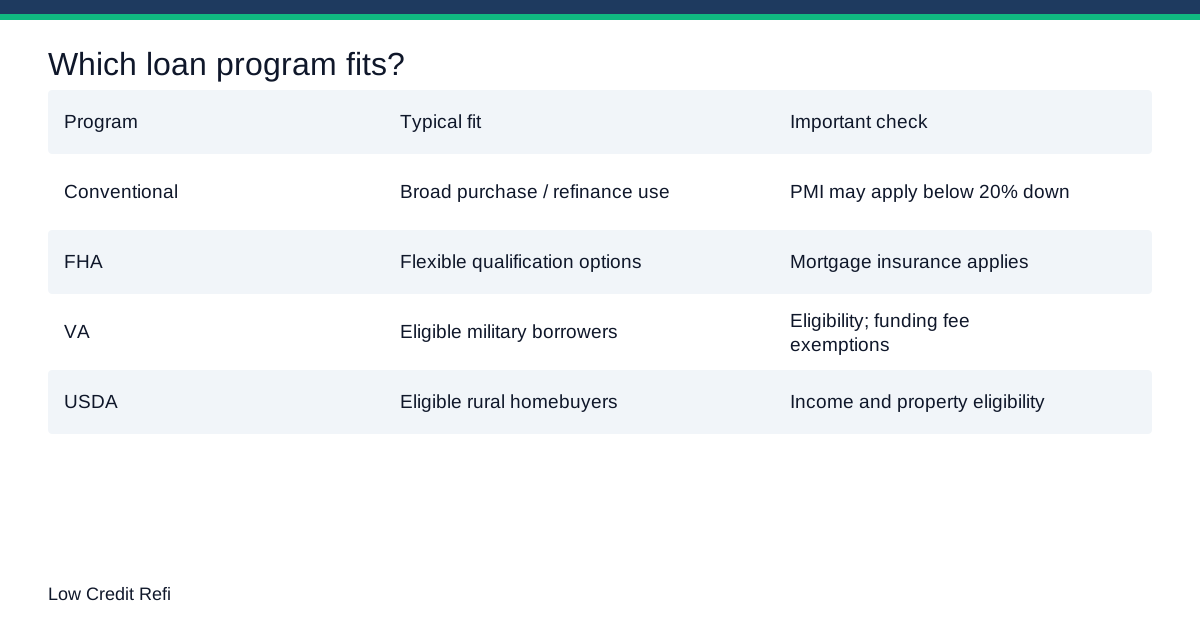
The FHA loan is the workhorse of the low-credit homebuyer market, and for buyers at 590, it is the most accessible product with the widest lender availability. HUD Handbook 4000.1 sets the published minimum at 580 for a 3.5% down payment — meaning a 590 score clears the federal floor by 10 points. The vast majority of FHA-approved lenders originate loans for borrowers in the 580–599 range without an internal overlay that raises their floor above the HUD minimum.
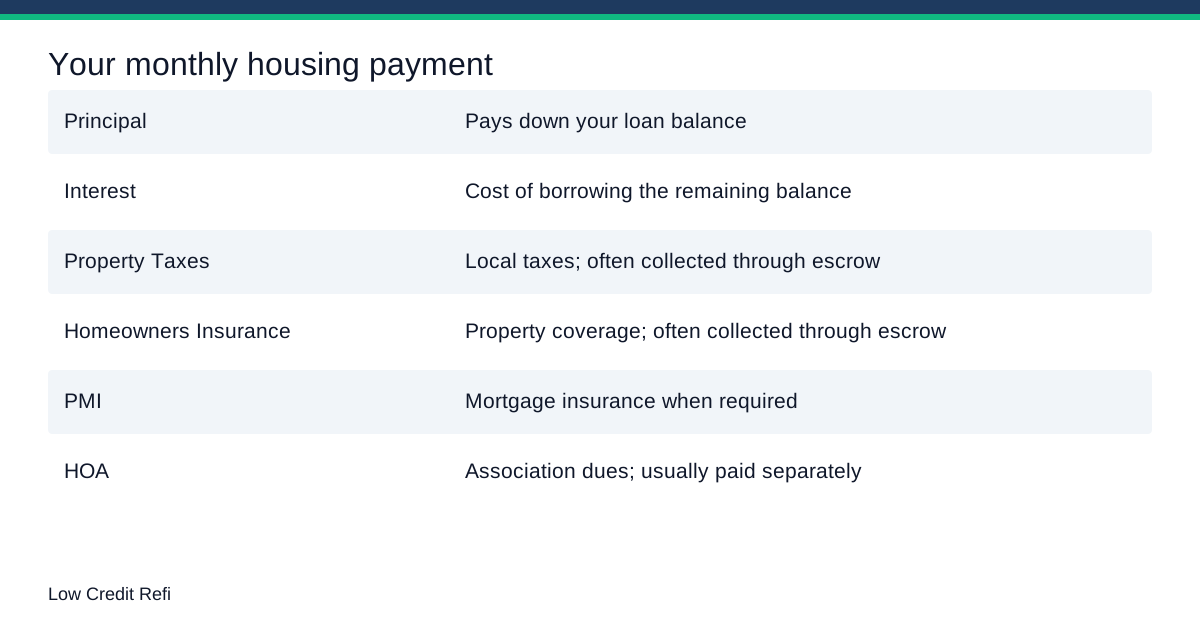
Mortgage insurance costs matter enormously here. FHA's current published MIP structure includes a 1.75% upfront premium (typically financed into the loan balance) and an annual premium of 0.55% for most 30-year loans with an LTV above 90%. On a $300,000 loan, that is $5,250 financed at closing and approximately $137 added to your monthly payment. Critically, HUD policy requires FHA's annual MIP to remain in force for the life of the loan when the borrower puts down less than 10% — it does not automatically cancel when equity reaches 20%, as conventional PMI does. This is the single most significant long-term cost trade-off of the FHA route.
Down payment flexibility: FHA allows the entire 3.5% minimum to be gifted by a family member, employer, or approved nonprofit — a feature unavailable on most conventional products below 20% down. Down payment assistance programs from state and local housing finance agencies can often be layered with FHA financing, further reducing the cash required at closing.
DTI latitude: FHA's published maximum back-end DTI is 57% with automated underwriting system (AUS) approval and qualifying compensating factors — higher than conventional's 45–50% cap. This makes FHA particularly useful for borrowers carrying student loans or auto payments alongside their housing costs.
Pros: Accessible 3.5% minimum down (fully giftable); broad lender availability; high DTI tolerance; well-understood underwriting process.
Cons: Lifetime annual MIP if less than 10% down; property must pass FHA minimum property standards (stricter than conventional appraisal); upfront MIP adds to loan balance.
Expert Tip
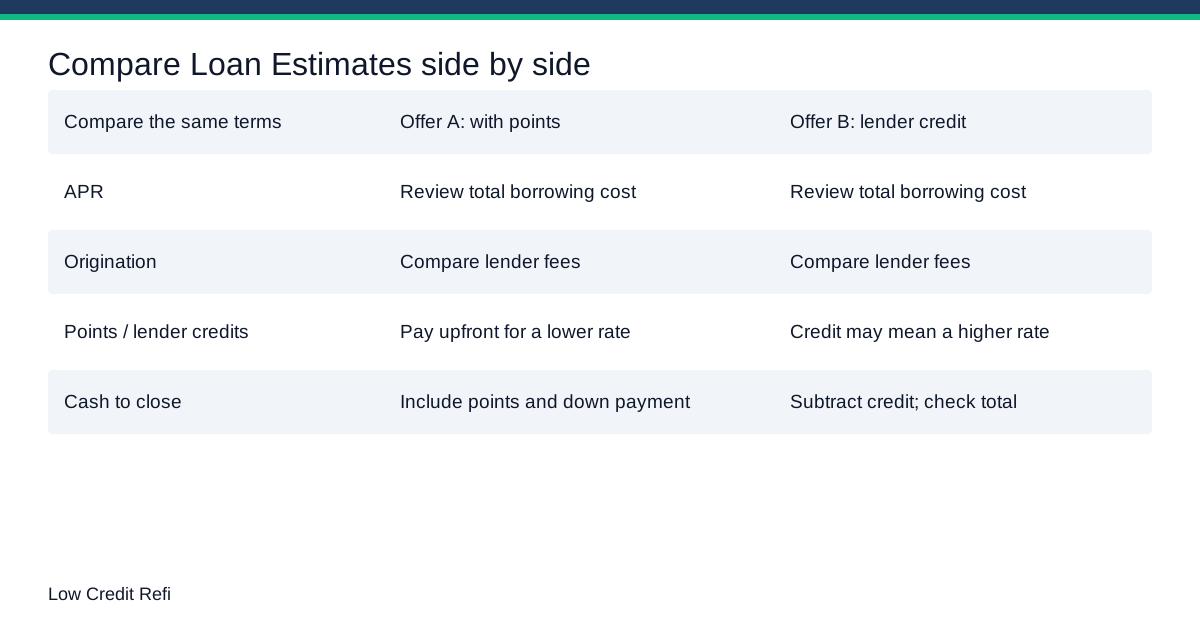
Compare Loan Estimates for the same loan type and term. Include closing costs when calculating whether refinancing saves money.
See If You Qualify Find out in minutes what FHA rate and payment you'd qualify for at your current 590 score. A licensed loan officer can pull your file and give you real numbers — no cost, no commitment.
VA Loan with a 590 Credit Score
For any buyer with VA eligibility — veterans, active-duty service members, and qualifying surviving spouses — the VA loan is almost always the superior option at every credit score level, including 590. VA Pamphlet 26-7 (the Lenders Handbook) explicitly states that VA imposes no minimum FICO score requirement. Individual lenders apply their own overlays, and in practice most VA-approved lenders originate at 580+, with some going as low as 550 for borrowers with strong residual income and compensating documentation.
The zero-MIP advantage is structural, not marginal. VA loans carry no monthly mortgage insurance premium — a savings of $137–180/month on a $300,000 loan compared to FHA's annual MIP. Compounded over 10 years, that is $16,000–$21,000 in insurance premiums avoided. The VA charges a one-time funding fee in lieu of insurance; for first-time use with no down payment, the published VA rate is 2.15% of the loan amount (subject to periodic VA schedule updates). Veterans with a service-connected disability rating of 10% or higher are exempt from the funding fee entirely under VA rules — an additional several-thousand-dollar advantage.
Residual income underwriting: VA's framework gives significant weight to residual income — the monthly dollars remaining after housing costs and all debt obligations — rather than relying exclusively on DTI ratios. This means a borrower with steady employment income and a modest debt load can qualify even when DTI nominally exceeds the 41% guideline, making VA meaningfully more flexible than its headline numbers suggest for borrowers with imperfect credit profiles.
Pros: Zero down payment; no monthly MIP; competitive rates even at lower credit scores; assumable loan structure (valuable if rates fall); no prepayment penalty; no conforming loan limit (for most eligible borrowers with full entitlement).
Cons: Eligibility-restricted; VA minimum property requirements (MPR) must be met; primary residence use only; funding fee adds upfront cost for most borrowers.
USDA Guaranteed Loan with a 590 Credit Score
The USDA Single Family Housing Guaranteed Loan Program offers 100% financing in eligible rural and suburban areas, but at 590 FICO it presents a meaningful underwriting hurdle. The USDA Technical Handbook establishes 640 as the minimum for automated approval through USDA's Guaranteed Underwriting System (GUS). However, it explicitly provides a manual underwriting pathway for borrowers scoring 580–639, contingent on documented conditions: at minimum 12 months of on-time payment history, no outstanding collections or judgments unrelated to documented extenuating circumstances, and a housing ratio that typically must not exceed 29% of gross monthly income.
Geographic eligibility is binding and non-negotiable. Before investing time in a USDA application at 590, confirm the specific property address qualifies using the USDA's official Property Eligibility Map (eligibility.sc.egov.usda.gov). Roughly 97% of total U.S. land area is USDA-eligible, but most major metro cores and dense suburban rings are excluded. Many buyers are surprised to find that towns of 20,000–35,000 people qualify.
Cost advantage vs. FHA: USDA's published fee structure is meaningfully cheaper than FHA — a 1% upfront guarantee fee (financeable) and 0.35% annual fee, versus FHA's 1.75% upfront and 0.55% annual. On a $250,000 loan, USDA's annual fee is $875/year versus FHA's $1,375 — a $500/year difference that compounds over the loan term.
Pros: Zero down payment; lower annual fee than FHA; competitive interest rates; serves moderate-income buyers who genuinely need rural or suburban housing.
Cons: Geographic restriction; at 590, requires manual underwriting (slower process, more documentation); household income caps apply (generally 115% of area median income); not available for investment or vacation properties.
Non-QM / Portfolio Loan with a 590 Credit Score
Non-Qualified Mortgage (Non-QM) loans are originated by lenders who retain them in their own portfolio rather than selling them through Fannie Mae or Freddie Mac. Because they operate outside agency guidelines, they can lend at credit scores below 620 — some as low as 500–560 with sufficient compensating factors. At 590, Non-QM is an available option, but the cost structure is materially different from government-backed programs.
The rate premium is the critical trade-off. Non-QM pricing typically runs 1.5–3.0 percentage points above comparable agency loan pricing because the lender retains the full default risk on its balance sheet. On a $300,000 loan, a 2-point rate premium adds approximately $360/month to the payment and over $130,000 in total interest over 30 years compared to an FHA loan at a similar score. Additionally, Non-QM lenders typically require 10–20% down payment, eliminating the low-cash-to-close advantage of FHA and VA.
Who genuinely benefits at 590: Self-employed borrowers whose tax returns significantly understate their economic income (bank statement programs calculate qualifying income from 12–24 months of deposits); buyers with a recent bankruptcy discharge or foreclosure that blocks agency access; real estate investors purchasing non-owner-occupied rental properties; and borrowers with complex asset structures that standard agency documentation cannot capture.
Pros: Flexible income documentation; accommodates complex financial profiles; faster close in some cases; no agency loan limits.
Cons: Significantly higher rates; larger down payment required; varies widely by lender — standards and availability are not standardized; fewer consumer protections than QM loans.
Conventional Loan (590 Score — Not Currently Eligible, but the 30-Point Path Forward)
Conventional conforming loans require a minimum 620 representative credit score under both Fannie Mae's Selling Guide and Freddie Mac's Single-Family Seller/Servicer Guide. At 590, you are 30 points short of the floor. This is not a soft guideline — it is enforced at the automated underwriting system level, and no amount of compensating factors will override it for agency-sold loans.
Why 620 matters so much: Reaching 620 does not just open conventional access — it eliminates lifetime mortgage insurance. Conventional PMI is cancellable by law (Homeowners Protection Act) once equity reaches 20%, unlike FHA's life-of-loan annual MIP for borrowers who put down less than 10%. A buyer who puts 5% down on an FHA loan and refinances to conventional at 620+ after 2–3 years of payments may save tens of thousands in long-term MIP costs. Running this calculation before committing to FHA is worthwhile.
The 30-point improvement is achievable in 60–120 days for many borrowers through targeted actions: reducing revolving credit utilization below 10% of each card's limit (FICO updates utilization every billing cycle, so paydowns reflect within 30–45 days); disputing and correcting factual errors on all three credit bureau reports; and becoming an authorized user on a family member's aged, low-utilization account. Published FICO research identifies utilization and payment history as the two highest-weighted score factors, making paydowns the fastest lever for most 590 borrowers.
On a $350,000 loan, published FICO cost illustrations show the total interest differential between a 590-tier rate and a 640-tier rate can exceed $40,000 over 30 years. For buyers with 60–90 days of flexibility, the math of waiting almost always favors the wait.
Get a Free Consultation A licensed advisor can model the apply-now vs. wait-90-days scenarios with your actual numbers — so you choose the path that saves the most money over the life of your loan.
What Matters Beyond the Headline Numbers
The Rate Premium Is Cumulative, Not Cosmetic
The CFPB's publicly available loan-comparison tool consistently shows a meaningful rate gap between borrowers in the 590–619 FICO band and those above 760. Directionally, CFPB data shows gaps of 1.5–2.5 percentage points between these bands on 30-year fixed loans, though the exact spread varies by lender, loan type, and market conditions. On a 30-year, $300,000 loan, a 1.5-point rate difference translates to approximately $90,000 in additional total interest by standard amortization math. This is not a reason to delay indefinitely — market appreciation, equity building, and rent savings may still favor buying now. But it means the rate penalty deserves deliberate calculation, not dismissal.
Compensating Factors Actually Move the Underwriting Needle
Both FHA and VA underwriting systems recognize compensating factors — documented evidence that offsets the risk signaled by a lower credit score. Per HUD Handbook 4000.1, compensating factors that can support FHA approval with a DTI above 43% include: verified cash reserves of at least three months' PITI (principal, interest, taxes, insurance); a housing payment increase of less than 10% over current verified rent; or residual income that meets VA-level thresholds for household size and geography. A borrower with $30,000 in verifiable savings or retirement funds who documents it thoroughly before application can meaningfully shift the underwriting outcome at 590.
Lender Overlays Are Invisible Until You Ask
FHA's minimum is 580, but individual lenders are permitted to set higher internal floors called "overlays." A lender advertising FHA loans may actually require 620 or 640 internally, with no public disclosure. A buyer who is declined by one FHA lender at 590 may be approved by a second or third lender at the same score. The practical solution: before submitting a full application and triggering a hard credit inquiry, contact 3–5 FHA-approved lenders and ask directly whether they originate FHA loans for borrowers below 620. Most will answer without pulling your credit. The CFPB notes that multiple mortgage inquiries within a 14–45 day window count as a single inquiry under FICO models, reducing the scoring cost of rate shopping.
Down Payment Size Affects MIP Duration and Score Impression
On an FHA loan, putting down 10% or more — rather than the 3.5% minimum — changes the MIP duration from life-of-loan to 11 years. For a buyer planning to own long-term without refinancing, this is a meaningful cost difference. Additionally, a larger down payment lowers your loan-to-value ratio and reduces the lender's perceived risk, which can sometimes support approval at 590 where a tight file at 3.5% down might not. If gifted funds or down payment assistance brings you to 10%, model both the 3.5% and 10% scenarios before deciding.
Authoritative Guidance & Official Standards
- HUD Single Family Housing Policy Handbook 4000.1 (HUD.gov) — The definitive federal source for FHA credit score minimums, MIP rate schedules, DTI limits, and compensating factor rules. Any lender citing different FHA score minimums is describing their own overlay, not HUD policy.
- VA Loan Guaranty Program — Lender Information (VA.gov) — Confirms that VA imposes no minimum credit score and that residual income is a core underwriting metric. Essential context for understanding why VA lender overlays vary and why VA flexibility at 590 is real, not marketing language.
- USDA Property Eligibility Map (USDA.gov) — Official lookup tool to confirm whether a specific property address qualifies for USDA Rural Development guaranteed financing. Confirm eligibility before pursuing this path at 590 FICO.
- CFPB Explore Interest Rates Tool (ConsumerFinance.gov) — Real lender-submitted mortgage rate data stratified by FICO score range, state, loan type, and down payment. The most transparent publicly available source for understanding how a 590 score affects the rate you'll actually be offered relative to higher-score peers.
- CFPB Credit Reports and Scores Hub (ConsumerFinance.gov) — Practical guidance on ordering free annual credit reports, disputing errors under FCRA rights, and understanding the factors that influence your FICO score. Directly actionable for buyers attempting to move from 590 to 620 before applying.
- FTC Free Credit Reports (FTC.gov) — Explains your right under FCRA to free credit reports from all three bureaus annually via AnnualCreditReport.com. Reviewing all three for errors is the prerequisite first step for any borrower targeting a score improvement before applying for a mortgage.
Questions to Answer Before Deciding (FAQ)
Can I really get approved for a mortgage with a 590 credit score in 2026?
Yes — FHA approval at 580+ is a published HUD policy, not an exception or rumor. Thousands of FHA loans are originated each month for borrowers in the 580–619 FICO band across the United States. The practical hurdles are lender overlays (some lenders set their internal floor above the HUD minimum of 580) and property condition (FHA requires the home to pass minimum property standards). Before triggering hard inquiries by mass-applying, contact lenders specifically to ask whether they originate FHA loans for borrowers below 620. The CFPB advises that multiple mortgage hard inquiries made within a 14–45 day window count as a single inquiry under FICO scoring models, so comparison shopping is far less costly to your score than many buyers fear.
How much higher will my interest rate be with a 590 score compared to 720?
Published CFPB loan-comparison data consistently shows that borrowers in the 590–619 FICO range pay materially higher mortgage rates than those at 720+. Directionally, the gap on 30-year fixed loans has historically ranged from 1.0 to 2.0 percentage points between these two bands, though the precise spread varies by lender, current market conditions, and loan type. On a $280,000 FHA loan, a 1.5-point rate difference adds approximately $250/month in payment and over $85,000 in total interest over 30 years by standard amortization. The CFPB's Explore Interest Rates tool at consumerfinance.gov/owning-a-home/explore-rates/ allows you to model this with real submitted rate data at your specific parameters.
What down payment do I need with a 590 credit score?
For FHA at 590: 3.5% of the purchase price, which HUD allows to be fully gifted from a family member, employer, or approved nonprofit. On a $300,000 home, that is $10,500. For VA: 0% — no down payment required for eligible borrowers. For USDA: 0%, subject to property geographic eligibility and income limits; at 590, requires manual underwriting approval. For Non-QM: typically 10–20% depending on lender and product. For conventional: not available at 590 regardless of how large a down payment you offer — the 620 minimum is absolute at the AUS level. Note: putting down 10% or more on an FHA loan converts the annual MIP from a lifetime obligation to an 11-year obligation — a significant long-term cost difference worth modeling if you have access to those funds.
How long does it realistically take to raise a credit score from 590 to 620?
For many borrowers, the 30-point improvement from 590 to 620 is achievable within 60–120 days through targeted actions — not years of gradual rebuilding. The highest-impact levers, grounded in published FICO factor research: (1) Reducing revolving credit utilization below 10% of each individual card's limit. FICO models update utilization every billing cycle, meaning a paydown today reflects in your score within 30–45 days. (2) Disputing and correcting factual errors on your credit report. FTC-published research estimates roughly one in five consumers has a material error on at least one bureau report. (3) Becoming an authorized user on a family member's or partner's old, low-utilization credit card — the account history is added to your file immediately after the next billing cycle closes. What does take longer: a recent missed payment within the past 12–24 months carries heavy FICO weighting and cannot be removed without a successful goodwill deletion from the creditor. If a late payment from 2025 is driving your 590, your improvement runway may be longer than 90 days.
Is a VA loan or FHA loan better if I'm a veteran with a 590 credit score?
VA is structurally superior in nearly every case for eligible borrowers at 590. The direct comparison: VA carries no monthly mortgage insurance (saving $137–180/month on a $300,000 loan versus FHA's annual MIP); VA allows 0% down versus FHA's 3.5% minimum; and VA rates at 590 are generally comparable to or better than FHA rates at the same score, because the VA guaranty reduces the lender's effective credit risk. The only scenarios where FHA might be preferable are: the property meets FHA minimum property standards but not VA's stricter Minimum Property Requirements (MPR); the veteran has fully exhausted VA entitlement on a prior unreleased loan; or the veteran is specifically purchasing a condo in a complex not yet approved under the VA approval process. In all standard cases, eligible veterans should exhaust VA eligibility before considering FHA at 590.
Related Guides
- FHA Loan Requirements in 2026: The Complete Borrower's Guide — Detailed breakdown of HUD's published credit score thresholds, MIP cost structure, property appraisal standards, income limits, and the full documentation checklist for FHA applications at every credit tier.
- How to Improve Your Credit Score for a Mortgage in 2026 — Step-by-step actions ranked by FICO impact, including utilization reduction strategies, FCRA error dispute procedures, and authorized user tactics for moving from fair to good credit within 60–120 days before applying.
- VA Loan Eligibility and Benefits: What Veterans Need to Know in 2026 — Covers Certificate of Eligibility requirements, funding fee exemptions for disabled veterans, entitlement restoration after a prior VA loan, and how VA's residual income model creates flexibility conventional DTI underwriting does not.
- First-Time Homebuyer Guide 2026: From Pre-Approval to Closing Day — The complete buying process from initial credit review through closing, including state-level down payment assistance programs that can be layered with FHA financing, inspection strategy, and negotiation tactics in a competitive market.
The Bottom Line
A 590 credit score is a real, workable mortgage score in 2026 — not a disqualifier. For most buyers, FHA is the most accessible, most widely available, and most predictable path forward: the 580 minimum is a published HUD guideline enforced at the federal level, the 3.5% down payment can be fully gifted, and the approval infrastructure spans thousands of lenders. Eligible veterans have an even stronger option in the VA loan — no monthly mortgage insurance and no required down payment make it structurally superior to FHA at every credit level, including 590.
The decision every 590-score buyer must calculate honestly is whether to apply now or wait. The 30 points separating you from conventional eligibility can eliminate lifetime mortgage insurance, lower your interest rate, and save $40,000–$80,000 in total loan cost. For buyers who can realistically close that gap in 60–90 days through utilization reduction or credit error correction, the delay may be the highest-return financial move available. For buyers who cannot — due to recent missed payments, genuine credit history limitations, or time-sensitive housing needs — FHA or VA now is the right call.
The only way to make this decision with precision rather than estimates is to see your actual rate quotes and have someone model both scenarios against your specific file. That costs nothing and commits you to nothing.
Get Your Free Mortgage Consultation A licensed loan officer can review your 590-score file, identify whether a 60-day improvement is realistic for your situation, and give you real rate quotes for both FHA now and conventional after improvement — so you make the decision with actual numbers, not industry generalizations. No cost. No commitment.
Key Takeaways
- Understanding your options for 590 credit score home loan is the first step
- Getting pre-qualified helps you understand your real options